
[The following text was originally added to the Postcolonial Web in 1991, and has been reformatted and illustrated for the Victorian Web by Jacqueline Banerjee. Click on all the images to enlarge them. You may use them without prior permission for any scholarly or educational purpose as long as you (1) credit the person who scanned them, or the photographer, and (2) link your document to this URL in a web document or cite the Victorian Web in a print one.]

ore than 40,000 years ago, several groups of people from Southeast Asia emigrated to Australia and are now regarded as that country's indigenous population - the Aboriginals. Before European colonization in the nineteenth century, the Aboriginals organized their existence around nature. Their ability to survive depended on an extensive knowledge of Australia's flora and fauna, as well as an ability to adapt to different areas of the land.
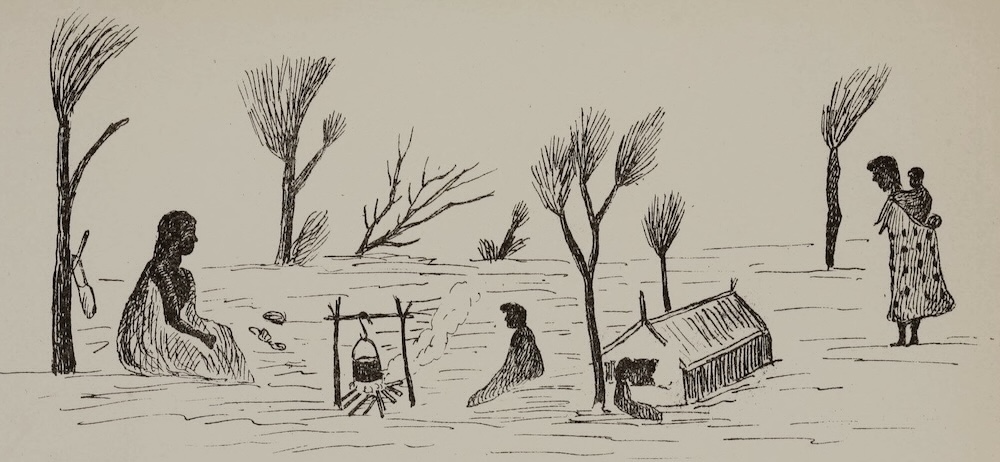
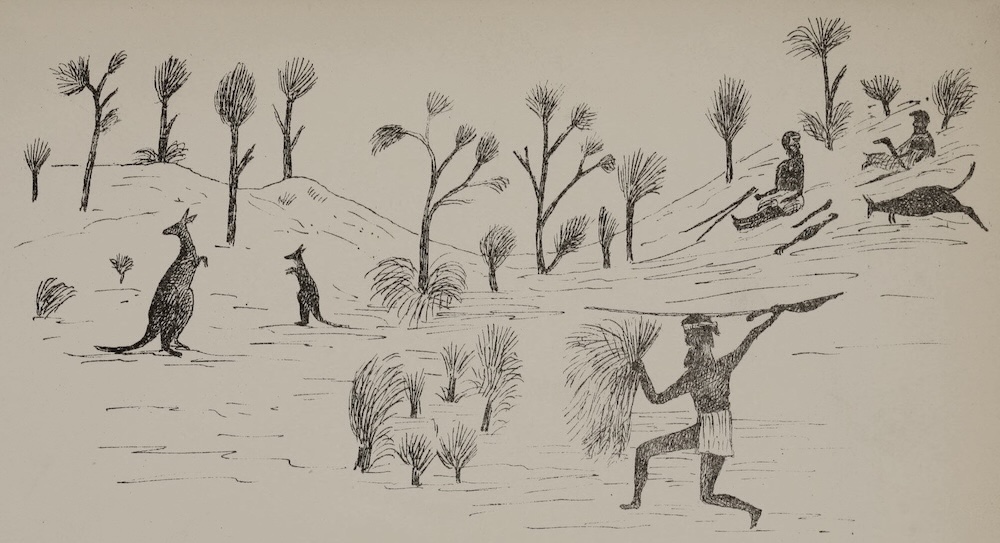
Left: Native encampment, Taplin, facing p.56. Right: Hunting Scene, Taplin, facing p. 40. Both drawn by Yertabrida Solomon, an aboriginal from Coorang, in 1876.
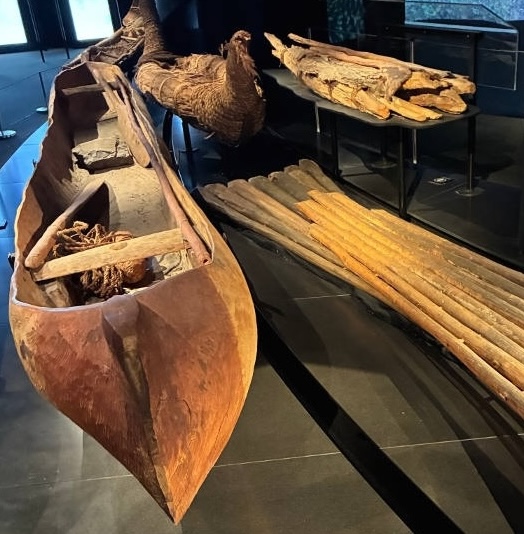
Native canoes in the Australian National Maritime Museum, Sydney, photographed by Philip Allingham.
Naturally, differences arose amongst these groups over time, however a core culture, language, and approach to life remained. Their communal co-existence with nature suffered a permanent alteration and near extinction with the advent of the Europeans beginning in the late 1700s.
Europeans moved to Australia and claimed the better land for themselves. Though the Aboriginals struggled to keep their land, the fighting was unequal and they were inevitably forced to adjust to the new arrivals, becoming paupers in a land that had previously been theirs. Those who lived near the Europeans had to rely less on the land and more on an unsuitable diet given them by the new settlers. The Europeans also forced covering on them, providing clothes and blankets which they used unhygienically and suffered from various new diseases.
These factors contributed to a demoralization and defeatism within these groups which caused them to die out. Other groups survived by managing to retain much of their traditional customs, while becoming a menial part of this new world by working for the foreigners.
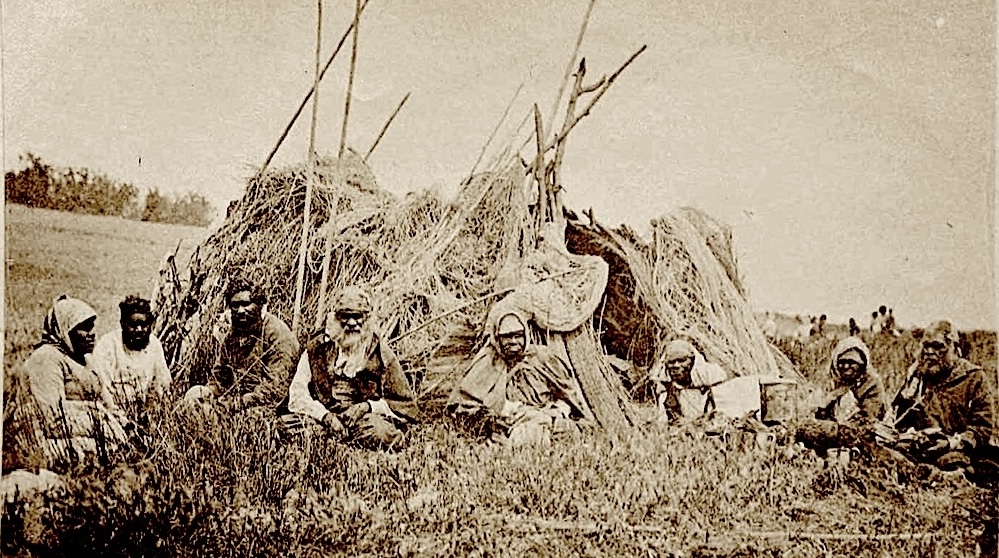
A Camp of the Narrinyeri, Lake Alexandrina, frontispiece to Taplin.
In the mid twentieth century, the Australian government began to redress those wrongs. In the 1950s and '60s the aboriginals were finally enfranchised. Later governments have also committed to a program of Aboriginal self-determination, and have given grants to Aboriginal-run organizations which provide legal and medical assistance for the groups. In addition, a process of land reclamation was begun in 1976 with the passing of the Aboriginals Land Rights Act. This act has enabled some former reservations to be returned to original hands.
Bibliography
Taplin, the Late Rev. George, ed. The Folklore, Customs, and Languages of the South Australian Aborigines: Gathered from enquiries made by authority of the South Australian Government. Adelaide: E. Spiller, 1879.
Created 18 July 2021
Last modified (illustrations added) 12 March 2026