

n Ellen Wood's 1863 novel Verner's Pride, a village physician, Dr. West, needs money to leave the district quickly. He asks his young colleague Jan Verner to "oblige" him with a loan of "a couple of hundred pounds or so." Jan replies that he would give the money to Dr. West "with all the pleasure in life" if he had any, but he has already used his savings to support his mother. Having failed to secure a loan, Dr. West then tries for the next best thing, a money substitute in the form of a bill of exchange:
"I'll tell you what, Mr. Jan," said he, brightening up, "you shall give me your signature to a little bill — a bill at two months, let us say. It will be the same as money."
"Can't," said Jan.
"You can't!" replied Dr. West.
"No," said Jan, resolutely. "I'd give away all I had in hand, and welcome; but I'd never sign bills. A doctor has no business with 'em. Don't you remember what they did for Jones at Bartholomew's?"
"I don't remember Jones at Bartholomew's," frigidly returned the doctor.
"No! Why, what's gone with your memory?" innocently asked Jan. "If you think a bit, you'll recollect about him, and what his end was. Bills did it; signing bills to oblige some friend. I'll never sign a bill, doctor. I wouldn't do it for my own mother."1
In this encounter, the author uses a bill of exchange to show both the willingness of the mercenary Dr. West to prey upon Jan's good nature, and the protection Jan gains from his artless honesty. Wood could trust that most of her readers would know what was happening here, because bills of exchange — and their relatives, promissory notes — were widely used by the commercial and professional classes. Bills and notes, as they were commonly called, were a familiar form of money substitute in the eighteenth and nineteenth centuries, helping to meet Britain's need for cash and cash transfers at a time when banking was still underdeveloped. Bills and notes also served a narrative purpose in fiction: their intricacies gave authors a way to reveal financial connections between characters' lives and to precipitate sudden changes in fortune. This article seeks to aid readers' understanding of Victorian fiction by explaining the main features of bills and notes, and drawing illustrations from novels of the period.
Notes — Their Standard Form
Promissory notes were the simpler of the two instruments. A note (also called a note of hand) was a signed, unconditional promise by one person (the "maker") to pay a specified sum to another (the "payee"), either on demand or at a determinable future time.2 A typical nineteenth-century note might read as follows:
London, Aug. 14, 1866
£150
Three Months after date I promise to pay to Mr. Jas. Jackson, or his order, One Hundred and fifty pounds, for value received.
[signed] Edward Philips, 504, Regent Street.3
Here, Edward Philips is the maker, and James Jackson the payee. The amount of the note appears both in figures (upper left) and written out in words in the body of the note, where the maker's promise to pay is also expressed. The place where and the date when the note was signed are given in the upper right. The maker has signed in the lower right, with his address. The note might state expressly where it would be paid, such as at the maker's bank, but absent such specification, demand for payment would be made at the maker's address given in the note or, if no address is given, at the maker's residence or regular place of business.4
If a note was not payable on demand, its due date had to be certain, or at least capable of becoming certain.5 The example above specifies payment three months after the note's issuance, but other formulations were acceptable — for example, "ten days after the death of Robert Cornwall" or "two months after notice." 6 Under English law, a three-day grace period was automatically added to the due date, unless the note was to be paid on demand.7
Bills — Their Standard Form
Bills of exchange (or drafts) normally involved more parties than did notes, and their use could be much more complicated. The classic bill had three parties: the "drawer," the "drawee," and the "payee." It consisted of a signed, unconditional order by the drawer, directing the drawee to pay a specified sum to the payee, either on demand or at a determinable future time.8 Accordingly, whereas a note was a promise to pay, a bill was an order to pay.
A typical Victorian bill might read:
Bristol, Aug. 16, 1866
£214. 10s. 6d.
Two Months after date Pay to the Order of Messrs. James Bell and Company, the sum of Two hundred and fourteen pounds ten shillings and sixpence, for value received.
[signed] E. Smith.
To Messrs. Albemarle & Co., Regent Street, London.9
Here, E. Smith (the drawer) orders Albemarle & Co. (the drawee) to pay James Bell and Company (the payee). The format resembles that of a note, except that the drawee's name and address appear at the lower left, and the bill contains an order to the drawee to pay the payee, rather than a promise by the maker that he will himself pay the payee. As with notes, bills not payable on demand benefited from an automatic three-day grace period.10
In the standard scenario, the drawee owed money to the drawer, who was directing the drawee to pay some or all of that money to a third party (the payee). To give a simple example, a livestock dealer in Norfolk who had sold cows to a buyer in London would have "credit" with that buyer until payment for the cows was made. The Norfolk dealer could "draw on" this credit to pay his London wine merchant by sending to the wine merchant a bill "drawn on" the London cattle buyer. The wine merchant would present the bill to the cattle buyer, who would pay the wine merchant as directed in the bill and would then update his books to show that his debt to the Norfolk dealer was reduced accordingly. In this way, no cash needed to travel physically between Norfolk and London: the Norfolk dealer simply used a bill to instruct his buyer in London to pay the wine merchant, also in London, out of the amount that the buyer owed to the dealer.
Bills were classified as inland or foreign. An inland bill, like the above example, was both drawn and payable in England or Wales.11 A foreign bill was drawn or payable (or both) elsewhere.12 Because of the risk of loss in international transit, foreign bills were generally drawn "in sets" of two or three duplicates, each one sent separately to the drawee. Each duplicate would be labeled "First [or Second or Third] of Exchange."13 Dickens mentions this in Stave Two of A Christmas Carol, where Scrooge imagines a bill reading, "'three days after sight of this First of Exchange pay to Mr. Ebenezer Scrooge or his order,' and so forth."14 A foreign bill that was part of a set would normally also direct that it be paid only if none of the duplicates in the set had already been paid,15 although the example in A Christmas Carol omits this language.
The Stamp Requirement
Notes and bills, along with many other classes of documents, had to be written on paper bearing a government stamp to show that the applicable duty was paid.16 For much of the nineteenth century, the stamps were impressed by dies,17 but in the 1850s, adhesive stamps became available.18 The use of stamped paper for a note is illustrated by Dickens in Martin Chuzzlewit, when the confidence man Tigg Montague writes a note "on an oblong slip of paper" naming his fraudulent insurance company as payee and his accomplice, Jonas Chuzzlewit, as the maker:
"I want you to put your name here," he [Montague] returned, glancing at him [Jonas] with a smile, "as soon as I have filled up the stamp. I may as well have your note of hand for that extra capital. . . ."
Jonas sat scowling at him as he [Montague] wrote, in silence. When he had finished his writing, and had dried it on the blotting paper in his travelling-desk; he looked up, and tossed the pen towards him [Jonas].
"What, not a day's grace, not a day's trust, eh?" said Jonas bitterly. "Not after the pains I have taken with to-night's work?"
"To night's work was a part of our bargain," replied Montague; "and so was this."
"You drive a hard bargain," said Jonas, advancing to the table. "You know best. Give it here!"
Montague gave him the paper. After pausing as if he could not make up his mind to put his name to it, Jonas dipped his pen hastily in the nearest inkstand, and began to write.19

"The Spider and the Fly," by Fred Barnard. Montague gets the better of a browbeaten Jonas.
Bill-Brokers and Discounters
By the nineteenth century, the use of bills had become streamlined by the appearance of bill-brokers, who facilitated transactions and in some cases provided financing.20 To see how bill-brokers added value, consider four merchants: Atwell and Charteris in London, and Bingham and Dallas in Manchester. Atwell owes Bingham money but has no credit in Manchester on which he can draw. Atwell therefore enlists the aid of a bill-broker to locate someone in London who has credit in Manchester that he wishes to monetize. The bill-broker connects Atwell with Charteris, who is owed money by Dallas. Atwell purchases from Charteris a bill drawn on Dallas, which Atwell sends to Bingham. Charteris meanwhile sends an "advice" to Dallas to alert him to expect the bill, so that Dallas will not question the bill's authenticity and also can make sure he will have enough cash on hand to meet it.21 The broker earns a commission (paid by Atwell);22 Atwell's debt to Bingham is discharged when Dallas pays Bingham following his presentation of the bill — and Dallas's debt to Charteris is reduced commensurately — all without any movement of cash between Manchester and London. In the Victorian period, thousands of similar transactions were occurring daily between cities in England and between England and other countries, greatly lessening any need for shipments of specie.23
In addition to acting as a go-between, a bill-broker with spare funds might also make loans against bills in his own right.24 Thus, the bill-broker in the above example, upon learning that Charteris wanted to monetize some of his credit in Manchester, could himself pay Charteris for a bill drawn on Dallas. If the bill was for £100 payable at three months, the broker would pay Charteris the face amount of the bill "discounted" by three months of interest — say, 2.5%, or £2 10s.25 Or the broker might demand a higher "discount" rate to compensate for his risk if he doubted the creditworthiness of the other parties. Functionally, the broker was investing his money for one calendar quarter at the discount rate.
Making a loan by buying a borrower's bill or note was known as "discounting."26 It is one of the ways in which Ralph Nickleby makes money in Dickens's Nicholas Nickleby. Among his "clients" are the Mantalinis — a dressmaker and her extravagant husband, Alfred. When Alfred finds that the couple's cash is running low, he exclaims, "We must have some more . . . we must have some discount out of old Nickleby." Alfred later visits Ralph to have him discount two bills, which Madame Mantalini had presumably received in payment for dresses. Ralph feigns reluctance to discount the bills and questions Alfred about them:
"How many bills have you there?"
"Two," returned Mr. Mantalini.
"What is the gross amount?"
"Demd trifling—five-and-seventy."
"And the dates?"
"Two months, and four."
Ralph then offers to discount both bills at the outrageous rate of 33.3%. When Alfred balks, Ralph asks to "see the names," i.e., the names of the drawer, drawee, and any indorsers, so that he can gauge the risk of the bills' being uncollectable:
"Let me see the names," replied Ralph, impatiently extending his hand for the bills. "Well! They are not sure, but they are safe enough. Do you consent to the terms, and will you take the money? I don't want you to do so. I would rather you didn't."
"Demmit, Nickleby, can't you—" began Mr. Mantalini.
"No," replied Ralph, interrupting him. "I can't. Will you take the money—down, mind; no delay, no going into the city and pretending to negotiate with some other party who has no existence, and never had. Is it a bargain, or is it not?"
Ralph pushed some papers from him as he spoke, and carelessly rattled his cash-box, as though by mere accident. The sound was too much for Mr. Mantalini. He closed the bargain directly it reached his ears, and Ralph told the money out upon the table.27
Alfred is susceptible to Ralph's obvious high-pressure tactics because, as it turns out, Alfred needs to have the bills discounted before his wife discovers that he has lifted them from her desk. Indeed, no sooner does Alfred take Ralph's fifty pounds than Madame Mantalini bursts into the room, accusing Alfred of the theft. As Madame Mantalini explains to Ralph, "I have no doubt that he came straight here, Mr. Nickleby, to convert the papers I have spoken of, into money."28
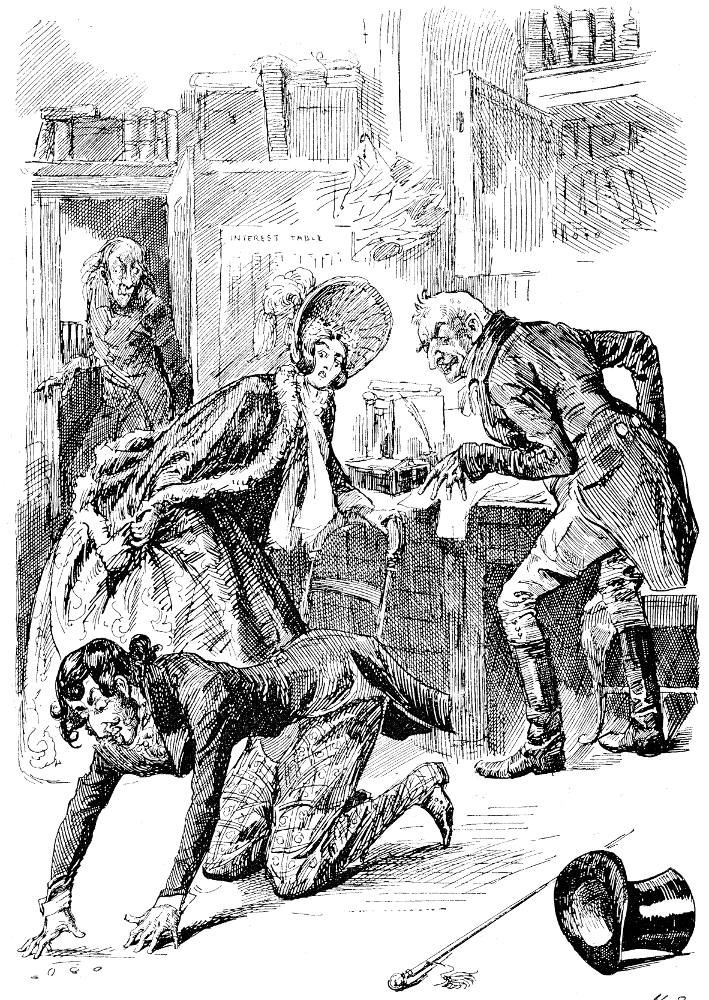
"Mr. Mantalini plays at 'Tom Tiddler's Ground,'" by Harry Furniss. Alfred scrounges for a stray coin when Mrs Mantalini turns up in Ralph Nickleby's office.
The bills that Ralph Nickleby discounted for Alfred Mantalini were received by Madame Mantalini in business. But someone who wanted to borrow money by means of a bill might also do so by selling to the discounter a bill in which the borrower was both the drawer and the drawee, with the discounter as the payee.29 The borrower was thus "drawing on" himself, "ordering" himself to pay the payee at some future date. A bill in which the drawer and drawee were the same person was fully enforceable — the holder could treat it as a note made by the drawer-drawee for the benefit of the discounter-payee.30 It seems to have been quite common in nineteenth-century England for bills to be used in this way. It is not clear why a borrower would use a bill drawn on himself when a note would appear to be the more straightforward mechanism. Possibly, bills were used because discounters handled a larger volume of bills than notes,31 and therefore bills found a readier discount market as brokers and discounters were more accustomed to seeing them.
A discount differed from a typical modern loan in that the interest was paid up front, as a deduction from the face amount of the loan, instead of being added to the face amount and paid later.32 A shrewd bill-broker who engaged in discounting could become very wealthy, acting more as a moneylender or quasi-banker than as a broker.33 In his study of the British money market, Lombard Street, Walter Bagehot explains how specialized knowledge of the "relative credit of different merchants" enabled bill-brokers to make profitable loans by discounting bills that banks considered too risky. A bill-broker with good credit could even engage in a form of interest-rate arbitrage, borrowing from a bank at an interest rate lower than what he charged when he in turn loaned out the borrowed funds when discounting bills.34
Transfer of Notes and Bills
In both notes and bills, the phrase "or his order" after the payee's name, or "to the order of" before the payee's name, had special significance. Those formulations, and certain variations to similar effect, made notes and bills transferable — they could be transferred from one person to another to another until they fell due, and whoever held a note or bill when it fell due would be entitled to enforce it against the maker or drawee.35 This transferability, referred to as "negotiability," is what made notes and bills exemplary as money substitutes,36 and is why notes and bills (and, eventually, certain other instruments) were referred to collectively as "negotiable instruments."37
In the course of business, a single note or bill might pass through the hands of multiple holders before it was finally satisfied, as each holder used it to pay a debt he owed to the next holder. In An Enquiry into the Nature and Effects of the Paper Credit of Great Britain, the economist and banker Henry Thornton (1760-1815) gave the example of a bill that began life as a farmer's means of paying a debt to his grocer. The bill was drawn on the farmer's "cornfactor in London for grain sold in the metropolis." The grocer then transferred the bill to a "neighbouring sugar-baker, in discharge of a like debt"; the sugar-baker transferred the bill as payment to his importer from the West Indies; and the importer deposited it with his banker, who might transfer it in turn or present it at maturity to the cornfactor in London (the drawee) for payment. A bill could pass in this way "in consequence chiefly of the confidence placed by each receiver of it in the last indorser, his own correspondent in trade . . . . A multitude of bills pass between trader and trader in the country in the manner which has been described; and they evidently form, in the strictest sense, a part of the circulating medium of the kingdom."38
Transfer was effected by indorsement (signing the back) and delivery.39 An indorsement could be "in blank" or "in full" (the latter also being termed a "special indorsement"). An indorsement in blank consisted of the payee's signature alone. A note indorsed in this way could be subsequently transferred "by mere delivery" (i.e., by simply handing it over), without any further indorsement. It was a bearer instrument, enforceable by whoever had it in his possession when it fell due.40 An indorsement "in full," by contrast, named the person to whom the note or bill was being transferred (the "indorsee") above the indorser's signature,41 as in the next example:
Pay to the Order of Messers. John Ranking & Co.
[signed] Alton Bell42
When Alton Bell delivered or transmitted this indorsed note or bill to its indorsee (John Ranking & Co.), John Ranking & Co. became the "holder," with the right to enforce or transfer the instrument.
Liability of Indorsers
Anyone who indorsed a note or bill could be liable to pay it if the maker or drawee defaulted.43 This feature provided Victorian novelists with a ready way to bring about sudden reversals of fortune.
Strict procedures governed such liability. When payment of a note was due on a determinable date, the holder had to present it to the maker on that precise date, calculated according to the note's terms and any added grace period.44 When a note was payable on demand, the holder had to present it to the maker or transfer it to someone else within a reasonable time after the note came into the holder's possession.45 What was "reasonable" depended on the circumstances and could vary considerably. In either case, if payment was refused, the note was considered "dishonored," and the holder could proceed against the indorsers—but only if prompt notice of the dishonor was given to them, so that they could prepare themselves for possible payment of the note.46
The holder, however, might fail to present the note on the date when it fell due (or within a reasonable time, if it was a demand note). When that happened, the indorsers would be relieved of any possible liability.47 One reason for discharging the indorsers was that by indorsing a note, a person undertook to pay it if the maker failed to do so — but only if the maker failed to do so on the precise date when payment was due, and not on some later date, by which time the maker's ability to pay might have changed for the worse.48 Unlike indorsers, however, a maker who failed to pay could be sued regardless of when the note was presented, until the statute of limitations barred the claim.49
Enforcement of a bill, unlike with a note, could involve two presentations. The first presentation would be to give the drawee an opportunity to indicate whether he "accepted" the bill, i.e., acknowledged his obligation to pay it when due.50 This was known as presentment for acceptance. If the due date for payment was expressed as so many days (or months) "after sight," then the holder had to make a presentment for acceptance to establish when "sight" by the drawee occurred and thus start the clock running.51 But even if a bill was not payable at some time "after sight," a holder might present it for acceptance simply to establish that the drawee would actually pay it.52 If, as was usually the case, the drawee accepted the bill, he would then be bound to pay it. Because an accepted bill bore evidence on its face that the drawee would honor it, it was taken in payment much more readily than a bill that had not (yet) been accepted.53
A drawee indicated his acceptance by writing "Accepted" on the face of the bill, with his signature and the date.54 In Genres of the Credit Economy, Mary Poovey reproduces a bill written on a printed form with space for the acceptance in the lower right corner.55 Typically, however, acceptances were written at an angle or vertically across the face of the bill.56 Le Fanu, for example, used this manner of acceptance as an analogy in Guy Deverell, when describing how a message was written on a calling card:
[T]he butler once more inclined his head from the back of Sir Jekyl's chair, and presented a card to his master on the little salver at his left side. It bore the inscription, "Mr. Pelter, Camelia Villa," and across this, perpendicularly, after the manner of a joint "acceptance" of the firm, was written — "Pelter and Crowe, Chambers, Lincoln's Inn Fields," in bold black pencilled lines.57
Once a bill had been accepted by the drawee, the drawee would usually be called the "acceptor," and the bill itself would be referred to as an "acceptance."58 In Thackeray's Barry Lyndon (set in the mid-eighteenth century), the narrator, Barry, mentions that he had little reason to fear the untrustworthy Captain Fitzsimons, because "I owed the fellow nothing; and, on the contrary, had his acceptance actually in my pocket for money lost at play."59 In other words, after losing money at cards, Fitzsimons had covered his debt with a bill drawn on himself, with his acceptance written on it.
A drawee was normally under no obligation to accept a bill drawn on him, and he incurred no liability by refusing acceptance.60 But if the drawee refused acceptance, the bill was immediately considered dishonored, and the holder had to take additional steps if he hoped to hold the indorsers or the drawer liable.61
For both inland and foreign bills, the holder had to provide prompt notice of the dishonor to the indorsers, as with a dishonored note, and to the drawer.62 And if the bill was foreign, the holder also had to have it "protested." To do this, the holder would take the bill to a notary on the same day as the refusal, and the notary would himself present the bill for acceptance.63 Assuming the drawee again refused, the notary would immediately make a note (or "minute") on the bill, giving his initials, the date, and his charge for the "minuting." The notary would later draw up and notarize a formal "protest," which would consist of a copy of the bill, a statement that acceptance was demanded and refused, and the reason for refusal, if known.64
Notice of dishonor to the drawer and indorsers would normally contain the same information that would appear in the formal protest. But the protest did not have to be included with the notice. It often would be drawn up much later,65 since it would be essential only if the holder wanted to enforce the bill in court against the indorsers or drawer.
Although formal protest was not required upon dishonor of an inland bill, holders of dishonored inland bills often undertook the protest procedure so that they would have a notary's evidence of the bill's presentment and refusal.66 For example, in R. S. Surtees' Handley Cross, the protest of an inland bill is mentioned during a hearing on the alleged lunacy of Mr. Jorrocks, the sporting London grocer. The attorney arguing in favor of lunacy tells how, the preceding October, Mr. Jorrocks was riding in London and noticed what he thought were signs of the first frost of the season. Suddenly seized by his supposed mania for fox-hunting, Jorrocks rode off to the country town of Handley Cross without telling his family or his business partners. He then issued three bills of exchange drawn on his London firm, "one being for oatmeal supplied at Handley Cross." But since his partners had not been informed of Jorrocks's doings, they dishonored the bills, "and the consequence was that a protest became necessary, to the injury alike of his [Jorrocks's] private character and his mercantile reputation."67 The harm to Jorrocks's mercantile reputation must have been particularly striking because, at the start of the novel, he was trusted implicitly—"country traders took his teas without tasting, and his bills were as good as bank notes."68
The other presentment of a bill was "presentment for payment." As with presentment of a note, this had to occur precisely on the bill's payment date if the date was determinable, and within a reasonable time after the holder obtained the bill if payment was due on demand.69 Otherwise, the indorsers and the drawer were discharged, and the holder's sole remedy was against the drawee.70 Just as with refusal to accept a foreign bill, refusal to pay a foreign bill had to be documented by protest and notice if the drawer and indorsers were to be held liable.71
These technicalities underlie one of Dickens's jokes in A Christmas Carol. When Scrooge awakes in the dark following the visit by Marley's ghost, he is confused because he hears the neighboring church bell strike twelve, while he knows that he went to bed "past two" in the morning. As he cannot believe that he has slept through an entire day until the following midnight, he wonders if, despite the darkness, it is actually twelve noon:
All he [Scrooge] could make out was, that it was still very foggy and extremely cold, and that there was no noise of people running to and fro, and making a great stir, as there unquestionably would have been if night had beaten off bright day, and taken possession of the world. This was a great relief, because "three days after sight of this First of Exchange pay to Mr. Ebenezer Scrooge or his order," and so forth, would have become a mere United States' security if there were no days to count by.72
The humorous idea here is that if, as Scrooge fears, "night had beaten off day," then a bill that was due "three days after sight" could never be presented for payment — and would thus never become collectable — because there would be no "days to count by" to reach the payment date.73
Because a misstep by the holder in seeking payment of a note or bill could result in the indorsers' being discharged of liability, and because in any event an indorser's liability would arise some time after he signed the note or bill, it was easy for an indorser to be caught by surprise when he suddenly received notice that he had to pay a dishonored instrument he had indorsed. In Wylder's Hand, for instance, Le Fanu uses forgetfulness about indorsements and acceptances as a metaphor for Stanley Lake's complacency in bending the truth:
People said . . . that he lied with too fertile an audacity: and, like a man with too many bills afloat, forgot his endorsements occasionally, and did not recognise his own acceptances when presented after an interval.74
Accommodation Indorsement
A particularly easy way for a well-meaning character to come to grief by way of an indorsement was indorsing as a favor. Because not everyone was equally creditworthy, a maker of a note, a drawer of a bill, or a holder of a note or bill might find that he could not use the instrument as a money substitute because no one trusted him enough to take the instrument in payment. In those situations, the maker, drawer, or holder might ask a more creditworthy friend to add his indorsement to the instrument and thus become a potential source of recovery if the instrument was dishonored.75 The accommodation indorser would simply sign the back of the instrument, as with a standard indorsement in blank.76
This was known as an "accommodation" indorsement because the indorser did not receive any compensation, signing the instrument instead to benefit another party.77 As it was often expressed, the accommodation indorser was "backing the bill" with his name, or "lending his name" to the maker, drawer, or holder.78 When someone asked an acquaintance for an accommodation indorsement, the latter could not refuse without giving insult, because declining to provide an accommodation indorsement was essentially an admission that one did not believe the person making the request could or would honor the instrument.
Since an accommodation indorsement was given as a favor and involved no element of greed on the indorser's part, it provided novelists with a convenient mechanism for bringing a sympathetic but naïve character into financial straits. In Conan Doyle's story "The Man with the Twisted Lip," the supposed murder victim (Neville St. Clair) explains how he found himself in need and began impersonating a beggar:
"I wrote my [newspaper] articles . . . until, some time later, I backed a bill for a friend and had a writ served upon me for £25. I was at my wit's end where to get the money, but a sudden idea came to me. I begged a fortnight's grace from the creditor, asked for a holiday from my employers, and spent the time in begging in the City under my disguise. In ten days I had the money and had paid the debt."79

"He is a professional beggar," by Sidney Paget. St Clair begging in disguise, from Conan Doyle's, "The Man with the Twisted Lip."
Note that this anecdote does not mention whether St. Clair received the requisite notice of the bill's dishonor before the writ was served on him. Conan Doyle instead conveys only in outline a situation readily understandable by most Victorian readers.
Wylder's Hand contains another example of a character burdened with debt arising from an accommodation indorsement. By the time the "quiet, bookish, self-denying" William Wylder "took holy orders and quitted his chambers at Cambridge," he was "as much in debt as many a scamp of his college." His worst financial mistake was that "he had lent that costly loan, his sign manual, on two or three occasions, to friends in need."80 Here, Le Fanu, like Conan Doyle above, merely sketches his character's predicament, trusting that his readers could fill in the details: Wylder imprudently "lent" his signature — his credit — to his friends by providing accommodation indorsements on their bills or notes. His resulting indebtedness shows that his friends never paid those instruments, leaving him liable as an indorser.
A similar situation is described more fully in Ellen Wood's Elster's Folly, when Percival Elster explains the ultimate cost of an accommodation indorsement he gave as a youth:
"Half the follies for which I am now paying were committed when I was but a boy," he [Percival Elster] said. "One of the men now visiting here, Dawkes, persuaded me to put my name to a bill for him for fifteen hundred pounds, and I had to pay it. It hampered me for years; and in the end I know I must have paid it twice over. I might have pleaded that I was under age when he got my signature, but it would not have been honourable to do so."
[Anne Ashton :] "And you never profited by the transaction?"
"Never by a sixpence. It was done for Dawkes's accommodation, not mine. He ought to have paid it, you say? My dear, he is a man of straw, and never had fifteen hundred pounds of his own in his life." 81
Elster's statement that the bill "hampered [him] for years" implies that he had to have the bill "renewed" repeatedly as he struggled to pay it off. With each renewal, the holder would give Elster additional time in exchange for increasing the amount due or requiring that interest accrue.82 Hence, the multiple renewals could have resulted in his ultimately paying the bill "twice over," as he recalls.
In Middlemarch, an accommodation indorsement serves as an obstacle for Fred Vincy to overcome in his effort to win Mary Garth. The irresponsible son of a manufacturer, Fred owed a horse-dealer £160 on a bill. When that bill came due, Fred could not meet it, and rather than ask his father for the money, he took "the easier course . . . to renew the bill with a friend's signature." The friend was Caleb Garth, a kind-hearted man and Mary's father. Through a series of poor decisions, Fred again found himself short when the renewed bill came due, with the result that Caleb became liable as indorser. The debt created financial hardship for the Garths and caused a rift between Fred and Mary that is not healed for many chapters.83
Finally, in the scene from Wood's Verner's Pride quoted at the start of this article, Dr. West tried to put Jan Verner in the same spot that Caleb Garth found himself in. At first, Dr. West asked Jan for a loan, which the reader knows is highly unlikely to be repaid. When Jan replies that he has no money to lend, Dr. West plays on Jan's good nature by asking him to "sign a little bill," i.e., put his accommodation indorsement on a bill that Dr. West would draw, presumably upon himself. Jan, however, in his unvarnished honesty, tells Dr. West that he "can't," a flat refusal that causes Dr. West to exclaim, "You can't!" Jan explains that while he is happy to loan money when he has any, he never signs bills. By way of example, Jan reminds Dr. West of what happened to "Jones at Bartholomew's," who was ruined by giving accommodation indorsements ("signing bills to oblige some friend"). What may seem like a simple gesture to aid a friend — adding your indorsement to his note or bill — could turn out to be a costly mistake if the instrument was dishonored.
Created 24 July 2026