
The following piece is a transcription of a talk delivered at the City and Book Conference in Florence in April 2023. With the approval of the author, it has been edited, linked and documented for inclusion in the Victorian Web. — JB
Wilde's Visits to Italy (1875-94)
n June 1875 Oscar Wilde (1854-1900), at the time a twenty-year old student at Oxford University, undertook his first trip to Italy, in the company of his ex-professor of Greek at Dublin’s Trinity College, the ordained protestant minister, John Pentland Mahaffy (1839-1919), and a friend called William Goulding. Italy attracted him for cultural as well as religious reasons because in that same year his close friend, Hunter Blair, had become a Roman Catholic convert and Wilde himself was tempted to follow in his steps — but his conversion would take place only at the time of his death, in the great Catholic Jubilee year of 1900 (see Blair 141-42).
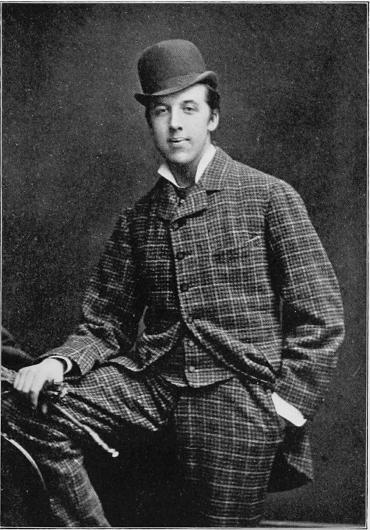
Oscar Wilde at around this time (click on the image for more information).
In Italy Wilde could visit all those cities and sights which had been artistically described and transfigured by John Ruskin, whose books he appreciated and avidly read. Before the middle of June 1875, Oscar Wilde and his companions started off from Oxford and presumably reached London where they boarded a ship that took them to Leghorn in Italy. From Leghorn the tourists travelled to Florence where they stayed from 15-19 June. As soon as he arrived in Florence, Oscar wrote a long letter to his father, addressing it to Sir William Wilde, where he describes, in detail and with many drawings, the sights he had visited in the city on that first day. He started by going to San Lorenzo, with its “gorgeous dome” (Letters, 5), the two chapels of the Medici, “one bearing Michael Angelo statues of Night and Morning and the other those of Evening and Dawn” (Letters, 8). Then the Biblioteca Laurenziana, where he was shown such marvellous illuminated manuscripts that, for the extreme clearness of their letters, he thought, were certainly superior to the Book of Kells. From San Lorenzo he walked to the Etruscan Museum (now the Archaeological Museum), in the site of the ex-monastery of Sant’ Onofrio, which had been inaugurated in 1870 by King Vittorio Emanuele. Here he spent most of the afternoon, while a thunderstorm was raging over Florence, literally enthralled by Etruscan art and its representations of the soul and of life after death. Since he knew how interested his father was in archaeology, he sent him many drawings of cinerary urns, jewels, and common utensils.
Emerging from the Museum, feeling delighted by what he had seen, energized by a clear and cool evening, he went to dine “at a restaurant on top of San Miniato.” On the way back to his lodgings, just opposite the Pitti Palace, he stopped to admire a funeral procession “of monks bearing torches, all in white and wearing a long linen veil over their faces – only their eyes can be seen. They bore two coffins and looked like those awful monks you see in pictures of the Inquisition” (Letters 9).
Wilde left Florence on the 19 June, boarding a train, which, via Bologna, would take him to Venice, from which he travelled to Padua and Verona, and then, from there to Milan. He regretted leaving the inspiring city of Florence on Sunday, after only four days, when there was so much to see and do, and we realize that he had visited more sights only from other scattered notes. For instance, he probably went to San Marco to see the frescoes by the Beato Angelico and the tomb of Pico della Mirandola (mentioned in the poem “Phèdre,” dedicated to Sarah Bernhardt, in The World, June 1879, where “the actress 'should’st have talked/At Florence with Mirandola…'"). In the poem, “Ave! Maria,” published in the Trinity College magazine Kottabos, 1879, he stated that it had been written at St. Marco, Florence (Mason 298), but, when it was published in the Irish Monthly in July 1878, he dated it Vatican Gallery, Rome, 1877. The poems, “San Miniato” and “By the Arno” were certainly written in Florence, since he published them soon after his return to Oxford in The Dublin University Magazine in March 1876. Probably some confusion arose from the fact that in 1875 Wilde left Italy in haste, without visiting Rome and leaving his companions behind, because he had run through his money.
But he was determined to go to Rome and therefore in March and April 1877 he joined Mahaffy and two other students to visit Greece. They arrived in Genoa and proceeded to Ravenna, then boarded a ship at Brindisi for Zante, Olympia, Arcadia, Mykenae, Athens and Corfu. Then he returned with them to Rome (Letters 43-45). It was a short visit which led him directly to the English Cemetery near the Pyramid of Caius Cestius, and to the tomb of Keats, upon which he meditated. Some months later he dedicated a sonnet to it, entitled “Heu Miserande Puer” (published in Irish Monthly (July 1877, p. 478), then published in Poems, 1881, with the title “The Grave of Keats”), and wrote a letter to the Keats expert, Lord Houghton, lamenting the ugliness of the poet’s profile on the tombstone, which gave him a “hatchet face.” “Keats," Wilde continues, "was lovely as Hyakinthos, or Apollo, to look at and this medallion is a very terrible lie and misrepresentation. I wish it could be removed and a tinted bust of Keats put in its place, like the beautiful coloured bust of the Rajah of Koolapoor at Florence” (Letters 49-51; the letter is dated circa 17 May 1877).
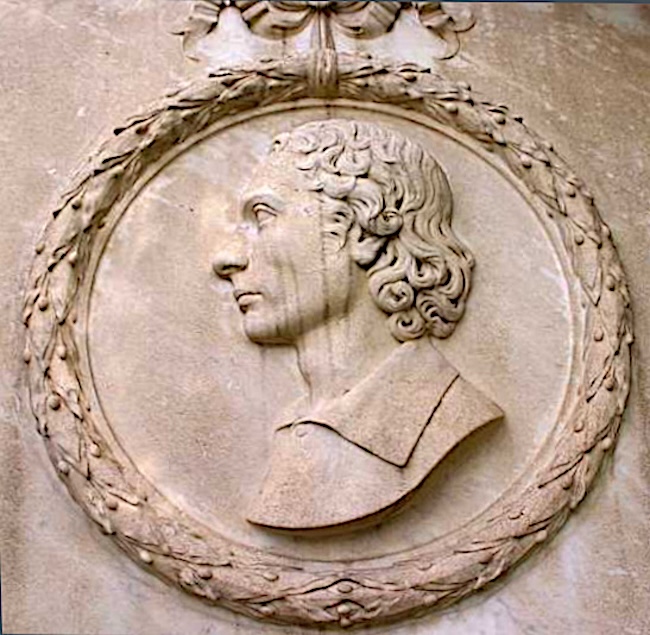
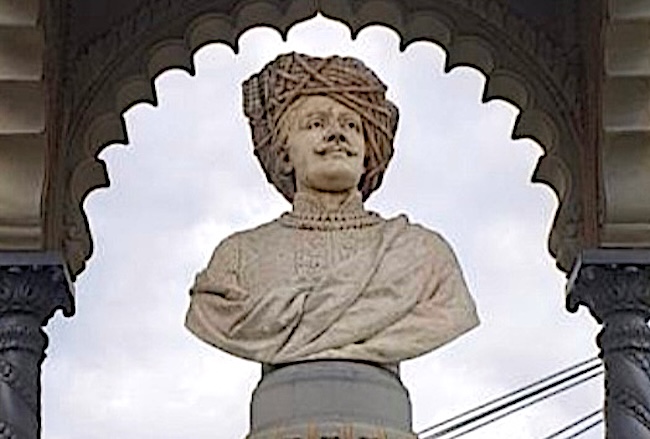
Left: The medallion relief that Wilde so disliked in Rome. Right: The "coloured bust" of the young Rajah of Koolapoor in his elaborate monument at Florence (courtesy of the author).
Since Wilde considered Keat’s grave “the holiest place in Rome,” he sent his sonnet to many friends, always insisting that it needed a complete restoration, as he had written in The Irish Monthly:
Reverently some well-meaning persons have placed a marble slab on the wall of the cemetery with a medallion-profile of Keats on it and some mediocre lines of poetry. The face is ugly, and rather hatchet-shaped, with thick sensual lips, and is utterly unlike the poet himself, who was very beautiful to look upon. "His countenance," says a lady who saw him at one of Hazlitt’s lectures, "lives in my mind as one of singular beauty and brightness; it had the expression as if he had been looking on some glorious sight." And this is the idea which Severn’s picture of him gives. Even Haydon’s rough pen-and-ink sketch of him is better than this "marble libel," which I hope will soon be taken down. I think the best representation of the poet would be a coloured bust, like that of the young Rajah of Koolapoor at Florence, which is a lovely and lifelike work of art. [see Letters 50; and Diary of the late Rajah of Kolhapoor..., p.85 ff.]
Wilde’s association of his favourite poet with the young Rajah, who had died in Florence in 1870, is the first documented example of his attraction for Indian art and culture, which undoubtedly took place at the Cascine in Florence. Wilde returned to Florence in 1894 to join Alfred Douglas and the couple toured the city together, visiting Frederick Stibbert, where he signed the Visitors’ Book. This later short stay was full of meetings with writers and celebrities and still needs to be researched and described. But with a sort of Pindaric flight, I would like here to introduce other instances of Oscar Wilde’s appreciation of India and its civilization.
Wilde's Inclusion of Articles about Indian Culture in The Woman's World
n April 1887, Oscar Wilde was appointed editor of a women's magazine entitled The Lady’s World, run by Wemyss Reid, then in charge of Cassell publications (see Severi 2004, 31-45). In November, Wilde occupied the editor’s office and, taking his job very seriously, set out to enlist many of his aristocratic and intellectual women friends as writers or artistic collaborators of the periodical which, according to his more democratic ideas, he re-named The Woman’s World. For himself he reserved a space, “Literary Notes,” in which he reviewed books, discussed current cultural events, and, in general, expressed very encouraging opinions on the contemporary feminine universe and its diversified achievements. In the first volume of The Woman’s World (1888), the editor intervened five times, with brief contributions of about four pages each; in the second eight times. By 1889, his interest had waned and, quite suddenly, he stopped writing, but before resigning from his lucrative post, he wrote a review in that issue of a surprising book by the Pandita Ramabai Sarasvati, The High Caste Hindu Woman (London, George Bell & Sons, 1888), introduced by Miss Rachel Bodley MD, the Dean of the Woman’s Medical College of Pennsylvania (Wilde, Literary Notes 2: 389-92).
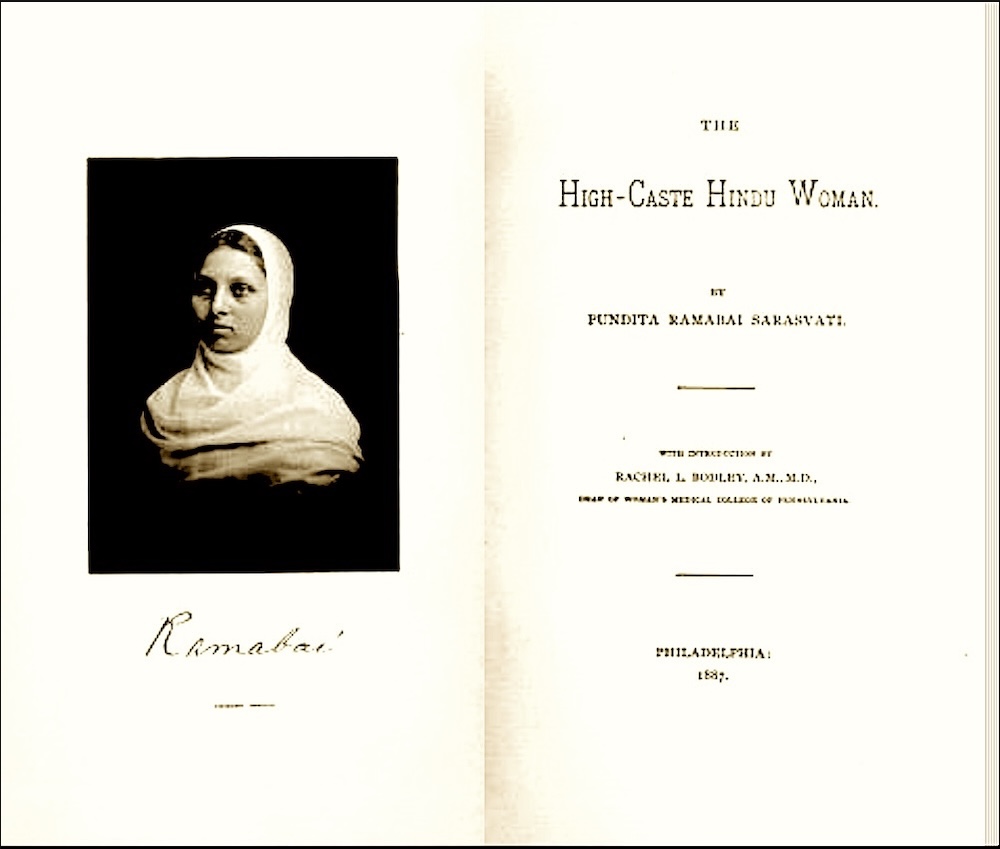
Frontispiece and title-page of Sarasvati's book.
Wilde initially comments on the Pandita’s strange upbringing. It seems that a Hindu father, travelling with his wife and two daughters, aged nine and seven, one morning came upon a young Hindu stranger who was bathing in the sacred river Godavari. When the stranger had finished his purification and prayers, the father introduced himself and asked him his name and provenance. After the father had learnt the stranger’s name, caste, provenance, and that he was a widower, he offered him his little, nine year old daughter in marriage. The contract was concluded almost immediately and the marriage was celebrated the day after. The little girl was taken away from her family and brought to a new home, almost nine hundred miles away. All this apparently cruel transaction, turned out rather favorably for the little girl. She was entrusted to her mother-in-law, and later, to her husband, who was “the learned Ananta Shastri, a Brahman pundit, who had very advanced views on the subject of women’s education” (392). He taught her Sanskrit and many subjects which were denied to most women in India. From this couple, Ramabai Sarasvati (1858-1922) was born in Canara (now Karnataka). She would be even better educated than her mother, and travelled widely across India, “advocating the cause of female education” (392), and proposed the establishment of the profession of women doctors. She held conferences all over India and when her fame as a lecturer reached Calcutta, she was invited to speak by the pandits who recognized her knowledge of the Sanskrit texts and her competence, attributing to her the titles of Pandita and Sarasvati.
The example of the Indian Ramabai is compared by Wilde to the life of Miss Mary Carpenter (1807-1877), who had travelled to India in 1866 and written an account of her journey (Six Months in India (London, Longmans, Green & Co., 1868, 2 vols.). Miss Carpenter was particularly keen on studying women’s condition in India and proposing improvements, of course from a Western point of view. “She at once discovered that the chief means by which the desired end could be accomplished was by furnishing women-teachers for the Hindu Zenanas” (392). She proposed a project that could be financed by the British government which could also award scholarships and assist poor women who had the brains, but lacked the means to pursue their education. “Mary Carpenter Scholarships,” financed by English philanthropists, helped many young Indian women to become teachers, especially because the schools were open to women of every caste. Unfortunately, though, the women teachers were not all allowed to exercise their profession, mostly because of caste-rules.
In her book, as Wilde approvingly points out, Ramabai introduces a different solution. She suggests that the high caste Indian widows should find shelter in open houses where none of their rights would be refused or compromised; living in this kind of environment, the high caste Hindu women would have “entire freedom of action as regards caste rules.” According to Oscar Wilde, then, the Pandita’s “wonderfully well-written book … is full of suggestion for the social reformer and the student of progress, and … is likely to produce a radical change in the educational schemes that at present prevail in India” (392). Clearly Wilde is against the intrusion of English schemes in Indian society, which can certainly fare much better on its own, relying on its great human resources.
In the same volume of The Woman’s World, Frederika Macdonald (1845-1923) signs a rather long article on "Old Indian Poetry and Religious Thought," which she had previously read as a lecture given at South Place Chapel, Finsbury (see Wilde, Literary Notes 2: 442-45). The “eclectic congregation” at South Place Chapel, off Liverpool Street, which, since the 1820s, had been associated with radical politics, was led by an American Unitarian preacher, Moncure Conway “who had toured Britain as an abolitionist in the 1860s” and was, by the 1890s, preaching “the benefits of Sunday opening for the poor” (Maltz 31) but also inviting lecturers to talk about the East. Frederika Richardson, married the journalist of the London Daily News, John Macdonald, and followed him to India where he lived for some time, as correspondent of his newspaper, in the 1870s. Fredericka was also a writer who had published books on Rousseau, Charlotte Brontë, an English rendition of the Ramayama in 1870, as well as a tale about two children growing up in India.
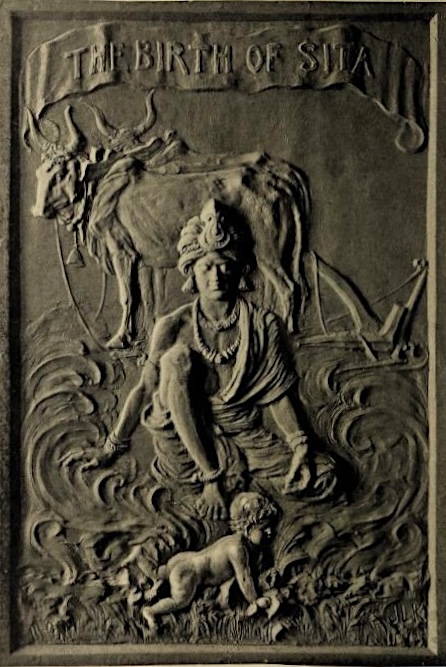
The Birth of Sita, by John Lockwood Kipling (frontispiece to the 1908 edition of MacDonald's book).
In her article she declares that it is practically impossible to understand the customs, traditions, feelings and ways of the Indian nation without some familiarity with its sacred poetry, by which she means the two masterpieces, the Ramayana and the Mahabharata, dating back almost 2000 years before Christ. These poems, “the comprehensive record of the imaginative life of India” (442) were preserved by poets and storytellers (like the Iliad and the Odyssey) who wandered from town to town reciting and retelling many cherished legends. Frederika Macdonald, like the Romantic German poet Heinrich Heine, believed that anyone who wished to learn anything about the Indian way of life must spend time in the “immense Flowering Forests of old Indian Poetry” (443). After the first impression of having entered into a world of marvels, she says, the interested reader will soon discover that the miraculous atmosphere relies not on the poet’s credulity, but on his incredulity. “Where all outer life is regarded as Maya, Illusion, a dream and a vision, there can be no objection felt to some incidents of the dream being incredible and extraordinary” (443). In old Indian poetry, Asuras, cruel creatures, demons, can achieve a valorous death, like the Rakshasas; there’s a certain display of the grotesque; Nature is pervaded by a mystical pantheism. Practically all facets of human life and its involvement with nature are considered equally important and poetically represented.
She then concludes her essay by narrating three exemplary tales from the sacred poems. Probably the first story might have caught Wilde’s fancy because it reads like an apologue, a literary form that he exploited in his Poems in Prose. It is the story of Valmiki, the supposed narrator of the Ramayana and how he received the gift of poetry. Valmiki would spend his time meditating about the sorrow of the world, but, when one day he happened to admire two herons flying happily about, innocently enjoying their delight in life, and one of the birds was suddenly struck by the arrow of a hunter, he felt such pain and compassion for the dead creature, that a cry broke from his heart, which he repeated rhythmically over and over again. And when, later on, he met Brahma who wanted to know if he had found the poet that is worthy to sing of Rama, the perfect man, his lament about the dead heron rushes to his lips. Brahma praises him by saying: “Happy Valmiki! You have received the grace of Sarasvati, goddess of Poetry, in recompense for your pity of the heron (MacDonald 444).
Another article, in the same volume of The Woman’s World, "Woman in Oriental Poetry and Literature," was written by Florence Layard (1850-1924), who was born in India, and was the editor and translator of The Correspondence of Madame Du Noyer (1890). Layard’s aim is to compare different forms of poetry from various Eastern cultures: Arab, Persian, Hindu, Siamese. In general, she declares, women are held in low esteem in these cultures and, in particular, in Hindu poetry, she points to the peculiar custom of the woman courting the man. The woman in Hindu culture, she avows, with a Victorian shudder of disgust, is actually the pursuer, instead of being pursued. The reason, according to Layard, may be traced in the practice of polygamy which induced women to exercise all their charms in order, first to secure a husband, and secondly to keep him bound to them. Comparing Hindu and Persian poetry, the author argues that in the latter the woman holds a higher position, whereas in the former the feminine ideal is “disfigured by gross and voluptuous imagery and description” (209). On the whole, the article seems too superficial to express any form of judgment or poetic definition on such a wide theme as the position of women in Oriental poetry.
But for Wilde, as editor of a woman's magazine at the end of the 1880s, his most important aim is apparently to invite women to voice their opinions freely on many issues. Among the many women writers who collaborated in The Woman’s World, some came from aristocratic backgrounds, like Her Royal Highness Princess Christian, or Lady Bellairs; others were professional writers, like Ouida, Olive Schreiner, Mathilda Blind, Mrs. Oliphant, and Amy Levy (a young poet discovered by the editor), who had manifested their social interest and, in many cases political engagement; others again were friends, acquaintances & family members of the editor (his mother “Speranza”, who had always expressed a libertarian strain in her political poems and articles, submitted a long poem, “Historic Women,” and his wife Constance, an article where she graciously comments on muffs).
When the editor accepted articles on Indian poetry and chose to review a book written by an Indian lady he was reacting to the new demand by the British public to learn more about the subcontinent, especially after the 1877 proclamation of Victoria as Empress of India. As Edward W. Said reported on the ongoing struggle of resistance and opposition: “The women’s movement is central here. For as primary resistance gets under way, to be followed by fully fledged nationalist parties, unfair male practices like concubinage, polygamy, foot binding, sati or suttee (the widow who accepts to sit on top of her dead husband’s pyre), and virtual enslavement become the focal points of women’s resistance” (218). And he further elaborated by adding a few examples from Indian women writers. Wilde also added that the Indian historian and social reformer, Rajah Ram Mohan Roy (1772-1833), an early nineteenth century nationalist influenced by Mary Wollstonecraft, mobilized early campaigns for Indian women rights, a common pattern in the colonized world, where the first intellectual stirrings against injustice included attention to the abused rights of all oppressed classes. Later women writers and intellectuals – often from privileged classes and often in alliance with Western apostles of women’s rights like Annie Besant - came to the forefront of agitation for women’s education. Amongst the Indian reformers mentioned by Said, the only militant is Pandita Ramabai (263-64).
As an Irishman, son of the outspoken nationalist, Jane “Francesca” “Speranza” Elgee, Oscar Wilde often expressed elective affinities with nationalist minorities, women, and, as seems quite plain,— after the publication of his pamphlet, The Soul of Man under Socialism (1891), and later on of the The Ballad of Reading Gaol (1898), a lyrical document about his poetical and political stance against the death penalty, — he was engaged throughout his life, without ever resorting to bombastic declarations, in overcoming injustice and upholding the rights of those sectors of society who still had a very feeble voice.
Wilde's Lifelong Interest in Indian Culture

hen Wilde married Constance Lloyd in 1884, he went to live in Chelsea, in “the house beautiful,” whose interior decoration he personally supervised. His aesthetic taste in the decoration of his house is inclined to “Japonisme”, but the presence of India can be seen everywhere. In his study, the place where Wilde stayed and invited visitors when at home, he kept small Indian spoons with jeweled handles, an Indian brass inkstand, and an Indian tray. The drawing room and the landing on first floor of his house were covered with Indian matting, as well as the back room on the second floor and the front room on the top floor.
Before accepting the enterprise of The Woman’s World, Wilde was a regular contributor to The Pall Mall Gazette, where he reviewed With Sa’di in the Garden by Sir Edwin Arnold (1832-1904), a well-known poet, who had become famous after publishing The Light of Asia (1879), a collection of lyrics which were meant to interpret in English the spirit and philosophy of India. Sir Edwin’s “Asiatic” (rhetorical, with a pejorative meaning) poetry did not suit Wilde’s taste. “Indeed, poetry may be said to need far more self-restraint than prose,” he commented, noting that "Sir Edwin Arnold has a very picturesque or, perhaps we should say, a very pictorial style. He knows India better than any living Englishman knows it, and Hindustani better than any English writer should know it” (Uncollected Oscar Wilde, 174). The narrative poem tells a story set in a mosque, near the Taj Mahal, where a group of people, which includes a “learned Mirza, two singing girls with their attendant, and an Englishman” (Uncollected Oscar Wilde, 174), have all come together to read verses of the Medieval poet Saadi (1210-1291/92) on the subject of love, while they are entertained by music and dance. Wilde quotes more than 30 verses from the poem, then concludes that what he regrets most in the book is the “writing in what really amounts to a sort of ‘pigeon English,' mostly because, in order to enhance local colour, Sir Edwin abounded with 'Asiatic expressions.' As it is, Sir Edwin Arnold has translated Sa’di and someone must translate Sir Edwin Arnold” (Uncollected Oscar Wilde, 177). Wilde knew what he was talking about because he had already read Sir Edwin Arnold’s collection, Indian Poetry (London, Trübner, 1881), listed in the catalogue of the auction of his library as “Lot 82” (Severi 2004, 145).
Wilde did not himself meet many Indians or, if he did, he did not write about them. In a review of Primavera: Poems by Four Authors (Oxford, Blackwell, 1890) for The Pall Mall Gazette (24 May 1890), he lists the name of the poets: Laurence Binyon, who had won the Newdigate prize at Oxford, as Wilde himself did in 1878; Stephen Phillips, actor and playwright, who was then acting as the Ghost in a performance of Hamlet at the Globe Theatre and “was so admirable in its dignity and elocution”; Arthur Cripps, a student at Trinity College, and Manmohan Ghose, “a young Indian of brilliant scholarship and high literary attainments who gives some culture to Christ Church” (Reviews, 645). The book is, according to Wilde “charmingly ‘got up’, and undergraduates might read it with advantage during lecture hours” (Reviews, 649).
On 25 September 1891, Oscar Wilde sent a letter to The Times, that published it the next day, in which he sought to defend himself from a reader, who signed himself “An Indian Civilian.” The Indian Civilian accused Wilde of having described Anglo-Indians as vulgar. Wilde replied that he had “never met a vulgar Anglo-Indian. There may be many, but those whom I had the pleasure of meeting here have been chiefly scholars, men interested in art and thought, men of cultivation; nearly all of them have been exceedingly brilliant talkers; some of them have been exceedingly brilliant writers” (qtd. in Gilbert 8).
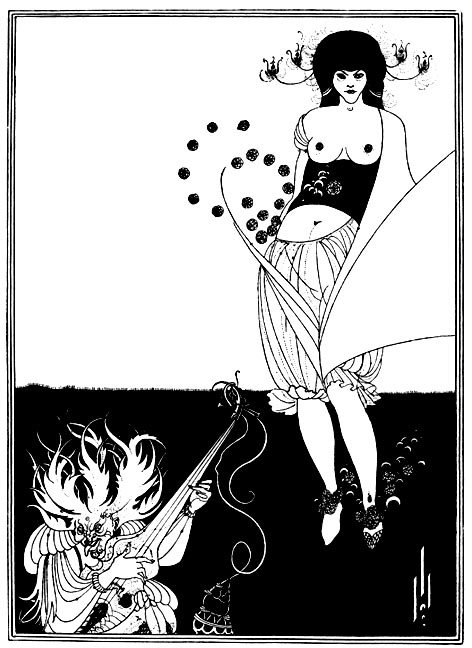
"[Salomé dances the dance of the seven veils]," by Aubrey Beardsley (Wilde, facing p. 56).
In the same year Oscar was writing in French his one-act aesthetic play, Salomé, where he dispenses with the dance in the telegraphic stage directions: “Salomé danse la danse des sept voiles,” conveying the idea that this particular dance is universally known. Yet this was not true if we are to believe what he wrote to Aubrey Beardsley in the dedication of the copy he sent him: “For Aubrey: for the only artist who besides myself knows what the dance of the seven veils is, and can see the invisible dance. Oscar” The dance of the seven veils corresponds to the dance of the seven planets, or the dance of creation performed by Shiva. It is through the cosmic dance that Shiva Nataraja (master of the dance) begins the process of transformation of the Universe from a state of pure matter to its development into the elements, to their combination into the vegetable and animal worlds and to the creation of man/woman as an act of love during which the androgynous Shiva separates himself into his two natures, the masculine and the feminine, each still retaining something of the other. The dance in Salomé is a mute rhetoric through which the dancer displays her best talents, her bodily charms, and her love for the world, which is the message of the dance (see Severi 2001, 50).
In July and September 1890, Oscar Wilde had published in the pages of the Nineteenth Century the first draft of his critical essay, “The True Function and Value of Criticism; with some Remarks on the Importance of Doing Nothing: A Dialogue”, which would be renamed “The Critic as Artist” and printed in the 1891 volume, Intentions. In that essay, he had made a few comments on Plain Tales from the Hills by Rudyard Kipling, stating that, as one read the book, “one feels as if one were seated under a palm-tree reading life by superb flashes of vulgarity.... The jaded, commonplace Anglo-Indians are in exquisite incongruity with their surroundings. The mere lack of style in the storyteller gives an odd journalistic realism to what he tells us” (Complete Works 4: 199-200).
In his letter to The Times Wilde makes his opinion clear once and for all. “Vulgarity is the distinguishing note of those Anglo-Indians whom Mr. Rudyard Kipling loves to write about, and writes about so cleverly.... For a realistic artist certainly vulgarity is a most admirable subject”. In any case, he feels the need to answer the anonymous writer because he is unwilling for anybody to see him as passing a harsh judgment “on an important and in many ways distinguished class....” What he was doing in his essay was “pointing out the characteristic qualities of some puppets in a prose play” (The Complete Letters, 489-90). It seems fair to conclude that Wilde had considerable respect for India, for both its women and its men, and its immensely rich culture, which influenced his works more than we might have thought; but less respect for those English people living in India who (as he realised from his reading of Kipling's work) neither had, nor wanted to acquire, any true understanding or appreciation of its customs and its poetry.
Bibliography
Blair, David Hunter. In Victorian Days and Other Papers. “Oscar Wilde as I Knew Him." New York: Books for Libraries Press, 1969. 115-43.
Diary of the late Rajah of Kolhapoor during his visit to Europe in 1870. Edited by Capt. Edward W. West. London, Smith, Elder &Co., 1872. [The Rajah’s handwritten entries in his diary stop at Innsbruck, but Capt. West, who assisted him throughout his tour, adds many details about his death in Florence on 30 November 1870, and how the city coped with the Hindu funeral ritual on the banks of the Arno, pp. 85-86 and pp. 121-29]. Internet Archive, from the Digital Library of India. Web. 7 April 2026.
Ellmann, R. Oscar Wilde. New York: Knopf, 1987.
Gilbert, Elliot L. Kipling and the Critics. New York: New York University Press, 1965.
Jackson, J. Wyse. The Uncollected Oscar Wilde. London: Fourth Estate, 1995.
MacDonald, Frederika Richardson. The Iliad of the East: a selection of legends drawn from Valmiki's Sanscrit poem, The Ramayana. London: John Lane, 1908. Internet Archive, from a copy in Pratt — University of Toronto. Web. 7 April 2026.
Maltz, D. British Aestheticism and the Urban Working Classes, 1870-1900. Beauty for the People. Palgrave Studies in Nineteenth-Century Writing and Culture. London: Palgrave Macmillan, 2006.
Said, E. W. Culture and Imperialism. London: Vintage, 1994.
Severi, Rita. La Biblioteca di Oscar Wilde. Palermo: Novecento, 2004.
_____. "Oscar Wilde, la femme fatale and the Salomé Myth." Proceedings of the Xth Congress of the International Comparative Literature Association, New York, 15-22 August 1982. Ed. C. Guillen. New York: 1985, vol. II: 458-463, collected in Eadem, Oscar Wilde & Company. Sinestesie fin de siècle. Bologna: Patron, 2001.
Sturgis, M. Oscar Wilde: A Life. New York: Knopf, 2021.
Wilde, Oscar. The Complete Letters of Oscar WildeLetters 45. Edited by M. Holland & Rupert Hart-Davis. New York: Henry Holt, 2000.
_____. The Complete Works. Edited by Jospephine M. Guy. Vol 4. Criticism: Historical Criticsm, Intentions, The Soul of Man. Oxford: Clarendon, 2007.
_____. Reviews. ReadHowYouWant Classics Library, 1969. Preview on Google Books.
_____. Salomé: A Tragedy in One Act. Boston: JW Luce, 1912. HathiTrust, from a copy in the University of Michigan. Web. 7 April 2026.
Women's World. Vols. 1-3. Edited by Oscar Wilde. London: Cassell, 1887-90. Hathi Trust, from the Universities of Minnesota and Illinois at Urbana-Champaign. See catalogue entries: https://catalog.hathitrust.org/Record/100640413
Created 10 April 2026