
As the author explains in her introduction, the following essay expands on an aspect of her doctoral thesis for Canterbury Christchurch University, Moving through Uncertainty with George Meredith (2023). Illustrations have been added; click on both for more information. The thesis itself, with its wider range of approaches, is available online at https://pure.canterbury.ac.uk/ — Jacqueline Banerjee
Introduction

here has been little recognition of the comedy in George Meredith’s novels, which have been dismissed by many critics simply as being "difficult" or "obscure." This essay demonstrates how and why he uses humour in fiction, and expands on an aspect of my doctoral thesis in which Meredith’s characteristic sense of fun was shown to be part of his optimistic outlook on life. Part One shows Meredith’s enjoyment of shared humour, revealed in the recollections and correspondence of friends and visitors. Part Two refers to his lecture "The Idea of Comedy and the Uses of the Comic Spirit," in which he asserted that Comedy should "awaken thoughtful laughter" (An Essay on Comedy, 88). Close readings from three of Meredith’s novels show that he shares humour in fiction with readers, as with friends, and inspires "thoughtful laughter."
PART I
"seldom long in his company without laughter"

The significance of Meredith’s sense of fun is highlighted by Jacqueline Banerjee, who begins the introduction to her biography, George Meredith describing him as "ebullient . . . brimming with humour" (1). The effect of Meredith’s close friendship with Frederick Maxse was "to bring out Meredith’s sense of humour" (Jones 100), and Maxse’s daughter recalled "gales of laughter" in her talk titled "George Meredith: Lover of Life and Laughter" (qtd. in Banerjee 1; 102, n.2). The Records and Reminiscences of Sir Francis Burnand describe Meredith’s "absolutely boyish enjoyment of mere fun, of . . . absurdity. His laugh was . . . of short duration, but it was a roar . . . he would laugh till he cried" (qtd. in Ellis, George Meredith, 107). Alice Butcher recalls her forty-one-year friendship with Meredith, remembering excursions and visits, when "his laughter, rhymes, and jokes were constant" (5). Her later memories are of Meredith "convulsed with mirth till the tears ran down his cheeks" (36), stating that "we were seldom long in his company without laughter. He himself had a most infectious laugh . . . his sense of humour was abnormally developed, and he could see comedy and farce where it could not be distinguished by duller mortals" (61).
Chaffing between friends
Meredith’s humour shared in close relationships is revealed in his correspondence with Sir William Hardman. According to Meredith’s cousin S. M. Ellis, who edited Hardman’s letters and memoirs, Meredith was the "greatest and most intimate of his friends" (A Mid-Victorian Pepys, vii), and Hardman records "a little recital of the chaff that passes between us as friends" (A Mid-Victorian Pepys, 187). His quotation from a "song," as part of a "wild letter’ announcing a yachting excursion, demonstrates Meredith’s improvisation of nonsense rhymes (A Mid-Victorian Pepys, 177), and Hardman’s absence caused Meredith to write "a series of the most original and laughter-provoking letters that ever were written" (The Letters and Memoirs of Sir William Hardman, 46). Hardman is nicknamed "Friar Tuck," with Meredith himself being "Robin," and Hardman’s wife is "Demitroïa" because, as Ellis notes, "her husband had taken five years to win her - half the period of the Siege of Troy" (A Mid-Victorian Pepys, 67). On Hardman’s move to Norbiton Hall, the "Friar" becomes the "Abbot of Norbiton" and is addressed in Meredith’s letters as "My dear Lord Abbot" or simply "Tuck" (The Letters and Memoirs of Sir William Hardman, 223).
"fiendish teasing"
Ellis recalls that Meredith’s teasing could be perceived as insensitive. When guests were present, he had a habit of "exercising his wit at the expense of his household" (George Meredith, 167). Describing Meredith as "a born tease," Edward Clodd notes that "not even the discomfort of his victim could check it" (159). Alice Butcher however, describing him as "ever a master of exquisite chaff," considered that "his words never really hurt" (5). Meredith’s intention seems to have been to stimulate a response, or to mock pretentious attitudes. "Mischief carried him away," as R E Sencourt notes, "when he found anyone who was unable to respond to his chaffing" (186). Butcher states that, with his wealthy neighbours he was "very genial, and chaffed them constantly about their French cooks, orchid houses, and well-filled stables" (8). The perceived insensitivity of his teasing could be attributed to Meredith’s natural shyness, resulting in the adoption of a persona in public or amongst strangers. When Meredith was able to relax with close friends such as Dr and Mrs Plimmer, "they thoroughly enjoyed the exchange of fiendish teasing with one another" (Sencourt 264).
"rise humorously above one’s body"
Meredith’s humour as a positive attribute is apparent in correspondence describing his illnesses, using figurative language which critics acknowledged in his writing. Simile and imagery convey sounds and colours, as Meredith "slain with a cold" describes his nose "as the trombe of an elephant challenging his love" (Cline 806, 807). When "slain by an Influenza cold" he writes: "My appearance resembles an ancient Wardour Street canvas, where a truculent cavalier shows daubs of raw carnations through sooty pigments. There has been a Kaleidascopic change of places of all the natural Colours on my face . . . I am nothing but nose" (Shaheen 99, 100). The same illness, described in another letter, shows Meredith’s typical use of metaphor, when he states: "I am on the violent foggy weltering sea of Influenza, and I am also a monstrous elephant careering through damps of the tropical forest with trumpeting proboscis" (Cline 952, 953). When bedridden with a broken ankle, his description of "the trial . . . with one leg in a cathedral gallows" in a letter to Alice Butcher expresses his optimistic philosophy: "I wore a smile through it . . . chaffed Doctor, nurse and myself. The thing to do in such a case is to rise humorously above one’s body" (Cline 1593).
PART II
The Comic Spirit
Meredith’s understanding of the importance of humour is conveyed in his only public lecture The Idea of Comedy and the Uses of the Comic Spirit. The talk, given at the London Institution in 1877, was published in essay form in the New Quarterly Magazine, and as a book in 1897. Here, he surveys earlier comedy and gives his highest praise to Molière, as "the sole creator of pure Comedy." This is because of the "rare" intellectual content of his humour. For Meredith, this kind of humour required a "society of cultivated men and women" to appreciate it properly, and, lacking this kind of balanced audience, earlier English comedy had simply been too crude. "Our traditions are unfortunate," he writes. "The public taste is with the idle laughers, and still inclines to follow them. It may be shown by an analysis of Wycherley's Plain Dealer, a coarse prose adaptation of the Misanthrope, stuffed with lumps of realism in a vulgarized theme to hit the mark of English appetite, that we have in it the keynote of the Comedy of our stage. It is Molière travestied," he contends. Little has changed since then, he adds: "how difficult it is for writers to disentangle themselves from bad traditions is noticeable when we find Goldsmith, who had grave command of the Comic in narrative, producing an elegant farce for a Comedy; and Fielding, who was a master of the Comic both in narrative and in dialogue, not even approaching to the presentable in farce" (30-31). In what has been accepted "as a classic contribution to the study of comedy" (Bartlett 16), Meredith shows where true, effective and valuable humour lies, carefully distinguishing the Comic Spirit from the cruelty of satire and the maliciousness of irony. In particular, he feels it can be used in the detection and prevention of pretentiousness: the capacity for Comic perception is estimated by one’s ability "to detect the ridicule of them you love, without loving them less: and more by being able to see yourself somewhat ridiculous in dear eyes, and accepting the correction their image of you proposes" (An Essay on Comedy, 78). Meredith asserts that the "laughter of Comedy is . . . often no more than a smile . . . it might be called the humour of the mind . . . the test of true Comedy is that it shall awaken thoughtful laughter" (88).
"thoughtful laughter" in fiction
The close readings selected from three of Meredith’s novels demonstrate the humour in apparently minor episodes, which also inspire thoughtful laughter. Sharing characters’ experiences and emotions, the voice of the narrator affirms a relationship with readers who are encouraged to smile, then recognise and reflect on their own situations and attitudes.
I. The Adventures of Harry Richmond (1871)
Meredith shares an amusing event with readers in chapter xvi, "The Statue on the Promontory," which also serves to highlight the contrast between fantasy and reality in the characterisation of Harry’s father, Roy Richmond. Meredith’s enjoyment of his character is recalled by the French writer Marcel Schwob, who was told that when Meredith "first met" Roy Richmond, he "perfectly roared with laughter!" (qtd. in Hammerton 121).
"There never was so fascinating a father as mine"
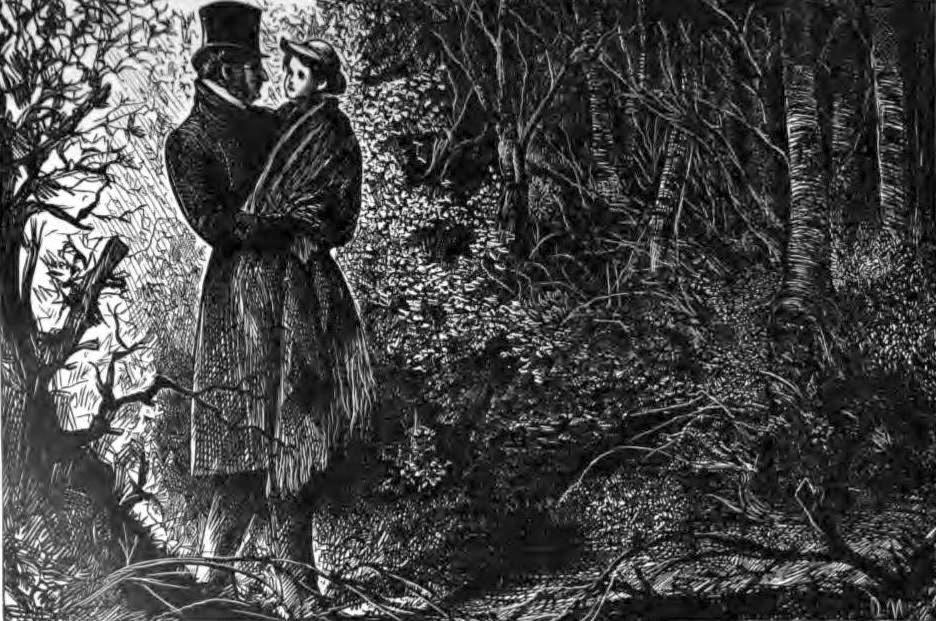
Harry in his father's arms, by George Du Maurier.
The introduction to Harry’s flamboyant father in the novel is melodramatic, recalled from Harry’s childhood memory. Roy Richmond’s arrival at midnight in winter is announced by "the determined violence of the knocks and repeated bell-peals" on the door of Riversley Grange, home to Harry and his grandfather, as if "a possible night attack" (1). Refused entry, Roy Richmond "plucked [his son] from his grandfather’s hold, and swinging him high," declared "I take him" (8, 9). To the child, his father appears to be "of enormous size, like the giants of fairy books" (8), and Harry is carried for miles, recalling that night "like the brazen castle of romance" (12). His early memories record that: "My father . . . could act dog, tame rabbit, fox, pony . . . I rode him . . . lashed him with a whip till he frightened me, so real was his barking" (13). Remembering the richness of his father’s "performances," Harry indicates his confusion between play-acting and reality, as stories of real and fictional heroes are combined. For a boy of eight or ten, there "never was so fascinating a father as mine" (15).
"adventures are what I call life’
Roy Richmond commands apparent respect in society, and Harry is impressed by his father’s extravagant lifestyle. Meredith shows how the attraction of fantasy and adventure, and love for his father, enable Harry to ignore the doubts concerning Roy Richmond’s reliability. Harry’s grandfather proclaims him to be "a scoundrel . . . a liar" (6), and Roy Richmond’s housekeeper predicts "evil days," as it is considered that he is "near the end of his wits and his money together" (36). Friends advise Harry: "Expunge him . . . he’s no good" (90). But when his father is "sometimes absent for days," the boy Harry misses the "enchantment of [his] companionship" (13). At boarding school, he has "neither visit nor letter" from Roy Richmond (39). Harry would have liked "a regular father, instead of a dazzling angel that appeared at intervals" (42). Nevertheless, even when no money is received for Harry’s boarding or schooling, he maintains the belief that his father "was a fountain of gold, and only happened to be travelling" (53). Harry lives "in extreme flights of imagination" (58), and in his mind, he "came to paint the mystery surrounding [his] father in tender colours" (88). It is only with hindsight that he acknowledges that he was "getting a false self" (97), when he told his friend Temple "adventures are what I call life" (116).
"our funmaker"
During one of Harry’s adventures, he and Temple find themselves "bound on a voyage" on a ship travelling to Germany (121). By coincidence of plot, he is reacquainted with a friend who tells him that his father is also in Germany, at the Court of the Prince of Eppenwelzen. Journeying to Sarkeld, determined to see his father, Harry sees workmen erecting a statue of a bronze horse, in preparation for "prodigious attractions" (150). He encounters Princess Ottilia, daughter of the Prince of Eppenwelzen, who recommends that Harry attend the Bella Vista event, at which the statue is to be unveiled. A warrior on horseback, commemorating the Prince’s ancestor has been organised by his sister "Markgräfin von Rippau" (152, 153), and suspense is building as the bronze horse has no rider as yet. When the Princess discovers that Harry is Richmond Roy’s son, she declares: "Oh! it is wonderful! . . . He is our fun-maker . . . You will see him up at our Bella Vista" (154).
"The Statue on the Promontory"
Confident that he "might detect him disguised" (157), Harry sees no-one resembling his father, although he is assured by Miss Sibley, an English tutor: "Your father will certainly be here; he is generally the margravine’s right hand" (158). She tells Harry that the widowed Prince depends on the margravine for amusement, which he has had "since she discovered your papa" (158), who is "full of laughter" (159). Suspense builds, until the cannon fires and the covering tent is raised to reveal the statue, which is "superb - horse and rider in new bronze polished by sunlight," and is pronounced "life-like! . . . really noble! . . . a true Prince!" (160). Enquiring if he has seen his father, the margravine teasingly asks if he would know him if he saw him? Harry responds with annoyance: "Yes . . . anywhere on earth!” He swears on his honour, on his life, that he was not present, and would bet any sum that his father was not on the ground. As Temple cheers "lustily," the "head of the statue turned . . . The eyes, from being . . . dull carved balls, were animated. They were fixed on me . . . Its chest heaved; both bronze hands struck against the bosom. 'Richmond! my son! Richie!' . . . was what the statue gave forth" (163).
"a tragic spectacle"
Readers who learn before Harry that his father’s attraction and popularity are built on fantasy, and are anticipating Roy Richmond’s downfall, can appreciate the farcical episode. The image of the statue of "new bronze polished by sunlight" is symbolically shattered, and having spoiled the Bella Vista spectacle, Harry’s father is perceived with scorn and anger.

Harry and Temple still being entertained by his father (in chapter xviii), by George Du Maurier.
Only later, in chapter xlvii of the novel, does Harry accept the reality that his father "acts the charmer" (448), and his admiration becomes pity. "Instead of a comic I found him a tragic spectacle . . . I knew . . . that to the rest of the world he was a progressive comedy" (449).
II. Diana of The Crossways (1885)
Laughter is shown to be part of the title character’s identity in Diana in the intervals at the whist-table, which is perceived by her older husband to be an outrage to decorum: it is reported that his mockery "killed the bright laugh, shot it dead," having the effect of her "too-dead ensuing silence" (6). Denied the expression of her natural laughter, Diana is deprived of "'the breath of her soul,' as she called it" (7). In chapter viii, she is planning to flee England, to escape the scandal of a court case brought against her by her husband. Attempting to persuade her to remain, Diana’s close friend Lady Emma Dunstane writes a letter which she entrusts for delivery to Tom Redworth.
Diversions on the journey
It is a damp and frosty November night, but Redworth is confident that, with three hours of daylight remaining, he will be able to find his way to Diana’s house, The Crossways. Taking sandwiches for the journey and fortified by "a tumbler of choice Bordeaux" (78), he sets off on horseback without delay, leaving his great-coat and travelling-bag behind in his haste. Emma’s groom estimates that he would arrive at the Three Ravens Inn in Storling by seven o’clock. The road seems "interminable" to Redworth, who reflects on the benefit of the railway, considering "the horrible state of the roads" (79). Leaving the road for a diversion "over fields and ditches" by moonlight "for a couple of hours," Redworth is informed that he is still five miles from Storling (80). Entering Storling when "the moon stood high on her march" Redworth fears that he is on a wild goose chase, that he would find The Crossways "in the silent night time, a certainly empty house" (80). After a further hour’s travelling he finds himself back in Storling and, determined to "pursue the chase," asks for directions at a cottage (80).
"the dissection of a pig"
Although the occupants had never heard of The Crossways, their elderly lodger Andrew Hedger claims to know "the spot they calls Crassways," and leads Redworth - not to a house, but a signpost. "Naw, there’s ne’er a house. But that’s crassways for four roads, if it’s crassways you wants" (81). Their return journey is through "such a maze of lanes that the old man was master" (81), and three-quarters of an hour pass as Redworth listens to Hedger’s views of the changes to "Old England" (82). At the "welcome sight of a blazing doorway" (82) Redworth waits impatiently for Hedger to obtain directions, finally approaching the group of people "all, and Andrew Hedger among them, the most entranced and profoundly reverent, observing the dissection of a pig" (83). The old man has forgotten to ask the way, being "intoxicated by the aspect of the pig" and responds slowly, saying "Ah could eat hog a solid hower!" (83). Refusing to be dismissed, Hedger continues with his discourse on pigs as they journey on, until the "hog-worshipper" declares, "that may be the house, I reckon" (84). With his fee paid, he "departed at high pedestrian pace . . . to have a concluding look at the beloved anatomy" of the hog (84).
Meredith’s characterisation of Andrew Hedger is gently humorous, and the elderly man is depicted with understanding, not derision. Despite his frustration, Redworth smiles at the "dogged astuteness of a dense-headed old creature," who is anticipating his fee for the journey (82). Readers feeling empathy for the urgency of Redworth’s journey learn with him the need for forbearance and good humour, in dealing with people and circumstances which are beyond control.
III. One of Our Conquerors (1891)
The apparent insignificance of an episode in chapter xxii, which nevertheless contributes to the novel’s plot and causes readers to reflect, is indicated in the title: "Treats of the ladies’ lapdog Tasso for an instance of momentous effects produced by very minor causes." The farcical scene which Meredith depicts within this particularly challenging novel concerns the belated discovery that Tasso has been rolling in something that smells extremely offensive, and inspires understanding and empathy for an embarrassing incident. A contemporary reviewer refers to the "hearty laughter" evoked in this chapter, describing it as an "immortal 'night piece'" concerning the Duvidney ladies and the "malodorous irruption of their lapdog Tasso" (H.S. Wilson, 1891, qtd. in Williams 349).
Victor and Nataly - "a mated couple""
Meredith responded to the "general attack’ on the opening sentence of One of Our Conquerors for its unnecessary obscurity, in a letter to Clement K Shorter, suggesting that "literary playfulness in description is antipathetic to our present taste" (Cline 1029). The lengthy sentence, which describes how Victor Radnor slips on a banana skin while crossing London Bridge, indicates the character’s pretentiousness. Victor is "another of [Meredith’s] egoists’ lacking humour (Banerjee 84) and his embarrassment concerns his self-image. With social ambitions described as "an ascension from heights to heights" (51), Victor is about to reveal to his family his "secret" of the move to Lakelands, a large country house. His family of twenty years comprises daughter Nesta and "her mother" Nataly. Although unmarried, Victor and Nataly are perceived by friends as "a mated couple, such as you won’t find in ten households over Christendom" (66). Victor’s legal wife is Mrs Burman Radnor, whom he married for her wealth, when he was "in youth" and she was "a more than middle-aged woman" (32). Hearing about Lakelands, Mrs Burman threatens to expose Victor and Nataly as "living in flagrant sin" (263). Victor is confident that rumours of her ill-health signify Mrs Burman’s imminent demise, but to protect his daughter from possibly discovering the truth of her parents’ unmarried status, he plans to lift Nesta "out of the atmosphere awhile; she goes to my cousins the Duvidney ladies" (266).
The Duvidney ladies
Victor believes that they can rely on his cousins because "those two good old spinsters are less narrow" than Nataly’s relatives (54), although Nataly is aware that the ladies see her as "the woman misleading him . . . the naughty adventuress!" (115). The "maiden ladies Dorothea and Virginia Duvidney" are described as "thin-sweet old-fashioned grey gentlewomen, demurely conscious of their excellence . . . who imposed a certain reflex primness on the lips of the world when addressing them or when alluding to them" (268). Meredith’s narrator conveys a sense of their complacency, their air of authority as "knowledge assisted by" the clergy. "They were good women, striving to be humbly good" (269). Observations by the narrator question attitudes and priorities of a "type" for whom public appearance matters. The use of "we" and "us" includes everyone, suggesting that "duty to mankind diverts us not from the love we bear to our dog; and with a pathetic sorrow for sin, we discard it from sight and hearing. We hate dirt" (269,270). The Duvidney ladies are shown to abhor both mental and physical "dirt" and uphold their principles by refusing Victor’s "urgent pleas" (276) to take in Nesta. Resistance leaves them exhausted, and causes the delay of "their darling dog Tasso’s . . . evening’s trot," the purpose of which is "amusingly" (and euphemistically) "to compose his vesper hymn" (274). There is no further discussion. They have "done rightly" and know "the power of good consciences to summon sleep" (274). On his return, Tasso is sent to his basket "at the foot of the ladies’ beds" (275).
"a befouled degraded little dog"
Being "so fatigued" the sisters smother yawns with "hand at mouth, for not in privacy would they have been guilty of exposing a grimace" (275). Preparing for sleep, Dorothea asks her sister: "Are you aware of anything, dear?" Both are incredulous, doubting "the pure atmosphere of their bed-chamber," but Dorothea’s "nose in repugnance convicted [Tasso] absolutely. Virginia’s nose . . . inhaled . . . Dorothea’s eye-lids fainted. Virginia dismissed the forlornest of efforts at incredulity. A whiff of Tasso had smitten her" (276). The ladies perceive the situation as a "catastrophe," a "dilemma": they are dressed in nightwear, with no servants available, and no hot water to wash the dog, who would refuse to sleep elsewhere. Their "solitary alternative" is to have "a befouled degraded little dog in their chamber through the night" (277). They pity the "innocent little dog, knowing not evil, dependent on his friends for help to be purified," and demonstrate their love for Tasso by liberally sprinkling lavender water on his basket, the rug and the dog himself (278). Tasso is "unaware of the exaggeration of his iniquitous conduct," and he sleeps. He had "sinned unknowingly" (279). The ladies are sleepless, "mutually haunted," wondering if they are intended to review the day’s deeds (280). Reflecting on Nesta’s innocence, they achieve composure by considering their potential to be "guides to a tender young life," whilst not countenancing Victor’s sin (281). "Their souls were mounting to a serenity above the nauseating degradation, to which the poor little dog had dragged them" (281). Early next morning, Victor receives their note, stating: "we are prepared to receive the child for a month" (283).
Meredith’s description of the fastidious sisters’ reaction to an embarrassing situation is amusing, and their exaggerated response is caused by their concern for public perception of their status. The episode is a critique of judgmental attitudes and fixed opinion - but the Duvidney ladies’ conclusion that it would be impossible to use lavender water in future signifies a process of learning and permanent change. Readers reflecting on the sisters’ response also consider Victor’s reaction to their note. His cousins’ agreement is seen as a personal triumph, confirming the egoism and pretentiousness of social ambitions indicated in the first sentence of the novel.

"Waiting for His Master" — Meredith's own little dog in the sitting room at Flint Cottage, Box Hill, Surrey. Source: Butcher, facing p.120.
Conclusion
Meredith shares humour with his readers as he did with close friends, and uses comedy in his fiction to "awaken thoughtful laughter." Readers are encouraged to smile, recognising themselves as others see them, and to reflect on how they interact with others, which may act as a form of gentle correction. The characterisation of Andrew Hedger is typical of Meredith’s representation of "type" in many of his novels. Characters are frequently given a nickname, as were his close friends, to indicate an idiosyncrasy or attitude familiar to readers. The humour and observational skills of Meredith’s characterisation, often described in a brief phrase in contrast to the verbosity for which he was criticised, is a topic worthy of further consideration.
Bibliography
Banerjee, Jacqueline. George Meredith. London: Northcote House Publishers, 2012.
Bartlett, Phyllis. George Meredith. London: Longmans, Green & Co. 1963.
Butcher, Alice Mary Brandreth, Lady. Memories of George Meredith, O.M. London: Constable and Company Ltd.
Cline, C.L., editor. The Letters of George Meredith. 3 Vols (continuous pagination). Oxford: The Clarendon Press, 1970.
Clodd, Edward. Memories. London: Chapman and Hall Ltd, 1916.
Ellis, S. M. George Meredith: His Life and Friends in Relation to his Work. London: Grant Richards Ltd, 1920.
_____, ed. A Mid-Victorian Pepys: The letters and memoirs of Sir William Hardman. London: Cecil Palmer, 1923.
_____, ed. The Letters and Memoirs of Sir William Hardman: Second series. New York: George H. Doran, 1925.
Hammerton, J. A. George Meredith in Anecdote and Criticism. London: Grant Richards, 1909.
Jones, Mervyn. The Amazing Victorian: A Life of George Meredith. London: Constable & Co., 1999.
Meredith, George. The Adventures of Harry Richmond. [1871]. London: Constable & Co., 1909.
_____. Diana of The Crossways: A Novel. [1885]. London: Constable & Co., 1911.
_____. One of our Conquerors. [1891]. London: Constable & Co., 1924.
_____. An Essay on Comedy and the Uses of the Comic Spirit. Westminster: Archibald Constable and Co., 1897.
Sencourt, Robert Esmonde. The Life of George Meredith. London: Chapman and Hall, 1929.
Williams, Ioan, ed. Meredith: The Critical Heritage. London: Routledge & Kegan Paul, 1971.
Created 5 September 2026