
The popular American periodical Harper's Weekly: A Journal of Civilization in 1861 featured several advertisements for A Strange Story, which succeeded Great Expectations as the serial novel for All the Year Round in England, and began its serial run in Harper's immediately after the conclusion of the Dickens novel. On 6 July 1861 the following advertisement appeared in Harper's on page 418:
A NEW SERIAL BY BULWER.
Mr. Chas. Dickens's admirable Tale "GREAT EXPECTATIONS" will be concluded in No. 240 of Harper's Weekly. We have the pleasure of announcing that it will be followed by the commencement of
A NEW SERIAL BY SIR EDWARD LYTTON BULWER [sic], ENTITLED "A STRANGE STORY,"
which will be continued from week to week till completed.
The unrivalled merit of the latest works of Sir Edward Lytton Bulwer justifies the assertion that his power as a Novelist is steadily on the increase, and warrants the belief that his new Tale will be even more thrillingly interesting than "WHAT WILL HE DO WITH IT?" or "MY NOVEL" — both of which were read by at least half a million of people in this country.
The magazine's advertisement was repeated on 27 July 1861; it is noteworthy that, although the second publicity statement mentioned that the new Bulwer Lytton novel would be "handsomely illustrated" (p. 466), neither blurb mentioned the extent and artist behind the illustrations for it would again, like Great Expectations, be illustrated by house-artist John McLenan, whose forty plates, large and small, had accompanied the Harper's run of the Dickens Bildungsroman. The formats of McLenan's designs were, in fact, identical in that he tended to begin each instalment of both novels with a single-column width, uncaptioned plate of 3.75 inches (10.2 cm) in height, and then at the bottom of the same page provide a larger, one-and-a-half-column width captioned plate 4.25 inches (11.5 cm) wide and 4.0 to 5.0 inches high. During the period of its serialization in Harper's the Bulwer Lytton novel's instalments sometimes appeared without illustration of any kind (e. g., 21 Sept., 5 Oct., 12 Oct., 9 Nov., 30 Nov., and 28 Dec.), probably because the editorial staff wanted to devote more space to illustrations depicting the conflict between the federal and secessionist forces then raging.
Pressure was undoubtedly being placed upon Great Britain by the break-away Confederacy for full diplomatic recognition, despite general British sentiment against slavery and in favour of President Lincoln's anti-separatist stance. Ironically, although the magazine's political cartoons often criticized Great Britain (in the person of John Bull) for supporting the Confederacy economically by continuing to import Southern cotton despite a Northern embargo of ports such as Charleston, the attitude towards British writers throughout this volume of Harper's Weekly: A Journal of Civilization remains one of respect, and even veneration.
Commentary: Resolving the Conflict between Occult Mysticism and Scientific Rationalism
One may rightly view the principal internal conflict of A Strange Story as one of scientific rationalism versus humanity's physical and social forces within the Victorian "Intellectual Man," Allen Fenwick. In contrast, in the sensualist Margrave we see at work the gratification of instinctual drives, which he is determined to satisfy, regardless of whom he hurts, since his ultimate goal is living as long as possible by postponing death. Joyous, active, and heathy, Margrave "embodies not only man's animal instincts but also the mysterious and anarchic energies of the unconscious" (Christensen 186). Through both characters Bulwer rejects the notion that human beings can operate entirely on logic, for, once he has recognized the value of emotion and feeling as a chief aspect of soul, Fenwick receives his reward: a reinvigorated Lilian, "recalled to life":
Once Fenwick has attained such an apprehension, it ceases to matter, allegorically speaking, whether Lilian actually recovers. Bulwer had originally planned, in fact, for her to die, and although he later relented on this point, the love between Lilian and Fenwick here on earth is chiefly significant as a symbol and earnest of their reunion hereafter. . . . . Fenwick thus gives up his dependence upon empirical facts and renounces his scientific treatise; in the Strange Story [sic] he composes instead, he communicates the symbolist's vision of the universe and defines not the "Intellectual Man" but the true "invisible Me." [Christensen 204-205]
As the new work was "little understood or appreciated by contemporary reviewers" (cited in Victor Lytton, 350) on both sides vf the Atlantic and in serial it received "mortifying" reviews, Bulwer Lytton abandoned mysticism in the series of essays he then wrote for Blackwood's Magazine and a rhymed comedy on the first English Prime Minister, Sir Robert Walpole. Bulwer Lytton's other late works include Vril: The Power of the Coming Race (1871), which again reflects the author's peculiar interest in the occult, and was an early example of the new genre of science fiction which developed out of the Sensation Novel of the 1860s.
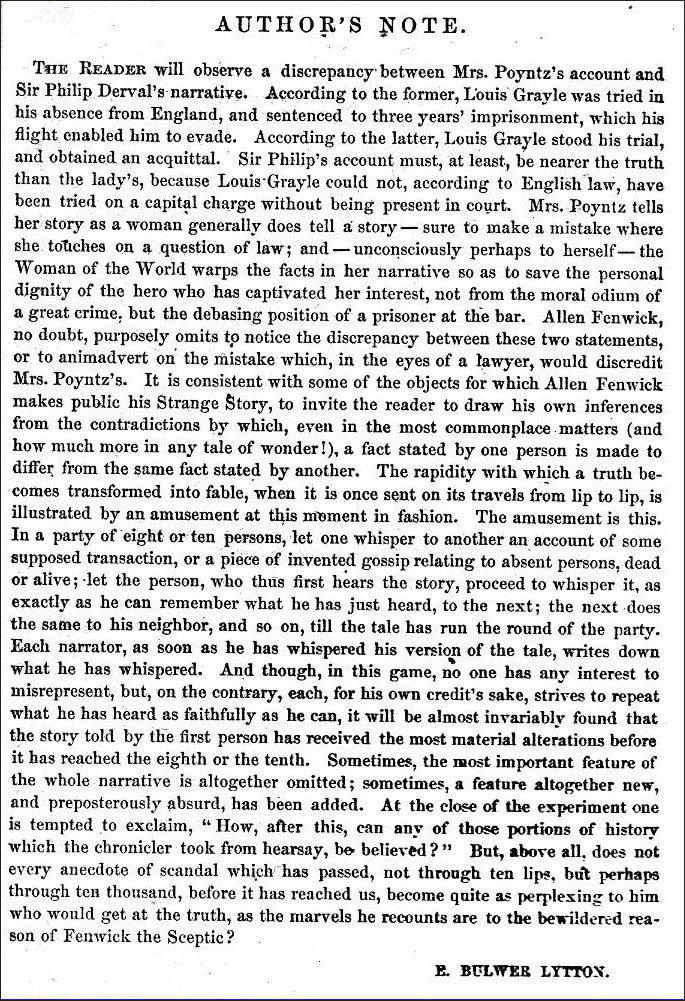
Note: See "Author's Note" from the pirated Boston edition (1862), above right, facing p. 386: "The reader will observe a discrepancy between Mrs. Poyntz's account and Sir Philip Derval's narrative."
It is consistent with some of the objects for which Allen Fenwick makes public his Strange Story, to invite the reader to draw his own inferences from the contradictions by which, even in the most commonplace matters (and how much more in any tale of wonder!), a fact stated by one person is made to differ the same fact stated by another — E. BULWER LYTTON, "Author's Note."]
Bibliography
Bulwer Lytton, Edward G. D. A Strange Story. Illustrated by John McLenan. Harper's Weekly V, 10 August — 8 March 1862.

Bulwer Lytton, Edward G. D. A Strange Story. Illustrated by F. O. Freeman and J. N. Hyde. Boston: Gardner A. Fuller, 1862.
Bulwer Lytton, Edward (Lord Lytton). A Strange Story. The Works of Edward Bulwer Lytton, Vol. VII. New York: P. F. Collier, n. d. Pp. 7-242.
Christensen, Allan Conrad. Edward Bulwer Lytton: The Fiction of New Regions. Athens, Georgia: University of Georgia Press, 1976.
Lytton, Victor A. (Lord Lytton). The Life of Edward Bulwer, First Lord Lytton. Vol. II. London: Macmillan, 1913.
Created 13 August 2005; Last updated 1 August 2026