
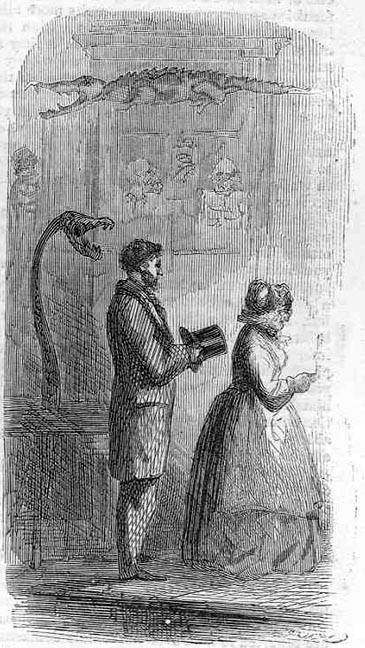
"Close where I stood yawned the open jaws of the fell anaconda."
John McLenan
10 August 1861 (opening number)
11 cm high by 6 cm wide (4 ¼ by 2 ⅜ inches) framed
Bulwer-Lytton's A Strange Story (1861-62)
Harper's Weekly 5 (10 August 1861): 497. Incident illustrated: p. 498 (Chapter 2).
Scanned image and text by Philip V. Allingham.
[You may use this image without prior permission for any scholarly or educational purpose as long as you (1) credit the person who scanned the image and (2) link your document to this URL in a web document or cite the Victorian Web in a print one.]

Passage Illustrated: Passing through Naturalist Dr. Lloyd's Foyer at the Abbots' House
A February night, sharp and bitter; an iron-gray frost below, a spectral melancholy moon above. I had to ascend the Abbey Hill by a steep, blind lane between high walls. I passed through stately gates, which stood wide open, into the garden ground that surrounded the old Abbots’ House. At the end of a short carriage-drive the dark and gloomy building cleared itself from leafless skeleton trees, — the moon resting keen and cold on its abrupt gables and lofty chimney-stacks. An old woman-servant received me at the door, and, without saying a word, led me through a long low hall, and up dreary oak stairs, to a broad landing, at which she paused for a moment, listening. Round and about hall, staircase, and landing were ranged the dead specimens of the savage world which it had been the pride of the naturalist’s life to collect. Close where I stood yawned the open jaws of the fell anaconda, its lower coils hidden, as they rested on the floor below, by the winding of the massive stairs. Against the dull wainscot walls were pendent cases stored with grotesque unfamiliar mummies, seen imperfectly by the moon that shot through the window-panes, and the candle in the old woman’s hand. And as now she turned towards me, nodding her signal to follow, and went on up the shadowy passage, rows of gigantic birds — ibis and vulture, and huge sea glaucus — glared at me in the false light of their hungry eyes.
So I entered the sick-room, and the first glance told me that my art was powerless there. [Chapter II, 498]
Commentary: A Suitably Gothic pening to the Novel
Ushered to the deathbed of his rival on Abbey Hill, Dr. Lloyd, young Dr. Allen Fenwick, brilliant, Edinburgh-trained pathologist, passes by the specimens in Dr. Lloyd's natural history collection, notably the anaconda. In front of the young physician is Doctor Lloyd's servant, carrying a candle.
The clue that the crocodile and the anaconda are not alive, but are mere specimens in a collection is the fact that Dr. Fenwick and the maid ignore them entirely. Moreover, suspended above their heads the reptile appears to float rather than swim. However, the plate admirably fulfills its main function, namely to excite the interest of the magazine reader in this introductory instalment and set the Gothic scene.
Bibliography
Bulwer-Lytton, Edward G. D. A Strange Story. Illustrated by John McLenan. Harper's Weekly V (Part 1: 10 August 1861), 498.
Victorian
Web
E. Bulwer-
Lytton
Illustra-
tion
John
McLenan
Next
Created 21 November 2007 Last updated 17 June 2026