
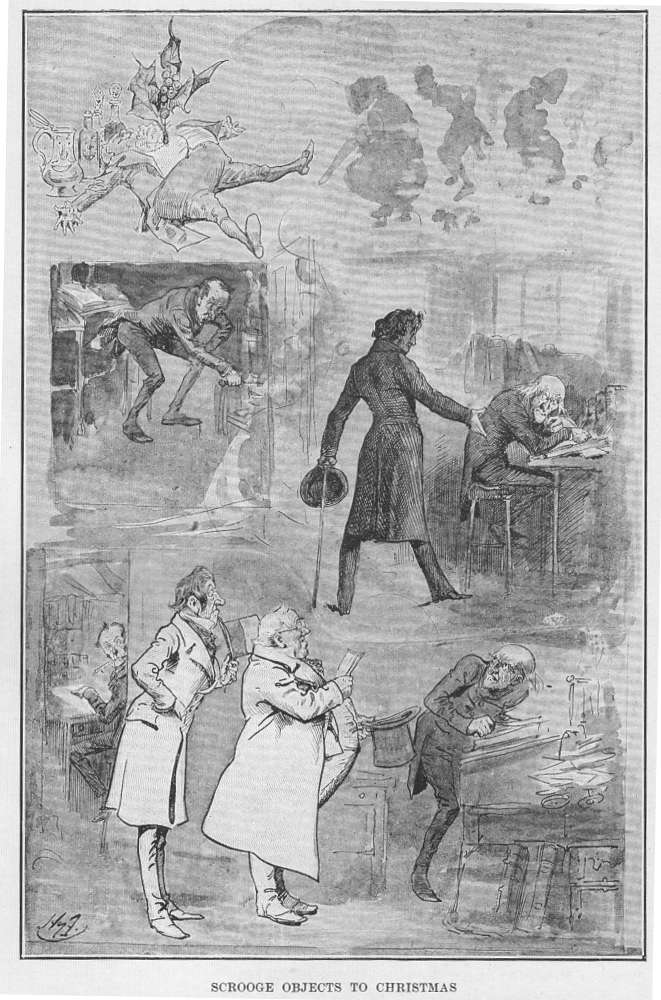
Scrooge objects to Christmas
Harry Furniss
1910
14.3 by 9.4 cm (5 ⅝ by 3 ¾ inches), framed
Second illustration for A Christmas Carol in The Christmas Books, Charles Dickens Library Edition (1910), Vol. VIII, page 2.
[Click on image to enlarge it.]
Passage Realised: "Out upon merry Christmas! If I could work my will," said Scrooge,"every idiot who goes about with 'Merry Christmas' on his lips, should be boiled with his own pudding, and buried with a stake of holly through his heart!" — Christmas Carol [Stave One, "Marley's Ghost," p. 6]
[See commentary below.]
Scanned image and text by Philip V. Allingham.
Details
- Inebriate with a stake of holly through his heart
- Fog-bound passersby in the court outside the countinghouse
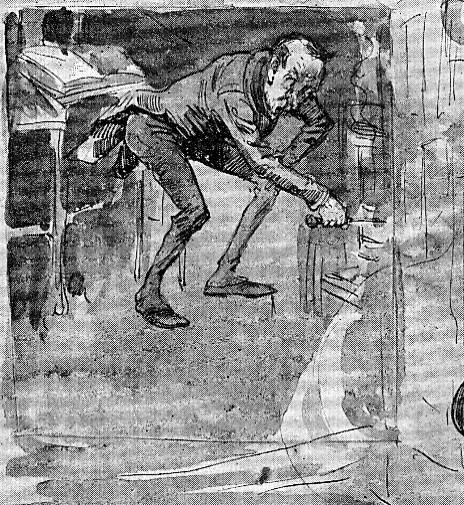
- Bob Cratchit trying to make his tiny stove function
- Nephew Fred wishes his dour uncle season's greetings
- The charity-collectors canvass Scrooge




Commentary
This amalgam of five scenes as an almost cinematic montage of connected and contiguous moments in the narrative from the initial stave emphasizes Scrooge's workaday world, with the bottom register juxtaposing Scrooge bent over his desk with the erect postures of the white-clad charity collectors (centre), whose appeal to the Utilitarian capitalist clerk Bob Cratchit in his "tank" or mere cubbyhole (left) overhears. The barren counting-house also dominates the centre, with the scowling clerk and his tiny stove (left) and the youthful form of nephew Fred confronting his miserly uncle (right) in a spartan space whose only background detail is financial ledgers. Most innovative and a sharp departure from steel- and wood-engraved illustrations in earlier editions is the top register of this lithograph, with the delightfully imagined Christmas celebrant ("idiot") — thoroughly inebriated, as the smiling flaggon and bottles (left) suggest — impaled with an oversized stake of holly to the left, and the foot-traffic outside, in the courtyard, barely discernible in the dense fog, "wheezing up and down, beating their hands upon their breasts, and stamping their feet upon the pavement-stones to warm them" (5). Davis notes that Furniss is emphasizing the crabbed, gnarled figure of Scrooge, a physically distorted state to which the illustrator draws the viewer's attention by juxtaposing this crabbed body (and by implication soul and psyche) with the erect, manly postures of Fred and the charity-collectors (dominating the centre of the bottom register), whose white clothing sharply contrasts with Scrooge's dark business-suit:
He concentrates on Scrooge, a gnarled and twisted man whose contorted body articulates his discomfort with the world, and five of the eight illustrations are based on scenes in Stave 1. The montage technique used in several of the pictures, clustering separate images into one illustration, suggests the way in which the text develops Scrooge's character by a series of images and his story by a sequence of tableaux. Juxtaposing the image of the body pinned by a stake of holly through its heart to images of the dramatic action of the story, such as Scrooge's confrontation with the charity solicitors, Furniss renders the point of view and style of the narrative as well as its plot . . . . [Davis 121]
Furniss's forcing the reader to move between scenes occurring on pages 5 (the fog), 6-7 (Fred's visit and the clerk in the tank), and 8 (the solicitation for the seasonal poor-relief fund) sets up the reader for the ensuing scenes in a proleptic (anticipatory) stance. The illustrator further implies a thematic connection between these five distinct scenes, namely that, while others enjoy the holiday (indeed, some try to make it possible for even the destitute to enjoy it, too), the covetous and egocentric can derive no enjoyment from Christmas because their own dissatisfaction colours their perception of those who would make merry as mere fools. Scrooge's inward fog prevents his apprehending the true value of Christmas.
Although Leech in the original edition depicted Bob Cratchit just once, in the heartwarming tailpiece as he and his reformed employer share a glass of Smoking Bishop before Scrooge's fireplace, Sol Eytinge in Ticknor and fields' twenty-fifth anniversary edition of 1868, and the Household Edition illustrators Fred Barnard and E. A. Abbey are all interested in the person and family of the poor clerk who aspires to better things for his children, and who knows far better than his rich employer how to keep Christmas: with childhood games, festive dishes, and a supportive family.
Related Illustrations from Earlier Editions (1867, 1869, and 1878)

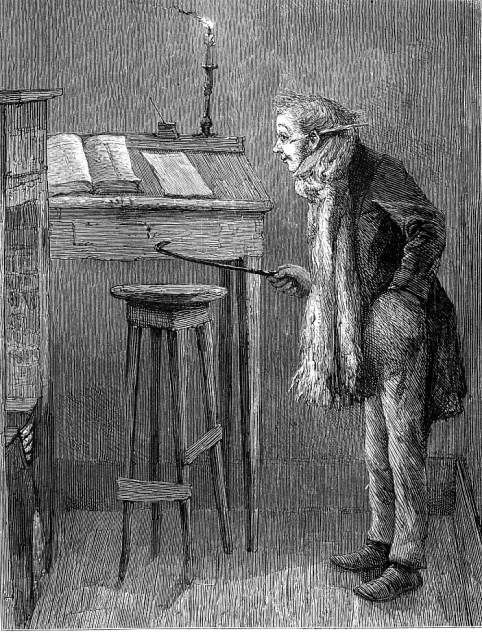

Left: Sol Eytinge, Jr.'s "The Philanthropists" (1868); centre: Eytinge's "In the Tank"; right: Fred Barnard's "It's not convenient.... you'd think yourself ill-used, I'll be bound" (1878). [Click on the images to enlarge them.]
Bibliography
Davis, Paul. The Lives and Times of Ebenezer Scrooge. New Haven: Yale U. P., 1990.
Dickens, Charles. Christmas Books, illustrated by Sol Eytinge, Junior. Diamond Edition. 14 vols. Boston: Ticknor and Fields, 1867. Vol. X.
Dickens, Charles. Christmas Books, illustrated by Fred Barnard. Household Edition. 22 vols. London: Chapman and Hall, 1878. Vol. XVII.
_____. Christmas Books, illustrated by A. A. Dixon. London & Glasgow: Collins' Clear-Type Press, 1906.
_____. Christmas Books. Illustrated by Harry Furniss. The Charles Dickens Library Edition. 18 vols. London: Educational Book, 1910. Vol. VIII.
_____. A Christmas Carol in Prose, Being a Ghost Story of Christmas. Illustrated by John Leech. London: Chapman and Hall, 1843.
_____. A Christmas Carol in Prose. Being a Ghost Story of Christmas. Illustrated by Sol Eytinge, Jr. Boston: Ticknor & Fields, 1868.
Created 30 May 2013
Last modified 3 January 2026