

Monsieur and Madame Defarge
Sol Eytinge, Jr.
Composite woodblock engraving
10 cm high by 7.5 cm wide (4 inches by 3 inches), framed
Eytinge's full-page illustration — one of only eight for the entire novel — appears in "Still Knitting" (Book Two, Chapter Sixteen) in the Diamond Edition of Dickens's A Tale of Two Cities (1867).
Scanned image and text by Philip V. Allingham.

In contrast to the marriage of mismatched opposites Jerry and "Aggerawayter" Cruncher Eytinge presents the leaders of the clandestone revolutionary society, the Jacquerie, in the Saint Antoine, the publicans or wine-shop keepers Ernest and Terese Defarge. [continued below].
The Passage Illustrated: in the Wineshp
This wine-shop keeper was a bull-necked, martial-looking man of thirty, and he should have been of a hot temperament, for, although it was a bitter day, he wore no coat, but carried one slung over his shoulder. His shirt-sleeves were rolled up, too, and his brown arms were bare to the elbows. Neither did he wear anything more on his head than his own crisply-curling short dark hair. He was a dark man altogether, with good eyes and a good bold breadth between them. Good-humoured looking on the whole, but implacable-looking, too; evidently a man of a strong resolution and a set purpose; a man not desirable to be met, rushing down a narrow pass with a gulf on either side, for nothing would turn the man.
Madame Defarge, his wife, sat in the shop behind the counter as he came in. Madame Defarge was a stout woman of about his own age, with a watchful eye that seldom seemed to look at anything, a large hand heavily ringed, a steady face, strong features, and great composure of manner. There was a character about Madame Defarge, from which one might have predicated that she did not often make mistakes against herself in any of the reckonings over which she presided. Madame Defarge being sensitive to cold, was wrapped in fur, and had a quantity of bright shawl twined about her head, though not to the concealment of her large earrings. Her knitting was before her, but she had laid it down to pick her teeth with a toothpick.
Commentary
All of these details of portraiture one may discern in this Eytinge illustration, which depicts Madame Defarge as still knitting as the spy, John Barsad, attempts to engage her and her husband in conversation. Eytinge's interpretation of the redoubtable middle-aged couple and of the impact upon them of the circumstances in which they find themselves in "Still Knitting" is more perceptive than Phiz's 1859 steel engraving The Wine-shop, in which Defarge seems at ease and his demure, beautiful young wife wholly absorbed in her knitting. On the other hand, Eytinge has a couple who are appropriate extensions of Dickens's text, for they are both more mature and less physically attractive, and better individualised, even if the Diamond Edition's illustrator, who realises little of their place of business, does not include Barsad in the picture, thereby in effect placing the viewer in Barsad's position. Under the penetrating gaze of the royalist regime's latest spy in the neighbourhood Defarge fumbles to light his pipe. The spy artfully alludes to the inhumane execution of the Marquis' assassin, Gaspard, but the wily couple refuse to commit themselves to either an opinion on his fate or even to a sympathetic comment about the death of the poor man whose child perished under the wheels of Monseigneur's speeding carriage. Unperturbed, Madame Defarge coolly appraises the interlocutor, even as she checks her coded knitting's entry for John Barsad. Before the couple lies the cognac glass that the spy has just emptied, so that we can assume that Eytinge has illustrated precisely this dialogue:
"I was saying to madame, with whom I had the pleasure of chatting when you entered, that they tell me there is — and no wonder! — much sympathy and anger in Saint Antoine, touching the unhappy fate of poor Gaspard."
"No one has told me so," said Defarge, shaking his head. "I know nothing of it."
Having said it, he passed behind the little counter, and stood with his hand on the back of his wife's chair, looking over that barrier at the person to whom they were both opposed, and whom either of them would have shot with the greatest satisfaction. [Book the First, "Recalled to Life," Chapter V, "The Wine-Shop."]
Relevant Illustrations of the Defarges from Other Editions: 1859 and 1874
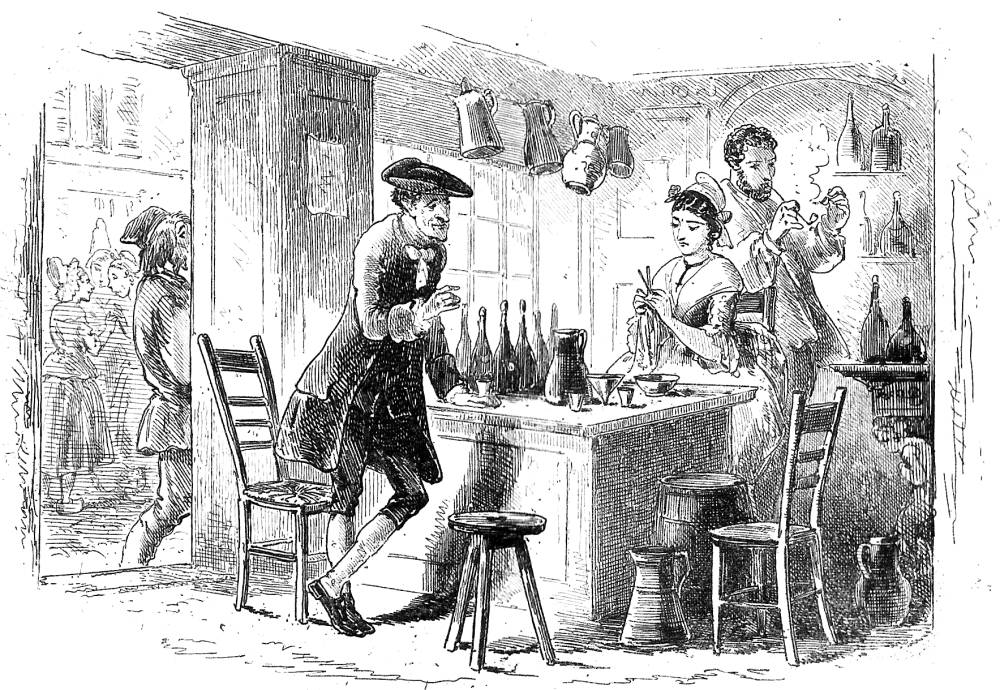
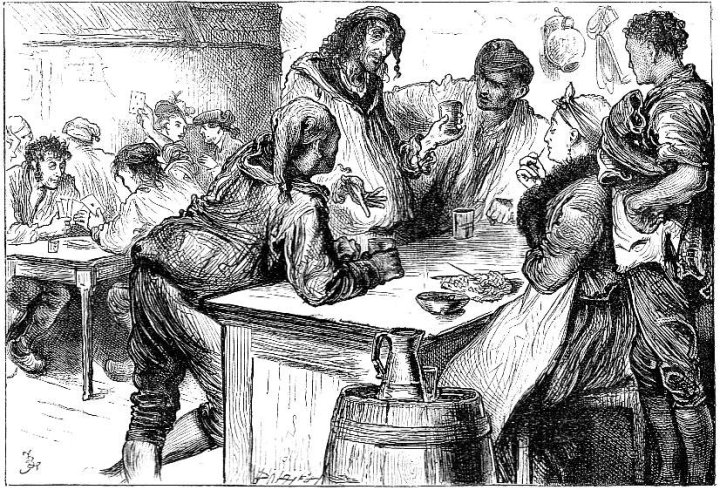
Left: Phiz's September 1859 depiction of the publicans in the social centre of the poverty-stricken suburb, The Wine-Shop. Right: A slightly later British interpretation of the St. Antoine pub, Fred Barnard's dramatic scene of the Jacques at the bar in the Household Edition, The Wine-Shop (Vol. VIII, 1874).
Scanned image and text by Philip V. Allingham. [You may use this image without prior permission for any scholarly or educational purpose as long as you (1) credit the person who scanned the image and (2) link your document to this URL in a web document or cite the Victorian Web in a print one.]
Bibliography
Dickens, Charles. A Tale of Two Cities. Ilustrated by Hablot Knight Browne. London: Chapman and Hall, 1859.
Dickens, Charles. A Tale of Two Cities and Great Expectations. Diamond Edition. Illustrated by Sol Eytinge, Junior. Boston: Ticknor and Fields, 1867.
Dickens, Charles. A Tale of Two Cities. Illustrated by Fred Barnard. The Household Edition, 22 vols. London: Chapman and Hall, 1874. Vol. VIII.
Created 12 August 2011
Last modified 16 August 2026