

Doctor Manette and His Daughter
Sol Eytinge
Composite woodblock engraving
10.2 cm high by 7.5 cm wide (4 by 2 ⅞ inches), framed.
Second illustration for Dickens's A Tale of Two Cities and Great Expectations in the Ticknor & Fields (Boston), Diamond Edition (1867).
[Click on image to enlarge it.]
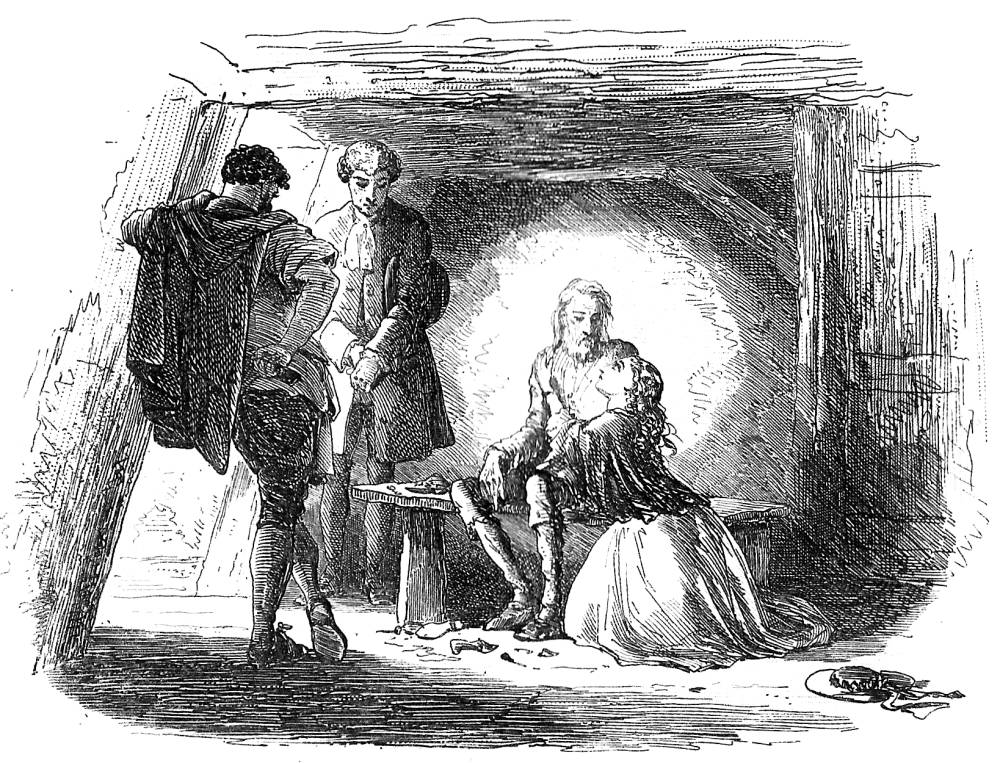
Here, we see what the St. Antoine wine-seller Ernest Defarge sees: the Doctor and his daughter, Lucie, reunited at last in the loft above the shop. Still to be fully "recalled to life," the latest Saint Antoine curiosity, the demented old shoemaker, recently released from the nearby prison-fortress, the Bastille, presents a lamentable symbol of the injustices of the Ancien Régime.

Doctor Manette and His Daughter, the second full-page illustration for the thirteenth volume of the Diamond Edition, illustrated entirely by Sol Eytinge, Jr. 10.2 cm high by 7.5 cm wide (4 by 2 ⅞ inches). Charles Dickens's A Tale of Two Cities (Boston: Ticknor and Fields, 1867).
Passage Illustrated: Liberated Physically, but not Psychologically
He stared at her with a fearful look, and after a while his lips began to form some words, though no sound proceeded from them. By degrees, in the pauses of his quick and laboured breathing, he was heard to say:
"What is this?"
With the tears streaming down her face, she put her two hands to her lips, and kissed them to him; then clasped them on her breast, as if she laid his ruined head there.
"You are not the gaoler's daughter?"
She sighed "No."
"Who are you?"
Not yet trusting the tones of her voice, she sat down on the bench beside him. He recoiled, but she laid her hand upon his arm. A strange thrill struck him when she did so, and visibly passed over his frame; he laid the knife down softly, as he sat staring at her.
Her golden hair, which she wore in long curls, had been hurriedly pushed aside, and fell down over her neck. Advancing his hand by little and little, he took it up and looked at it. In the midst of the action he went astray, and, with another deep sigh, fell to work at his shoemaking.
But not for long. Releasing his ann, she laid her hand upon his shoulder. After looking doubtfully at it, two or three times, as if to be sure that it was really there, he laid down his work, put his hand to his neck, and took off a blackened string with a scrap of folded rag attached to it. He opened this, carefully, on his knee, and it contained a very little quantity of hair: not more than one or two long golden hairs, which he had, in some old day, wound off upon his finger.
He took her hair into his hand again, and looked closely at it. "It is the same. How can it be! When was it! How was it!"
As the concentrated expression returned to his forehead, he seemed to become conscious that it was in hers too. He turned her full to the light, and looked at her.
"She had laid her head upon my shoulder, that night when I was summoned out — she had a fear of my going, though I had none — and when I was brought to the North Tower they found these upon my sleeve. 'You will leave me them? They can never help me to escape in the body, though they may in the spirit.' Those were the words I said. I remember them very well."
He formed this speech with his lips many times before he could utter it. But when he did find spoken words for it, they came to him coherently, though slowly.
"How was this? — Was it you?"
Once more, the two spectators started, as he turned upon her with a frightful suddenness. But she sat perfectly still in his grasp, and only said, in a low voice, "I entreat you, good gentlemen, do not come near us, do not speak, do not move!"
"Hark!" he exclaimed. "Whose voice was that?"
His hands released her as he uttered this cry, and went up to his white hair, which they tore in a frenzy. It died out, as everything but his shoemaking did die out of him, and he refolded his little packet and tried to secure it in his breast; but he still looked at her, and gloomily shook his head. [Book One, "Recalled to Life," Chapter VI, "The Shoe Maker"]
Commentary: Contrasting Youth and Innocence, and Age and Bitter Experience
Above: Phiz's interpretation of the same dramatic scene that opens the historical novel, The Shoemaker, for the June 1859 Chapman and Hall instalment. For a detailed discussion of the Phiz steel-engraving, see A Discussion of Phiz's June 1859 Plates.
It is entirely possible that Eytinge, working on the illustrations of the Diamond Edition volumes in 1866 and early 1867, had access to the original serial illustrations by Phiz (Hablot Knight Browne), steel engravings which month by month (at least, until the latter part of the novel's British serialisation) Dickens had sanction, and which therefore reflected his narrative intentions. One of these, The Shoemaker (above), resembles Eytinge's illustration in its locale and subject, although Phiz's earlier plate is markedly different in its composition for it suggests a staging rather than a closeup. Aside from the two principal figures, present in Phiz's full-page steel-engraving are the publican, Ernest Defarge, formerly the Doctor's servant (back towards the viewer, left), and, facing him, the somber Tellson's banker, Jarvis Lorry, standing beside the shoemaker's bench. Lucie Manette, having left her hat on the floor (right), caresses her father, who as yet has not apprehended who his fair-haired young visitor is. Although the stark garret above the wine-shop in poverty-stricken St. Antoine is dark, light from a window (off-left) illuminates the scene, implying that the light of sanity will gradually return to the prisoner of No. 105, North Tower, in the infamous prison, his address having displaced his identity after some eighteen years of solitary incarceration.
Now, contrast the original 1859 illustration with that of Eytinge, which focuses more narrowly on the emotional impact of the reunion of father and daughter. Despite his mental vacuity and white beard, Eytinge's former Bastille prisoner and medical practitioner is better dressed and has the tools of his prison trade immediately about him. Although he is temporarily resident in a room above the Defarges' wine-shop in Saint Antonine as in Phiz's plate, the viewer has little sense of the backdrop, other than the sloping roof of the garret. An interesting aspect of this early illustration is that Eytinge has deliberately made young Lucie resemble the little seamstress of the frontispiece, as if suggesting how Carton could so easily bond with a young woman whom he has only just met — note in particular, her rounded face and her streaming hair, which is both longer and lighter in Eytinge's illustration than in Phiz's original. The 1867 picture reflects the artist's intention to depict the depth of Lucie's attachment to her long-lost father. The juxtaposition and postures of the solid, realistically modelled figures suggests that Eytinge has chosen to realise the moment at which Dr. Manette, recalled to life, is now recalled to the present after an absence of almost two decades by the "golden thread" of his daughter's hair, so like that of his deceased wife.
Scanned image and text by Philip V. Allingham. [You may use this image without prior permission for any scholarly or educational purpose as long as you (1) credit the person who scanned the image and (2) link your document to this URL in a web document or cite the Victorian Web in a print one.]
Bibliography
Allingham, Philip V. "'Charles Dickens's A Tale of Two Cities (1859) Illustrated: A Critical Reassessment of Hablot Knight Browne's Accompanying Plates." Dickens Studies. 33 (2003): 109-158.
Dickens, Charles. A Tale of Two Cities. Illustrated by Hablot Knight Browne ("Phiz"). London: Chapman and Hall, November 1859.
Dickens, Charles. A Tale of Two Cities and Great Expectations. Illustrated by Sol Eytinge, Jr. The Diamond Edition. 14 vols. Boston: Ticknor and Fields, 1867. Vol. XIII.
Dickens, Charles. A Tale of Two Cities. Illustrated by Fred Barnard. The Household Edition. 22 vols. London: Chapman and Hall, 1874. Vol. VIII.
Created 29 January 2011 Last modified 3 December 2025