

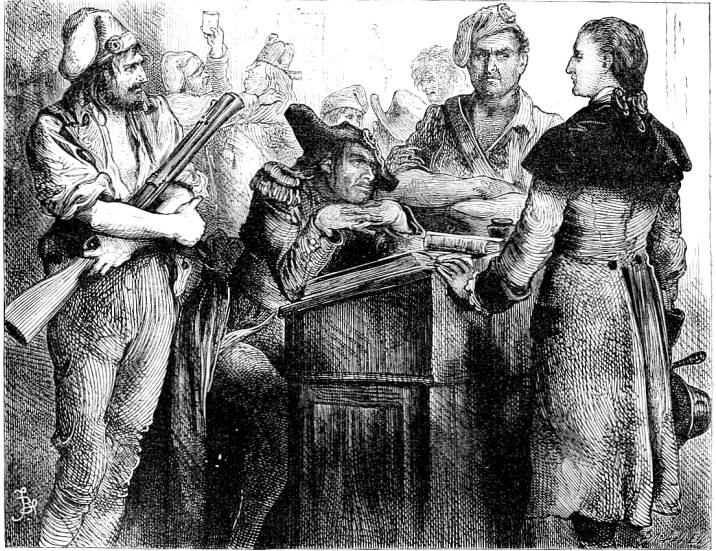
“You are consigned to La Force.”
A. A. Dixon
1905
Watercolor as lithograpgh
11.9 cm high by 8 cm wide (7 ⅛ inches high by by 5 inches wide), framed
Ninth illustration for Collins edition, facing p. 321.
Book III, “The Track of the Storm,” Ch. 1, “In Secret,” p. 301; Penguin edition p. 280; Oxford World's Classics edition p. 307. The tribunal passes judgment upon Darnay.
Scanned image and text by Philip V. Allingham.

Passage Realised: Emigrant Evrémonde Unjustly Consigned to a Revolutionary Prison
“Citizen Defarge,” said he to Darnay’s conductor, as he took a slip of paper to write on. “Is this the emigrant Evrémonde?”
“This is the man.”
“Your age, Evrémonde?”
“Thirty-seven.”
“Married, Evrémonde?”
“Yes.”
“Where married?”
“In England.”
“Without doubt. Where is your wife, Evrémonde?”
“In England.”
“Without doubt. You are consigned, Evrémonde, to the prison of La Force.”
“Just Heaven!” exclaimed Darnay. “Under what law, and for what offence?”
The officer looked up from his slip of paper for a moment. [Book III, “The Track of the Storm,” Ch. 1, “In Secret,” p. 307]
Commentary: The Well-intentioned Aristocrat Arrested to be Held in Secret
Darnay is to be buried, like Dr. Manette's manuscript, having come to paris to rescue the Evre´monde family's steward Gabelle. He realised, all too late, that he would be judged an enemy of the Revolution when the gatekeepers at the wall addressed him as "the prisoner." The "trial," then, is perfunctory: his fate has already been determined since a recently passed edict now classes all emigres as enemies of the Republic.
The illustration, then, must telegraph to the reader Darnay's new status in order to raise suspense. The lithograph paints Darnay as the noble, upright, and intellectual protagonist, for the moment displacing Carton as the reader's chief interest. Although those against him in the military tribunal as not as disreputable as previous illustrators such as Phiz (1859) and Barnard (1874) have represented them, by their dress and postures they reveal themselves unsuitable to administer even revolutionary statutes. Their careless attitudes and slovenly dress suggest that Darnay cannot expect to be treated fairly, let alone with compassion, by these representatives of the lowest members of the Fourth Estate. Thus, Dixon subtly spells Darnay's doom. One proletaraian raises a cup to toast Darnay's sentence; another carries a pike, suggestive of the blade of the guillotine.
Relevant Illustrations of the Defarges from Other Editions: 1859 and 1874

Left: Phiz's September 1859 depiction of the arbitrary sentencing of Darnay, Before the Prison Tribunal. Right: A slightly later British interpretation of the St. Antoine pub, Fred Barnard's version of Darnay's confronting a predatory "magistrate" in uniform and two Jacques at the tribunal in the Household Edition, Some registers were lying open on a desk (Vol. VIII, 1874).
Other Illustrated Editions (1859-1910)
- Hablot K. Brown or 'Phiz' (16 monthly steel-engravings)
- John McLenan (64 wood-engravings, 1859)
- Sol Eytinge, Junior (8 wood-engravings, 1867)
- Fred Barnard (25 wood-engravings, 1874)
- Harry Furniss (32 lithographs, 1910)
Related Material
- A Tale of Two Cities 1859 — the last Dickens's novel "Phiz" Illustrated
- How did Victorian critics define the historical novel?
- Images of the French Revolution
- A Tale of Two Cities (1859): A Model of the Integration of History and Literature
- Costume Notes on A Tale of Two Cities
Bibliography
Allingham, Philip V. "Charles Dickens's A Tale of Two Cities (1859) Illustrated: A Critical Reassessment of Hablot Knight Browne's Accompanying Plates." Dickens Studies. 33 (2003): 109-158.
Dickens, Charles. A Tale of Two Cities. Illustrated by John McLenan. Harper's Weekly: A Journal of Civilization, 7 May through 3 December 1859.
Dickens, Charles. A Tale of Two Cities. Ilustrated by Hablot Knight Browne. London: Chapman and Hall, 1859.
Dickens, Charles. A Tale of Two Cities and Great Expectations. Diamond Edition. Illustrated by Sol Eytinge, Junior. Boston: Ticknor and Fields, 1867.
Dickens, Charles. A Tale of Two Cities. Illustrated by Fred Barnard. The Household Edition, 22 vols. London: Chapman and Hall, 1874. Vol. VIII.
Dickens, Charles. A Tale of Two Cities. Illustrated by A. A. Dixon with an engraved title by Harry Furniss. London: Collins, 1905. (From the personal collection of George Gorniak, Editor of The Dickens Magazine.)
Dickens, Charles. A Tale of Two Cities, American Notes, and Pictures from Italy. Illustrated by Harry Furniss. Charles Dickens Library Edition. 18 vols. London: Educational Book Company, 1910. Vol. XIII.
Created 2 November 2013
Last updated 31 August 2026