

“Patriots and friends, we are ready.”
A. A. Dixon
1905
Watercolour as lithograph
12.2 cm high by 8 cm wide (4 ¾ inches by 3 ⅛ inches), framed
Seventh illustration for Collins edition, facing p. 225.
Book II, “The Golden Thread,” Ch. 21, “Echoing Footsteps,” p. 259. Penguin edition p. 245. Oxford World's Classics edition p. 263. The St. Antoine mob prepares to assault the Bastille.
Scanned image and text by Philip V. Allingham.

Passage Realised: The Defarges Lead St. Antoine against The Bastille (14 July 1789)
As a whirlpool of boiling waters has a centre point, so, all this raging circled round Defarge’s wine-shop, and every human drop in the caldron had a tendency to be sucked towards the vortex where Defarge himself, already begrimed with gunpowder and sweat, issued orders, issued arms, thrust this man back, dragged this man forward, disarmed one to arm another, laboured and strove in the thickest of the uproar.
“Keep near to me, Jacques Three,” cried Defarge; “and do you, Jacques One and Two, separate and put yourselves at the head of as many of these patriots as you can. Where is my wife?”
“Eh, well! Here you see me!” said madame, composed as ever, but not knitting to-day. Madame’s resolute right hand was occupied with an axe, in place of the usual softer implements, and in her girdle were a pistol and a cruel knife.
“Where do you go, my wife?”
“I go,” said madame, “with you at present. You shall see me at the head of women, by-and-bye.”
“Come, then!” cried Defarge, in a resounding voice. “Patriots and friends, we are ready! The Bastille!”
With a roar that sounded as if all the breath in France had been shaped into the detested word, the living sea rose, wave on wave, depth on depth, and overflowed the city to that point. Alarm-bells ringing, drums beating, the sea raging and thundering on its new beach, the attack began. [Book the Second, "The Golden Tread," Chapter XXI, "Echoing Footsteps," pp. 258-259]
Commentary: The Attack on the Bastille Begins in Poverty-stricken St. Antoine
Dixon foregrounds the activities of a purely fictional character, Ernest Defarge. Leading the St. Antoine mob, he carries out the historical attack on the prison-fortress, symbol of the centuries of injustice under the Bourbons. His object (not made plain in the Dixon lithograph) is the former residence of Dr. Manette, 105 North Tower. Dixon, however, is caught up in the revolutionary fervour of The Defarges, with the publican in Jacobin hat raising a sword (presumably stolen from an arms cache), upper centre, and his wife carefully watching (right) at the door of the wineshop, markedly not knitting as she throws herself into the action in a supervisory role. Muskets are not being distributed yet, but the holder of the purloined swords struggles to pick up one that he has dropped, although such a moment does not occur on the page indicated in the plate's caption (p. 259). This scene, combining the real and the imagined, is the essence of the genre of the Historical Novel, the only other example from Dickens being Barnaby Rudge — A Tale of the Riots of 'Eighty (1841).
As in other historical fiction of the Victorian period, in A Tale of Two Cities, the historical events depicted were at least fifty years in the past (seventy in the case of this Dickens novel), out of living memory, and the plot is very much a blend of the purely fictional and the well-researched historical, Dickens's primary source being Thomas Carlyle's The French Tale Revolution (1837). See in particular Chapter VII, "The Fall of the Bastille," whose opening line Dixon has echoed in his caption for this lithograph.
Relevant Illustrations of the Defarges from Other Editions: 1859 and 1874
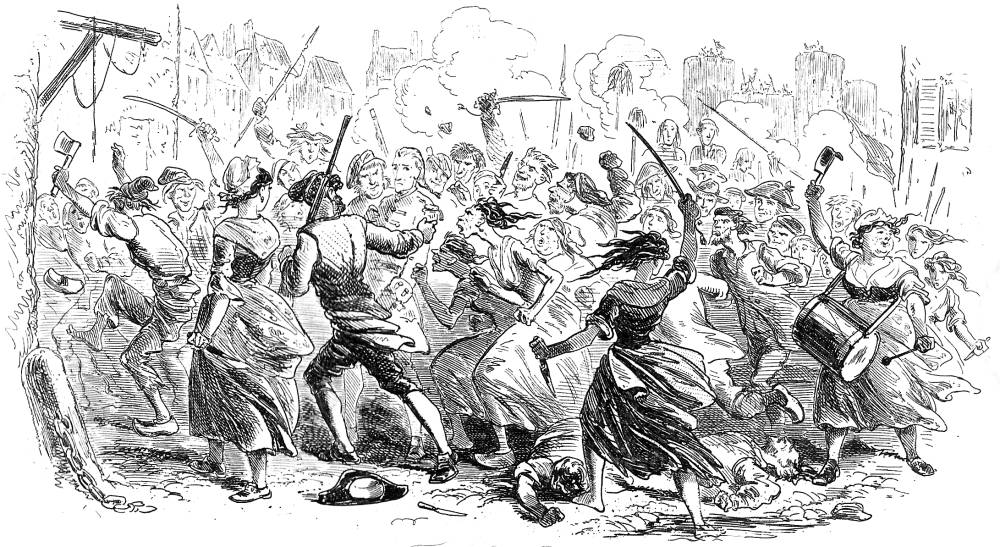
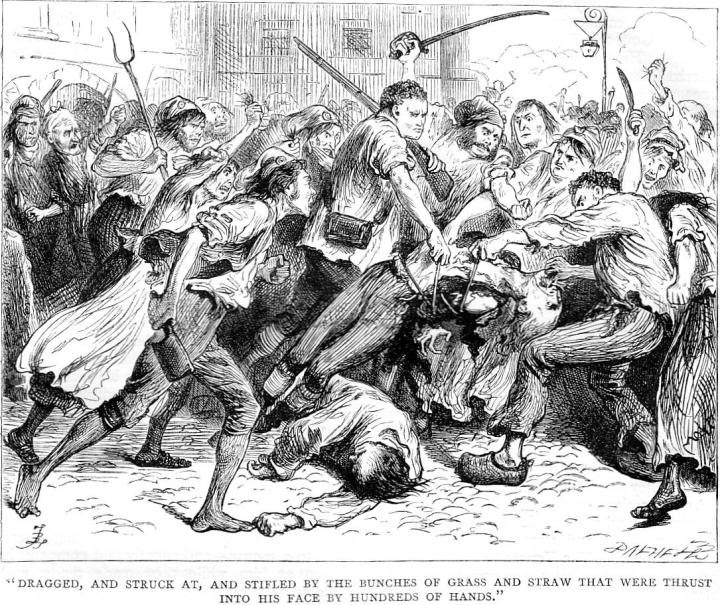
Left: Phiz's October 1859 depiction of the St. Antoine mob's storming the Bastille as it tears Foulon to pieces, The Sea Rises. Right: A slightly later British interpretation of the denizens' of St. Antoine storming the prison-fortress, Fred Barnard's dramatic scene of the attack on the Bastille and the lynching of the royalist Finance Minister, Joseph Foulon, in the Household Edition, Dragged, and struck at, and stifled by the bunches of grass and straw that were thrust into his face by hundreds of hands. (Vol. VIII, 1874).
Other Illustrated Editions (1859-1910)
- Hablot K. Brown or 'Phiz' (16 monthly steel-engravings)
- John McLenan (64 wood-engravings, 1859)
- Sol Eytinge, Junior (8 wood-engravings, 1867)
- Fred Barnard (25 wood-engravings, 1874)
- Harry Furniss (32 lithographs, 1910)
Related Material
- A Tale of Two Cities 1859 — the last Dickens's novel "Phiz" Illustrated
- How did Victorian critics define the historical novel?
- Images of the French Revolution
- A Tale of Two Cities (1859): A Model of the Integration of History and Literature
- Costume Notes on A Tale of Two Cities
Bibliography
Allingham, Philip V. "Charles Dickens's A Tale of Two Cities (1859) Illustrated: A Critical Reassessment of Hablot Knight Browne's Accompanying Plates." Dickens Studies. 33 (2003): 109-158.
Dickens, Charles. A Tale of Two Cities. Illustrated by John McLenan. Harper's Weekly: A Journal of Civilization, 7 May through 3 December 1859.
Dickens, Charles. A Tale of Two Cities. Ilustrated by Hablot Knight Browne. London: Chapman and Hall, 1859.
Dickens, Charles. A Tale of Two Cities and Great Expectations. Diamond Edition. Illustrated by Sol Eytinge, Junior. Boston: Ticknor and Fields, 1867.
Dickens, Charles. A Tale of Two Cities. Illustrated by Fred Barnard. The Household Edition, 22 vols. London: Chapman and Hall, 1874. Vol. VIII.
Dickens, Charles. A Tale of Two Cities. Illustrated by A. A. Dixon with an engraved title by Harry Furniss. London: Collins, 1905. (From the personal collection of George Gorniak, Editor of The Dickens Magazine.)
Dickens, Charles. A Tale of Two Cities, American Notes, and Pictures from Italy. Illustrated by Harry Furniss. Charles Dickens Library Edition. 18 vols. London: Educational Book Company, 1910. Vol. XIII.
Created 2 November 2013
Last updated 31 August 2026