

Frontispiece: “Is it bright enough now?”
Arthur A. Dixon
1906
Lithographic reproduction of a watercolour
12.3 cm high by 8.1 cm wide (4 ⅞ by 3 ¼ inches)
Initial illustration for Little Dorrit, Collins' Pocket Edition (1906), facing title-page, referencing p. 831.
[Click on image to enlarge it and mouse over text for links.]
Scanned image and text by Philip V. Allingham.

Passage Illustrated from the Final Chapter XXXIV, “Gone.”
‘My dear love,’ said Arthur. ‘Why does Maggy light the fire? We shall be gone directly.’
‘I asked her to do it. I have taken such an odd fancy. I want you to burn something for me.’
‘What?’
‘Only this folded paper. If you will put it in the fire with your own hand, just as it is, my fancy will be gratified.’
‘Superstitious, darling Little Dorrit? Is it a charm?’
‘It is anything you like best, my own,’ she answered, laughing with glistening eyes and standing on tiptoe to kiss him, ‘if you will only humour me when the fire burns up.’
So they stood before the fire, waiting: Clennam with his arm about her waist, and the fire shining, as fire in that same place had often shone, in Little Dorrit’s eyes. ‘Is it bright enough now,’ said Little Dorrit. ‘Does the charm want any words to be said?’ asked Arthur, as he held the paper over the flame. ‘You can say (if you don’t mind) “I love you!”’ answered Little Dorrit. So he said it, and the paper burned away. [Chapter XXXIV, “Gone,” pp. 830-831]
Commentary: Thrust Forward to the Last Chapter with the Burning of the Codicil
As is characteristic of the frontispieces for the Collins Pocket Edition volumes, Dixon here thrusts readers towards the very termination of the narrative, the final chapter in which the newlyweds John Clennam and Little Dorrit quit the Marshalsea, and descend into the busy city street to participate as fully functioning members of society. The image of John and Amy (for these are the figures clearly represented, with Amy in bridal white) at the fireplace naturally provokes such questions in the reader's mind as, “What paper are they burning in the fireplace, and where is this well-furnished parlour?”
The paper that Amy and Arthur burn in the grate is in fact (although unbeknownst to Arthur) Little Dorrit's fortune. It is the focus of her realisation that she and her husband should begin their marriage as economic equals, even if doing so means renouncing the inheritance that she has been left in the codicil. The background to her gesture is Arthur Clennam's wealthy uncle's having left a bequest to Arthur's biological mother and the youngest daughter of her patron, Frederick Dorrit, or, if he has no daughter, his niece. All of this backstory of Arthur Clennam's natural mother constitutes a massive plot complication. However, Amy resolves the inheritance issue by destroying her means of asserting her right to it. By implication, then, "Riches" (the title of the second book) constitute a burden and an impediment to happiness. Ruined in Merdle's financial collapse, Arthur will now be on the sane economic footing as his wife. The frontispiece thus establishes not merely that the chief concern of many of the novel's characters will be the acquisition of material wealth, but rather that the true happiness in life lies in realising the possibilities of romance, thereby rendering Amy and Arthur rather than the Dorrits and Mrs. Clennam the novel's focal characters. This is the story's happy ending.
Pertinent illustrations in three other British editions: 1857, 1873, and 1910

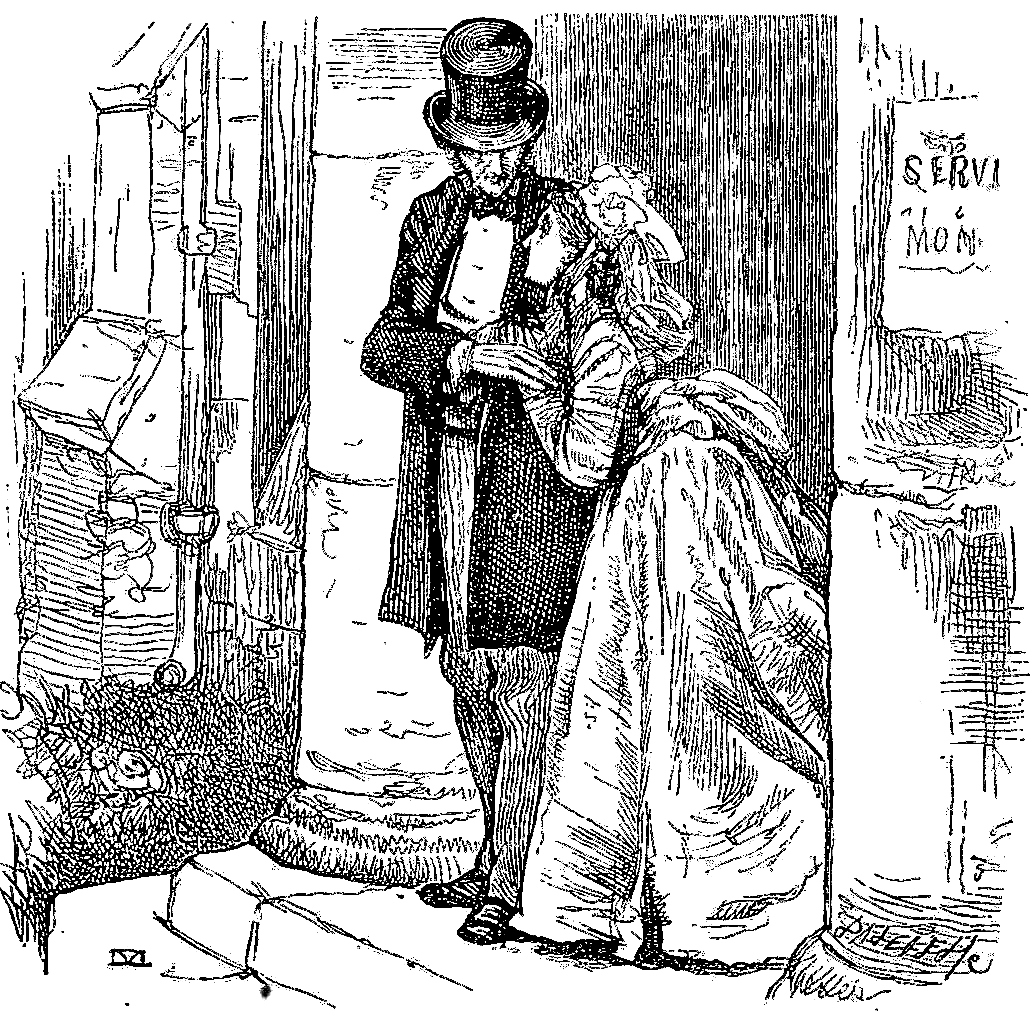
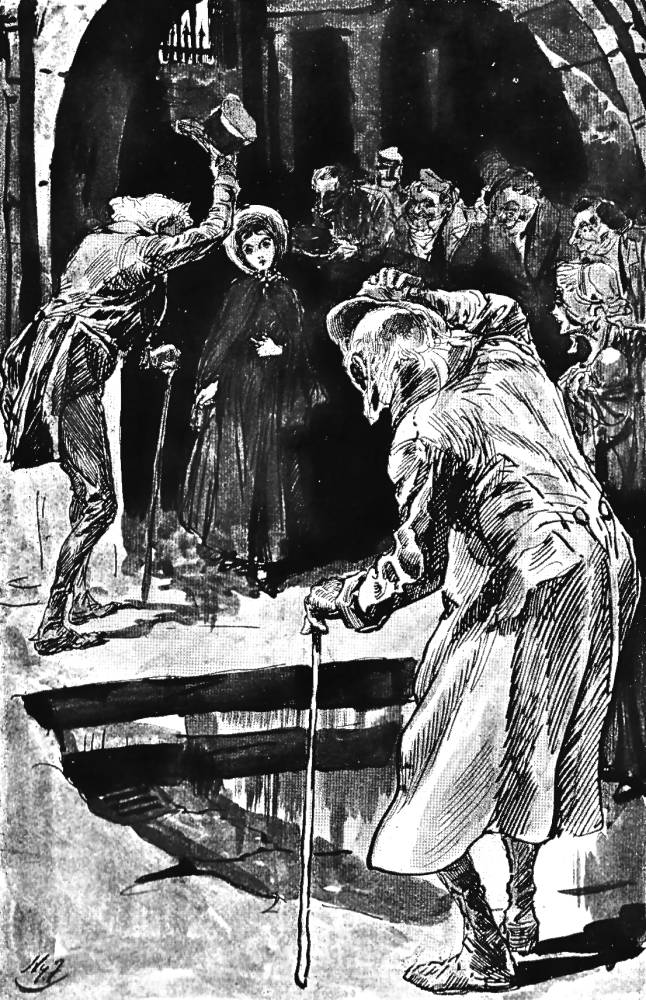
Left: Phiz's original serial illustration of leaving debtor's prison in the title-page vignette, with only a turnkey to see her off, Little Dorrit leaving The Marshalsea (June 1857). Centre: James Mahoney's version of the closing of the novel, with Arthur and Amy Clennam leaving St. George's Chapel with little fanfare, Little Dorrit and Arthur Clennam leaving the church (Household Edition, 1873). Right: Harry Furniss's treatment of the same subject: Little Dorrit, frontispiece for the 1910 edition.
Related Material: The Other Illustrated Editions (1863 — 1910)
- Illustrations by "Phiz" (Hablot Knight Browne) for Little Dorrit (December 1855 — June 1857)
- James Mahoney's 58 illustrations for Dickens's Little Dorrit (1873)
- Harry Furniss's 29 illustrations for Dickens's Little Dorrit (1910)
- Charles Dickens's Little Dorrit (1857): Site Map
- Felix Octavius Carr Darley — three engraved frontispieces, volumes 1, 2, and 4: 1863)
- Illustrations by Sol Eytinge, Jr. — 16 plates from the Ticknor and Fields' Diamond Edition (1867)
Bibliography
Dickens, Charles. Little Dorrit. Illustrated by Hablot Knight Browne ("Phiz"). The Authentic Edition. London: Chapman and Hall, 1901 [rpt. 30 May 1857 volume].
Dickens, Charles. Little Dorrit. Frontispieces by Felix Octavius Carr Darley and Sir John Gilbert. The Household Edition. 55 vols. New York: Sheldon & Co., 1863. 4 vols.
Dickens, Charles. Little Dorrit. Illustrated by Sol Eytinge, Jr. The Diamond Edition. 14 vols. Boston: Ticknor & Fields, 1867.
Dickens, Charles. Little Dorrit. Illustrated by James Mahoney. The Household Edition. 22 vols. London: Chapman and Hall, 1873. Vol. V.
Dickens, Charles. Little Dorrit. Illustrated by A. A. Dixon. With an engraved title by Harry Furniss. London and Glasgow: Collins Clear-Type Press, 1906.
Dickens, Charles. Little Dorrit. Illustrated by Harry Furniss. The Charles Dickens Library Edition. 18 vols. London: Educational Book, 1910. Vol. XII.
Created 5 September 2026