

The Ghosts of Departed Usurers, or, The Phantoms —
John Leech
1843
Wood engraving dropped into letterpress
9.5 by 6.3 cm (4 ⅝ inches by 2 ½ inches), vignetted
Dickens's A Christmas Carol, first edition (1843), "Marley's Ghost," page 37.
Leech's illustration reveals to Scrooge what he will become after death, a mere spectre, unable to intervene for good in the lives of people less fortunate than himself. A homeless woman, whom he would have ignored prior to this night of ghostly visitations, attempts to find shelter in the doorway of a building opposite. The ghosts of the departed usurers are agitated because their insubstantial condition prohibits them from alleviating the poor woman's suffering; hence, Leech includes area-railings between the spirits and the pauper to draw the line between the visible and the "invisible" world.
[Click on the image to enlarge it.]
Passage Illustrated: "The misery with them all was, clearly, that they sought to interfere"
The apparition walked backward from him; and at every step it took, the window raised itself a little, so that when the spectre reached it, it was wide open. It beckoned Scrooge to approach, which he did. When they were within two paces of each other, Marley's Ghost held up its hand, warning him to come no nearer. Scrooge stopped.
Not so much in obedience, as in surprise and fear: for on the raising of the hand, he became sensible of confused noises in the air; incoherent sounds of lamentation and regret; wailings inexpressibly sorrowful and self-accusatory. The spectre, after listening for a moment, joined in the mournful dirge; and floated out upon the bleak, dark night.
Scrooge followed to the window: desperate in his curiosity. He looked out.
The air was filled with phantoms, wandering hither and thither in restless haste, and moaning as they went. Every one of them wore chains like Marley's Ghost; some few (they might be guilty governments) were linked together; none were free. Many had been personally known to Scrooge in their lives. He had been quite familiar with one old ghost, in a white waistcoat, with a monstrous iron safe attached to its ankle, who cried piteously at being unable to assist a wretched woman with an infant, whom it saw below, upon a door-step. The misery with them all was, clearly, that they sought to interfere, for good, in human matters, and had lost the power for ever.
Whether these creatures faded into mist, or mist enshrouded them, he could not tell. But they and their spirit voices faded together; and the night became as it had been when he walked home.
Scrooge closed the window, and examined the door by which the Ghost had entered. It was double-locked, as he had locked it with his own hands, and the bolts were undisturbed. He tried to say "Humbug!" but stopped at the first syllable. And being, from the emotion he had undergone, or the fatigues of the day, or his glimpse of the Invisible World, or the dull conversation of the Ghost, or the lateness of the hour, much in need of repose; went straight to bed, without undressing, and fell asleep upon the instant. [Stave I, "Marley's Ghost," pp. 36-37]
Commentary: When the Hungry Forties Were at Their Height
Doubtless Dickens's first readers needed no melodramatic illustration dropped into the text to remind themselves of the misery and privation only steps away from their respectable doorsteps throughout urban Britain. In an interesting and far more sensational chromolithograph based on this Leech wood-engraving, twentieth-century illustrator Michael Cole has elaborated on the figure of the leading shackled miser in the white waistcoat. A laughing, horned demon grabs him around the shoulders, preventing him from touching the bonneted woman, crying on the middle-class, urban doorstep. But the evil responsible for such suffering is hardly metaphysical, as Dickens makes clear with his parenthetical quip abut "guilty governments" (36): the agrarian policies known as The Corn Laws (1814-46) have rendered grain specifically and food in general too expensive for the urban poor, and the mechanization of factories is throwing mechanics out of work. As its placement in the sequence of chapters ("staves") suggests, this composite woodblock engraving is very much "of the present." However, it is also transitional, in that Scrooge only becomes aware of the misery around him (literally, across the street) once Marley has opened the supernatural portal of dramatised memories. In his 1915 illustrations, Arthur Rackham intensifies the connection between scowling Scrooge at his window and the emotionally overwrought spirits without in The air was filled with phantoms, wandering hither and thither in restless haste, and moaning as they went. "Nearly all the Victorian reviews and adaptations characterize Scrooge simply as 'the miser'" (Davis, 48). After all, one of the most popular adaptations of the novella was not entitled simply A Christmas Carol, but had an "or" attached: or, The Miser's Warning: A Drama in Two Acts (first produced on stage on 5 February 1844) by C. Z. Barnett (published in Dicks Standard Plays, No. 722). Logically, then, in 1843 readers would have immediately stereotyped Scrooge, and would therefore have understood the connection between the scowling miser at his window and the whining, chain-rattling phantoms of misers in the street below.
The spirits of misers and usurers (in other words, deceased Utilitarian-minded businessmen very much of Scrooge's stamp) are purgatorial figures. The cause of their supreme misery is that they are powerless to intervene in the affairs of the living. To escape this Purgatorial impotence Marley needs Scrooge's help; he must effect the spiritual reclamation of his former partner (a reflection of Marley's living self) by persuading him "to interfere, for good, in human matters," since chained, lugubrious, insubstantial Marley, formerly a usurer and miser like Scrooge, has "lost the power for ever" to effect change in the mortal world. He had neglected the real "business of life" in favour of the pursuit of profit.
One did not need to understand the laws of political economy or know the sociology of industrial England to recognize the miser hoarding his gold. While this conventional reading over-simplified Scrooge's character sand his role in the story, he was not, to the Victorians, the emotional center of the tale. That place was held by the Cratchit family. [Davis, 48]
Related Socially Realistic Illustrations from Other Editions (1868-1910)


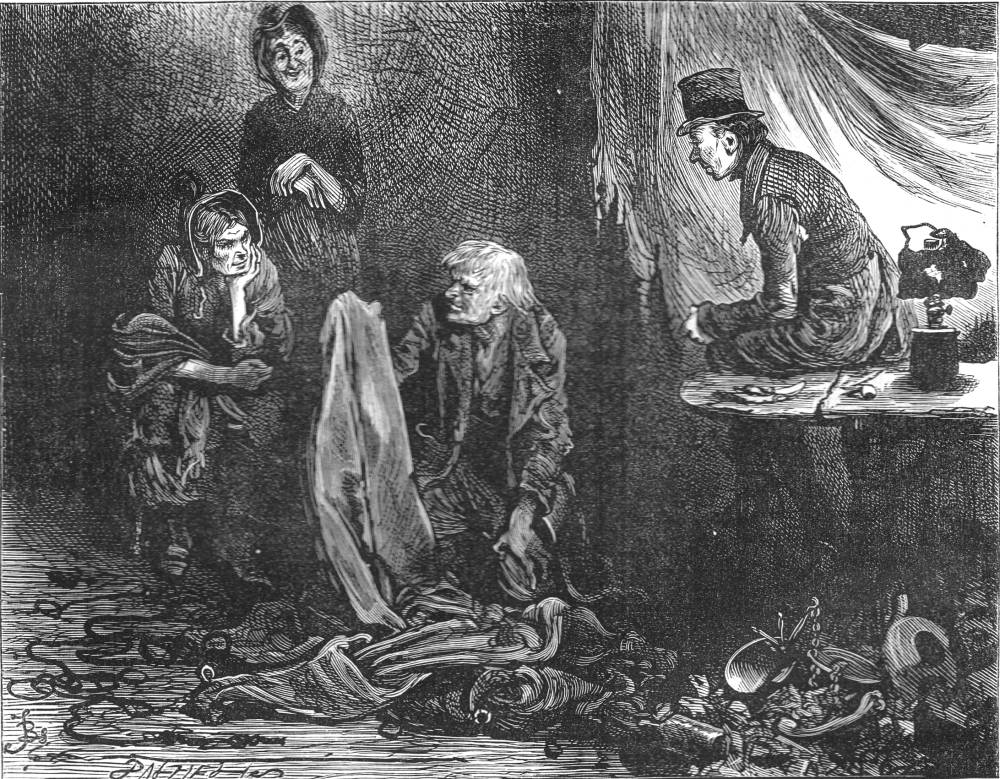
Left: Harry Furniss's Phantoms in the Street (1910); centre: Sol Eytinge, Jr.'s Want and Ignorance (1868); and, right, Fred Barnard's "What do you call this?" said Joe. "Bed-curtains?" (1878). [Click on the images to enlarge them, and for more information about them.]
Bibliography
Davis, Paul. The Lives and Times of Ebebnezer Scrooge. New Haven and London: Yale University Press, 1990.
Dickens, Charles. Christmas Books and Sketches by Boz Illustrative of Every-day Life and Every-day People, illustrated by Sol Eytinge, Junior. Diamond Edition. 14 vols. Boston: Ticknor and Fields, 1867. Vol. X.
Dickens, Charles. Christmas Books, illustrated by Fred Barnard. Household Edition. 22 vols. London: Chapman and Hall, 1878. Vol. XVII.
_____. Christmas Books. Illustrated by Harry Furniss. The Charles Dickens Library Edition. 18 vols. London: Educational Book, 1910. Vol. VIII.
_____. Christmas Books, illustrated by A. A. Dixon. London & Glasgow: Collins' Clear-Type Press, 1906.
_____. A Christmas Carol in Prose, Being a Ghost Story of Christmas. Illustrated by John Leech. London: Chapman and Hall, 1843.
_____. A Christmas Carol in Prose: Being a Ghost Story of Christmas. Illustrated by Sol Eytinge, Jr. Boston: Ticknor & Fields, 1868.
_____. A Christmas Carol in Prose, Being A Ghost Story of Christmas. Illustrated by John Leech. (1843). Rpt. in Charles Dickens's Christmas Books, ed. Michael Slater. Hardmondsworth: Penguin, 1971, rpt. 1978.
_____. A Christmas Carol. Illustrated by Charles Green, R. I. London: A & F Pears, 1912.
_____. Christmas Stories. Illustrated by E. A. Abbey. The Household Edition. 16 vols. New York: Harper and Brothers, 1876. Vol. III.
_____. A Christmas Carol. Illustrated by Arthur Rackham. London: William Heinemann, 1915.
_____. A Christmas Carol. Illustrated by Michael Cole. London: Pagoda, 1985.
Created 5 March 2014
Last updated 21 October 2026