
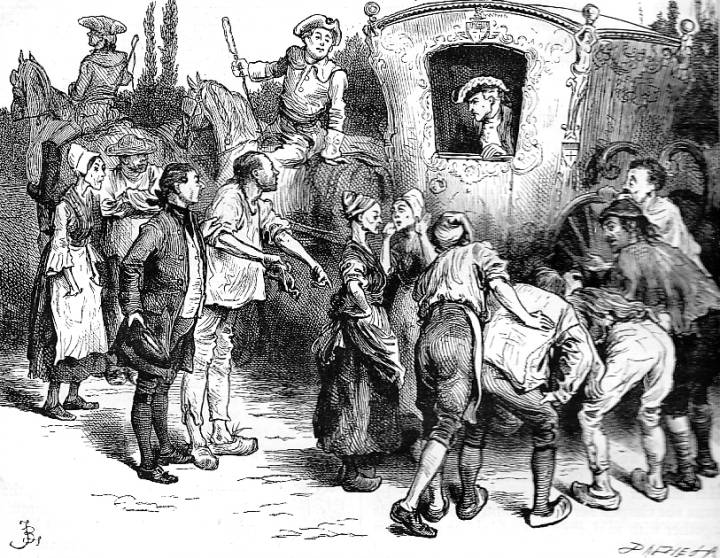
The ninth of Fred Barnard's twenty-five composite woodblock engravings in the eighth volume of the Household Edition of the Works of Charles Dickens: A Tale of Two Cities (1874), Book the Second, "The Golden Thread," Chapter VIII, "Monseigneur in the Country": He stooped a little, and with his tattered blue cap pointed under the carriage. All his fellows stooped to look under the carriage. 4 ¼ inches high by 5 ½ inches wide (10.8 cm by 13.9 cm), framed. [Click on the illustration to enlarge it.]
Commentary
Here, Barnard focuses on the contemptuous visage of the Marquis St. Evrémonde as he scowls at the interruption of his journey from the metropolis to his country chateau. Only slightly less impressive are the questioning expressions of the peasantry surrounding the carriage in the square of the little village near his chateau. The background described in the text — the posting-house gate beside the fountain — is not shown at all.
Barnard's lengthy title points to a specific moment in the text. Accosting the grizzled road-mender who has just joined the phlegmatic group looking under the carriage, the Marquis interrogates him:
"What did you look at so fixedly?"
"Monseigneur, I looked at the man."
He stooped a little, and with his tattered blue cap pointed under the carriage. All his fellows stooped to look under the carriage.
"What man, pig? And why look there?"
"Pardon, Monseigneur; he swung by the chain of the shoe — the drag." [52, facing the illustration]
Barnard probably concluded, after reviewing the original 1859 steel engravings, that it would be difficult to compete with Phiz's The Stoppage at the Fountain with its seething mob, rearing horses, and moment of high melodrama as the insensitive aristocrat's encouraging his driver to race through the crowded streets of St. Antoine has resulted in a child's death. Instead, realising a moment in Chapter VIII, "Monseigneur in the Country," of Book the Second, "The Golden Thread," Barnard has elected to reinforce the moment of the Marquis' discovering that he has been carrying a hitchhiker under his carriage. The reader studies the reaction of the villagers near the Marquis' chateau, and ponders why a denizen of St. Antoine has chosen to follow Monseigneur from town by so dangerous an expedient. Whereas Phiz's dual focus in is the group of grieving women at the fountain (left) and the Marquis' surveying the distraught father, Gaspard, and his comforter, Defarge (right), in a swirling vortex of action and raw emotion, Barnard's scene, showing the horses as entirely tranquil, is far more mundane: there is little sense of a social tragedy and no sudden loss of life, just a small mystery — which nevertheless is significant in that it prepares the reader for the discovery of the Marquis murdered in his bed in Chapter IX, "The Gorgon's Head."
A detail wholly consistent with the text is that the man who is holding his cap in his right hand as he points downward with his left (left of centre) has been brought forward by a fashionably attired courier, who has removed his own tricorn hat as the scowling Marquis addresses the peasant in his charge. A detail not mentioned by Dickens but consistent with the fashions of the countryside in eighteenth-century France is the wooden footwear worn by the nine villagers. Although their presence on the horses is entirely logical in Barnard's woodcut, Dickens does not mention the Marquis' having mounted, liveried postilions accompanying him. In this respect, Phiz's illustration more closely follows the text in depicting a driver, a pair of horses harnessed side-by-side, and a courier at the very back of the carriage. However, whereas Phiz in The Stoppage at the Fountain as a visual complement to the seventh chapter, "Monseigneur in Town," had emphasised the rearing horses to further energise the scene, Barnard has effectively realised the ornately trimmed carriage of the Marquis, using a shield with a cross on it to comment ironically on the owner's lack of Christian charity and perhaps also suggesting a connection with England, as the decoration suggests the shield of St. George, and may perhaps be an oblique allusion to Darnay's mother.
Curiously, in the 1859 Harper's Weekly serialisation, John McLenan expressed little interest in the Marquis and his carriage, which is depicted in very small scale in the background of the headnote vignette for 2 July 1859, Chapter 7, Monseigneur in Town. Instead, the American illustrator focusses on the assassination of the Marquis in his own bed in "This from Jacques!" in the same instalment.
Other Illustrated Editions (1859-1910)
- Hablot K. Brown or 'Phiz' (16 illustrations, 1859)
- John McLenan (63 illustrations, 1859)
- Sol Eytinge, Junior (8 illustrations, 1867)
- A. A. Dixon (12 illustrations, 1905)
- Harry Furniss (32 illustrations, 1910)
Related Material
- John McLenan's Thirty-One Headnote Vignettes for A Tale of Two Cities in Harper's Weekly (7 May — 3 December 1859)
- Hablot Knight Browne's (Phiz's) Monthly Serial Illustrations (June-December 1859)
- McLenan's and Phiz's Illustrations for
A Tale of Two Cities (1859): A Correspondence?
- Images of the French Revolution from Various Editions of A Tale of Two Cities (1859-1910)
Scanned image by Philip V. Allingham; text by PVA and George P. Landow. [You may use this image without prior permission for any scholarly or educational purpose as long as you (1) credit the person who scanned the image and (2) link your document to this URL in a web document or cite the Victorian Web in a print one.]
Bibliography
Allingham, Philip V. "Charles Dickens's A Tale of Two Cities (1859) Illustrated: A Critical Reassessment of Hablot Knight Browne's Accompanying Plates." Dickens Studies. 33 (2003): 109-158.

Dickens, Charles. A Tale of Two Cities. illustrated by Phiz. London: Chapman & Hall, 1859.
Dickens, Charles. A Tale of Two Cities. Illustrated by Fred Barnard. The Household Edition. Vol. VIII. London: Chapman & Hall, 1874.
Dickens, Charles. A Tale of Two Cities. Illustrated by John McLenan. Harper's Weekly. Tenth instalment (2 July 1859): 405.
Guiliano, Edward, and Philip Collins. The Annotated Dickens. 2 vols. New York: Clarkson N. Potter, 1986.
Sanders, Andrew. A Companion to "A Tale of Two Cities." The Dickens Companion Series, Vol. 4. London: Unwin Hyman, 1988.
Vann, J. Don. "A Tale of Two Cities in All the Year Round, 30 April — 26 November 1859." Victorian Novels in Serial. New York: The Modern Language Association, 1985. Pp. 71-72.
Created 22 February 2011
Last updated 20 December 2025