
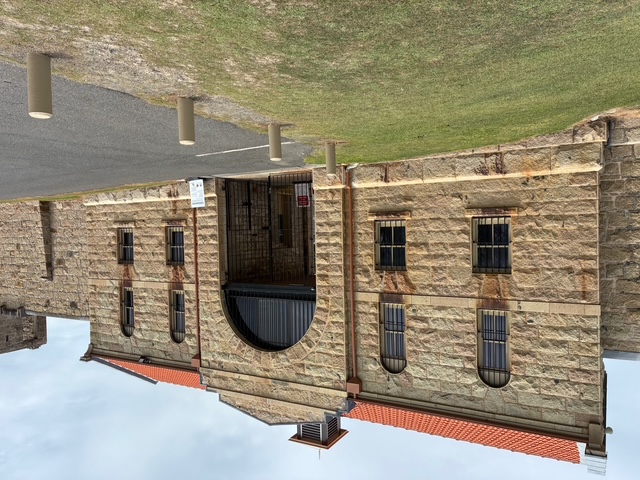
Trial Bay Gaol, Arakoon National Park, New South Wales, Australia. This historic gaol took more than ten years to build, and was completed in 1886. Of local granite, it stands on a bay named after an incident of 1816, when a stolen brig called The Trial was shipwrecked here. Close to where the Macleay River enters the sea on the north coast, the prison has been aptly described as "perched like a medieval walled city guarding the bay" (Flower 4).
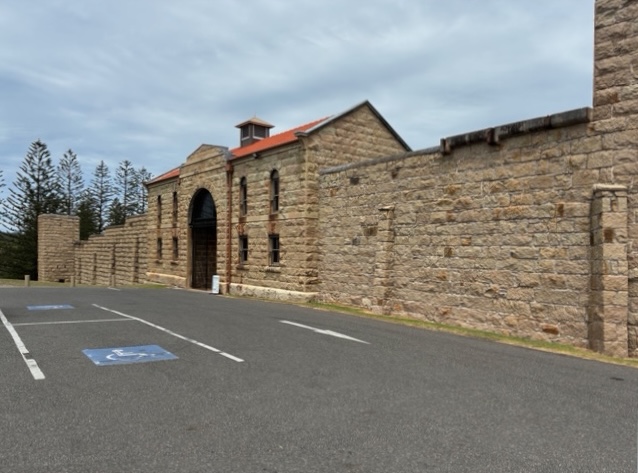
The new prison had a special purpose, to fulfil a project promoted by Harold Maclean (1828-1889). Maclean, whose family had come out to Australia from Inverness in Scotland in 1837, had been appointed Sheriff and Comptroller-General of Prisons in 1885. A far-sighted administrator, he had already banned the use of the treadmill ("against British advice," notes Suzanne Edgar), and now, along with other reforms, wanted to set prisoners to useful work:
He argued that the prisons should be industrious hives of labour, and allowed prisoners schooling, choir practice and visits by authorized outsiders. He was sometimes painfully conscious of his difficult position, open to misinterpretation as too lenient or too harsh, but ex-prisoners often visited him. [Edgar]
It is telling, and heartening, to read of previous inmates coming to see Maclean. His story shows how one man's humane views can, even in the face of initial opposition, bring about reforms that future generations can build on: Maclean's successor as Comptroller-General of Prisons, one Frederick Neitenstein (1850-1921), "guided the system into the first years of the twentieth century" [Ramsland], adding to Maclean's ideas by putting in place a scheme of incentives that could eventually lead to a prisoner's release.
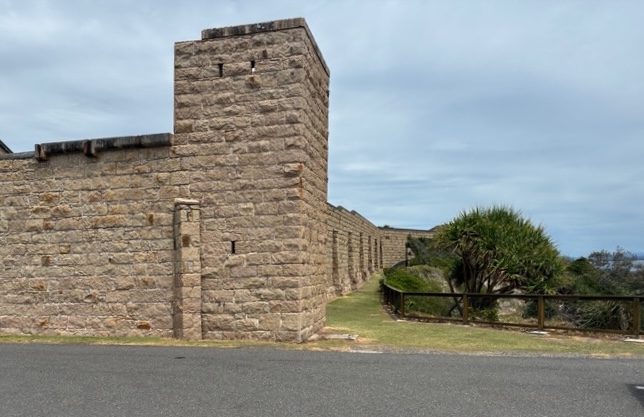
In the case of Trial Bay itself, the breakwater project never came to fruition, but remnants of the work can be seen from the guard's tower. Other features of the prison, besides the tower, also remain. As its forbidding exterior suggests, the interior is particularly atmospheric, with "long perspectives through rows of arches" (Flower 4).
The gaol came to have different purposes later on: first as an internment camp for people of German origin during the First World War, when it was feared they might be enemy sympathisers, and then as a facility for naval officers and their men — a time in its history when entertainment was provided in a theatre, and the erstwhile prison had its own orchestra. It was finally vacated in 1916. Now it has a museum, catering for vistors who come to the area for its natural attractions.
Related Material
Photographs by Philip V. Allingham, text and formatting by Jacqueline Banerjee. [You may use these images without prior permission for any scholarly or educational purpose as long as you (1) credit the photographer and (2) link your document to this URL in a web document or cite the Victorian Web in a print one. Click on the images to enlarge them.]
Bibliography
Edgar, Suzanne. "Harold Maclean (1828-1899)." Australian Dictionary of National Biography. Online ed. Web. 10 February 2026. https://adb.anu.edu.au/biography/maclean-harold-4122
Flower, Cedric The Heritage of Australia. Photographs by Robin V.F. Smith. Ringwood, Victoria: Viking O'Neill, 1987.
Ramsland, John. "Prisons to 1920."
"Trial Bay Gaol." NSW National Parks and Wildlife Service. Web. 9 February 2026. https://www.nationalparks.nsw.gov.au/things-to-do/historic-buildings-places/trial-bay-gao
Created 10 February 2026