
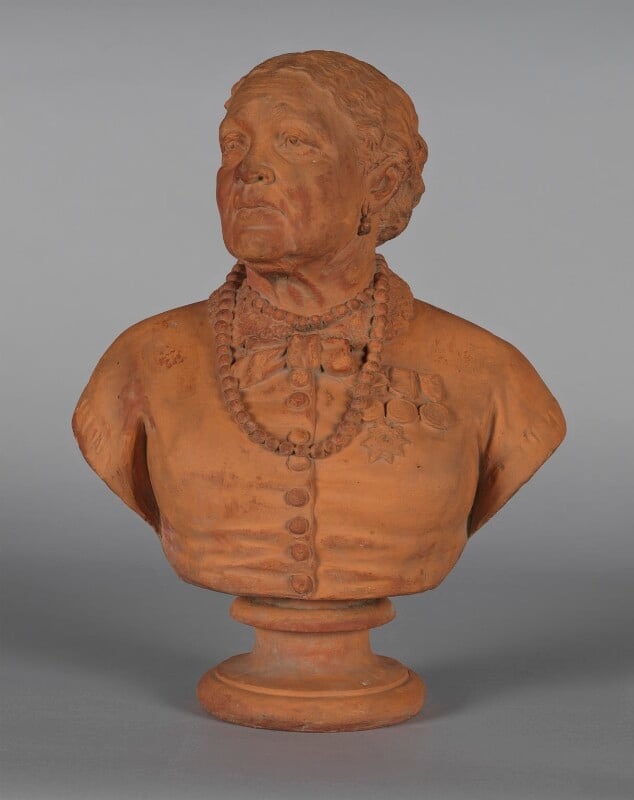
Count Gleichen's terracotta bust of Mary Seacole dates from 1871, measures 11 3/4 in. x 9 1/2 in. (300 mm x 240 mm) overall, and was purchased by the gallery in 2023. It is in their primary collection (NPG 7149), though on display at the time of writing in Nottingham Castle Museum, Nottingham. The photograph of it here is reproduced from the gallery's own site under the terms of the Attribution-NonCommercial-NoDerivs 3.0 Unported CC BY-NC-ND 3.0 Deed.
Seacole became something of a celebrity after her return from the Crimea, where she had run the part-hostelry, part-medical station "British Hotel" patronised mainly by officers in the Crimean War. She numbered even royalty among her circle. Count Gleichen (himself a nephew of the Queen through her half-sister, Princess Feodore) had patronised her establishment near Balaclava when he was serving with the Royal Navy during the war, and had become a friend. She must have been proud of his friendship, and pleased with this work, because, among her many and various bequests to "counts, colonels and lords" as well as relatives, she left him "the diamond ring given to her late husband by his godfather Viscount Nelson" (Salih xl). Considering the immense popularity of Nelson in the Victorian period, this was a treasure indeed.
Known as much for her entrepreneurship as her medical skills and experience, Seacole stopped short of having herself commemorated in a nurse's uniform. She was, however, proud of the services she rendered during the Crimean War. In discussing the oil portrait of Seacole by Albert Charles Challen, the National Portrait Gallery notes that the medals she is seen wearing "are medals awarded to soldiers in the Crimean War. They include the Crimea Medal, the Turkish Medjidie and the French Legion of Honour." However, it adds, "Women were not awarded medals at this time — we don’t know how Seacole came to own them, but she may have borrowed or bought them later." More information comes from Jane Robinson, who identifies the extra one in the sculpture as a Sardinian medal, and believes them to be "miniatures, or 'dress medals,'" which were items of jewellery rather than awards (167). That they feature in both oil portrait and bust suggests Seacole's great pride in having played her part in the war. — Jacqueline Banerjee

Related Material
Bibliography
"Analyzing the Portrait." National Portrait Gallery. Web. 25 January 2026.
Mary Seacole. National Portrait Gallery. Web. 25 January 2026.
Robinson, Jane. Mary Seacole: The Most Famous Black Woman of the Victorian Age. New York: Carroll & Graff, 2004.
Salih, Sara. Introduction. Wonderful Adventures of Mary Seacole in Many Lands. London: Penguin, 2005. xvi-l.
Created 25 January 2026