
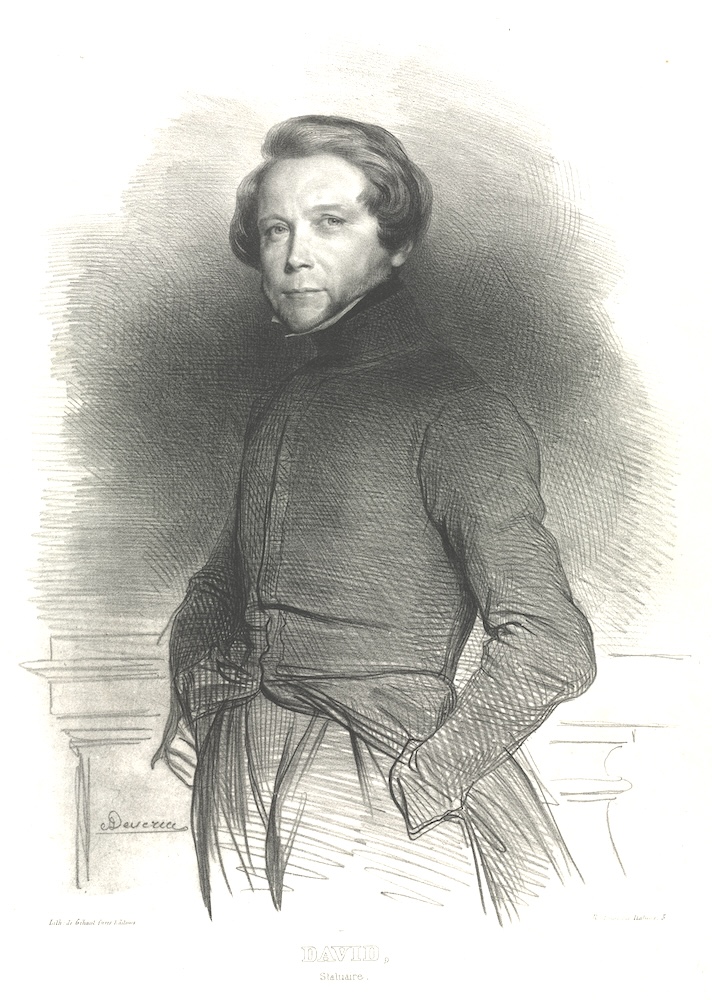
Portrait of the sculptor by Achille Devéria.
Pierre-Jean David d’Angers, who often signed his work simply as P.J. David, was born in the city of Angers in western France, where his father was "a cabinet-maker and wood carver in very poor circumstances" (Eaton 184). As a small boy, was taken to Paris by his father, a staunch Republican, and experienced at first hand the horrors of the French Revolution. On returning to Angers, he began attending the government art school when not helping his father in the workshop.
From the age of twenty, David studied in Paris under the sculptor Philippe-Laurent Roland, and won the coveted Prix de Rome in 1811. During the next five years in Italy, he came under the influence of the renowned Neoclassical sculptor Antonio Canova. Then, on returning to France, and finding Paris and Angers in a state of upheaval, he set off for London in 1816, where his hopes of being helped by John Flaxman were disappointed. It was, says James Holderbaum, "a brief and frustrating trip" (211). But, back in Paris again, and with his neo-classical beginnings giving way to a more Romantic style, he had a notable success with his dynamic statue of Le Grand Condé for Pont Louis XVI (later rechristened the Pont de la Concorde). The statue was colourfully described by Emerson Bowyer as a "confluence of oppositional forces," in which "the extravagantly costumed Condé rears back while preserving a forward momentum, and all the while he whirls like a turbine" (18). David was immediately established as
In a vast oeuvre, which included influential theoretical writings, David fulfilled many commissions for portrait busts, medallions and bas-reliefs of important personages, sometimes for funerary monuments, and was highly regarded in his own lifetime. D. Cady Eaton is highly critical of his later work, finding it "hurried, exaggerated and lacking in the calm and dignity which should characterize works of art" (191). Eaton was wrong, however, to conclude that David d'Angers would cease to be of interest. On the contrary, he is now lauded as "artist, intellectual, activist ... at the epicenter of early nineteenth-century French culture and politics" (Wardropper 6).
The sculptor's portrait is a lithograph from the Cleveland Museum of Art, in the Mr. and Mrs. Lewis B. Williams Collection 1940.1100, and comes via the Internet Archive on the Creative Commons CC01.0 Universal licence. Image scan and text by Jacqueline Banerjee
Works
Bibliography
Bowyer, Emerson. "David D'Angers: Making the Modern Monument." David D'Angers: Making the Modern Movement, by Bowyer with Jacques de Caso. New York: The Frick Collection, 2013. 13-68.
De Caso, Jacques. David D'Angers: Sculptural Communication in the Age of Romanticism. Princeton: Princeton University Press, 1992.
Eaton, D. Cady. A Handbook of Modern French Sculpture. New York: Dodd, Mead, 1913 Internet Archive. 26 October 2026.
Holderbaum, James. "Pierre-Jean David D'Angers, 1788 Angers — Paris 1856."The Romantics to Rodin: French Nineteenth-Century Sculpture from North American Collections, edited by Peter Fusco and H.W. Janson. Los Angeles, Calif.: Los Angeles County Museum of Art; New York: G. Braziller, 1980. Internet Archive. 211-12. 26 October 2026.
"Pierre-Jean David d'Angers." National Galleries of Scotland. Web. 26 October 2026.
Wardropper, Ian. Foreword. David D'Angers: Making the Modern Movement, by Emerson Bowyer with Jacques de Caso. New York: The Frick Collection, 2013. 6-7.
Created 26 October 2026