
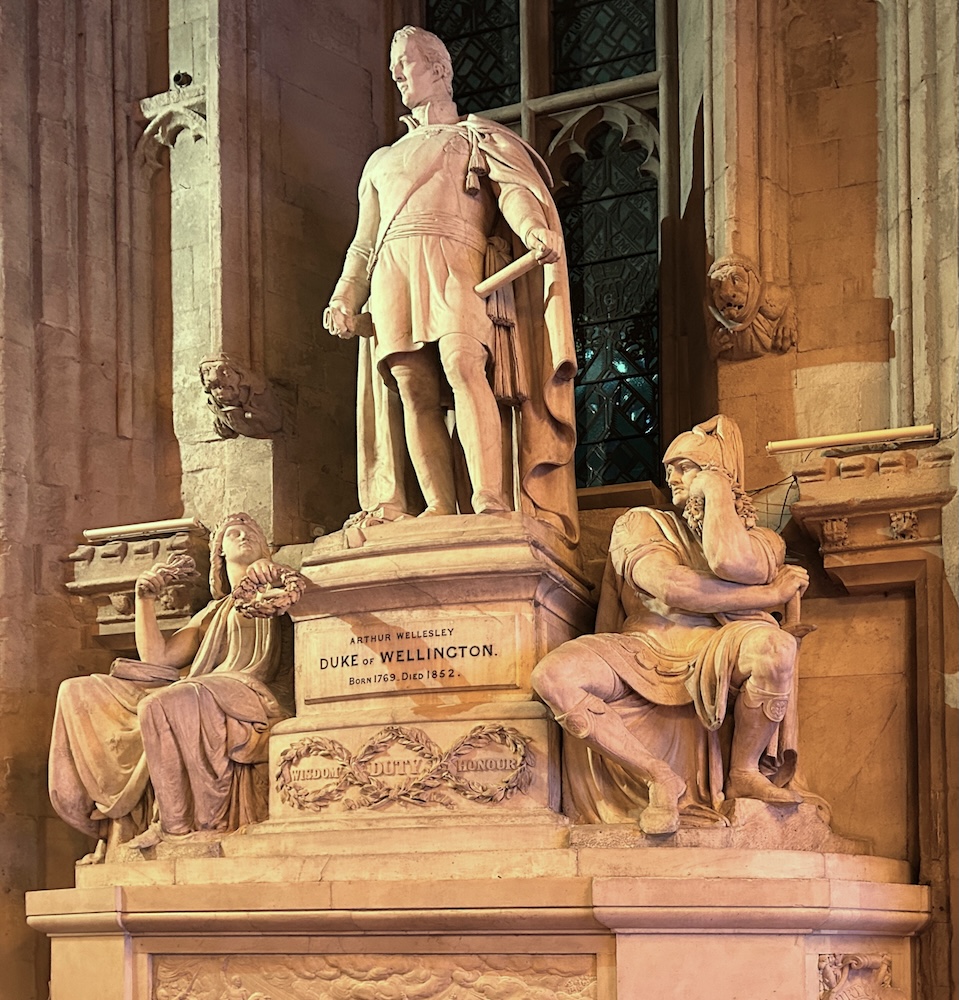
Monument to the Duke of Wellington, by John Bell (1811-1895). Completed in 1857 after a long process of selection and refinement, Bell's grand Carrarra marble monument to the Duke joined James Smith's Nelson and a handful of others in London's Guildhall — another of the great national heroes to be celebrated there, at the ancient civic heart of the city. According to Philip Ward-Jackson, the monument is not as Bell had originally envisaged it, but does seem "to conform fairly closely to the iconography and design of his second model" as described in the sculptor's correspondence (180). Bell presents the Duke as an over-lifesize figure in a military cloak with his insignia, including the Ribbon of the Garter, carrying a field-marshall's baton in one hand and a scroll representing "the Peace of 1815" (Ward-Jackson 180). [Click on the images on this page to enlarge them.]
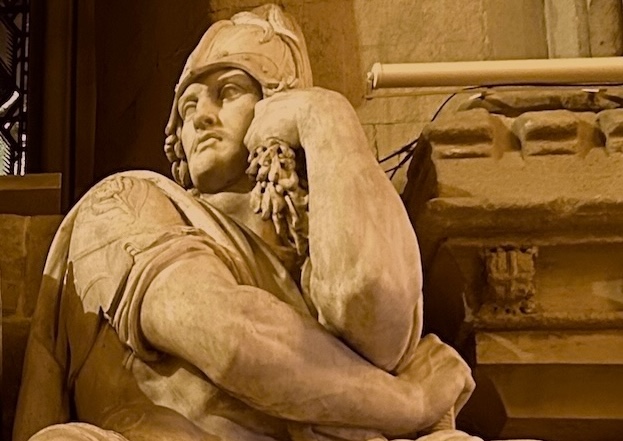
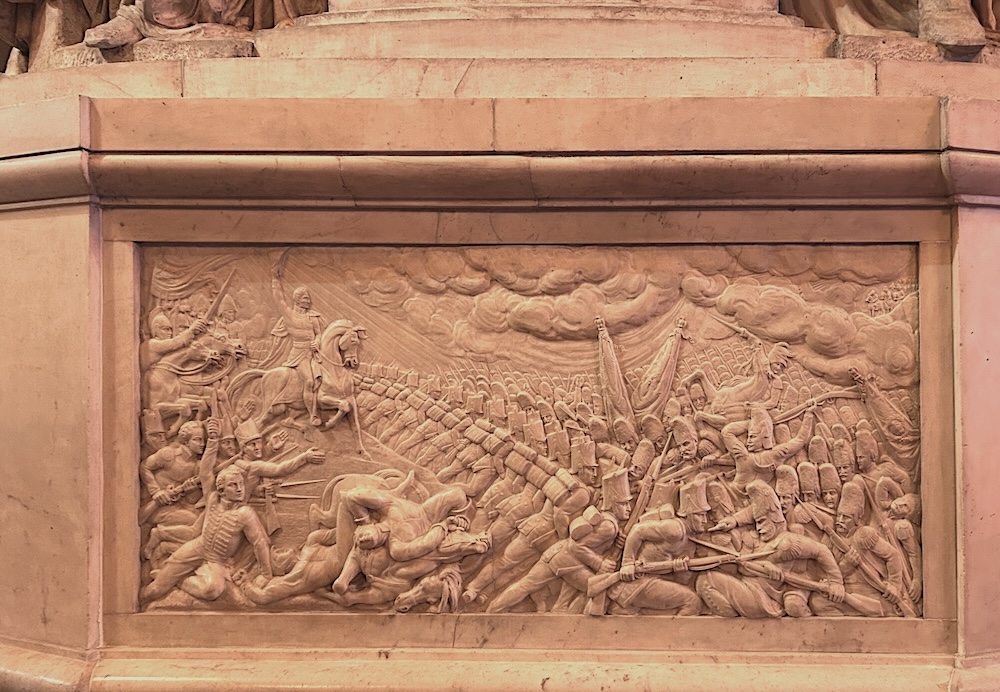
The allegorical figures below and on either side of the main elevated figure represent Peace (female, gazing up at him admiringly and holding some heads of corn and an oak wreath) and War (the very burly, muscular warrior shown more closely on the right here). The latter holds a victory wreath, but rather nonchalantly now that peace has been safely achieved. On the base of the statue itself are three linked wreaths enclosing the words WISDOM | DUTY | HONOUR. On the broader pedestal supporting the statue and flanking figures is a dramatic bas relief of the successful charge at the Battle of Waterloo. The Duke can be seen, a heroic figure with sword raised, rallying his men against the enemy even as some of the fallen lie tangled in the foreground. Criticised as "strangely non-naturalistic" (Bradley and Pevsner 302), the relief makes an impression by the curving line of the advance, counterbalanced by the rolling, roiling clouds above. Left out of the advance, a youthful soldier on the ground in the lefthand corner, behind a jumble of stricken horses and cavalrymen, raises his short, hilted sword defiantly, while two men go head to head (or bayonet to bayonet) on the opposite side. The detail is as impressive as the wider design.
This was not the first such tribute to the Duke in London: Sir Francis Chantrey's equestrian statue had been standing outside the Royal Exchange since 1844, when the Duke was still alive and being fêted for a different kind of victory — his success in getting parliamentary support for the rebuilding of London Bridge. The Guildhall monument also postdates Thomas Milnes's statue of Wellington as "Master General of the Ordnance, Royal Artillery 1818-1827," first erected on Tower Green in 1848. However, Bell's more ambitious one considerably predates Alfred Stevens's even more elaborate marble and bronze monument in St Paul's, which was first "provisionally erected in 1877" (Read 95) but not finally completed until 1912, long after Stevens's death.
You may use these images without prior permission for any scholarly or educational purpose as long as you (1) credit the photographer and (2) link your document to this URL in a web document or cite the Victorian Web in a print one.
Related Material

Bibliography
Bradley, Simon, and Nikolaus Pevsner. London 1: The City of London. Harmondsworth: Penguin, 1997.
Read, Ben. Victorian Sculpture. New Haven and London: Yale University Press, 1982.
Ward-Jackson, Philip. Public Sculpture of the City of London. Public Sculpture of Britain, Vol. Seven. Liverpool" University of Liverpool Press, 2003.
Created 3 February 2026