

he centre of Mohammedanism in England is Liverpool, and Mr. William Henry Quilliam, a solicitor of that city, is the life and soul of the movement. In the year 1884 Mr. Quilliam visited Morocco, and there his attention was drawn to Mohammedanism. His statement is that he was first struck with the apparent sincerity of the followers of Islam, and with the absence in Moslem cities of the vices so prevalent in large centres of population in Great Britain. Then he devoted his spare time to the study of the Koran, and every other work he could procure upon the subject, pro or con, with the result that he was at last convinced that of all the religions of the world Islamism was the best. Having reached this point, he had the courage of his convictions, and openly confessed himself a convert to Mohammedanism, while he formally renounced Christianity.
Returning to Liverpool, the new convert, filled with zeal, sought to propagate the Faith of Islam amongst his countrymen by means of conversation, but seems only to have been laughed at for his pains. Then he tried lecturing, and with somewhat more encouraging results, for after a year or two he could point to four disciples. Thereupon a Church of Islam was formed in a hall in Mount Vernon Street, and after five hard up-hill years of work, the number of the Faithful increased to over thirty, when it was resolved to move to more comfortable and commodious premises, and bring the religion of Islam somewhat more prominently before the people of England by vigorous meetings, press notices, and various pamphlets and books.
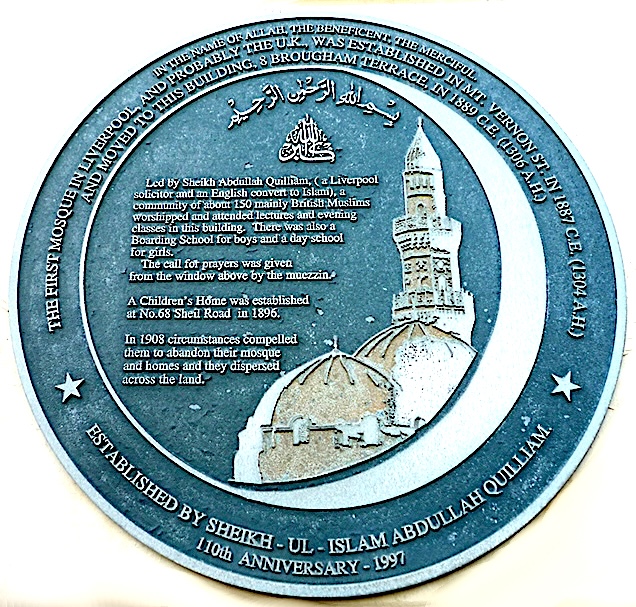
Plaque marking the "new premises" (photo by TonyMo22, originally posted on Flickr, reproduced on the Creative Commons CC BY-NC-SA 2.0 Creative Commons Licence).
On Christmas morning, 1889, the new premises at Brougham Hall, Brougham Terrace, West Derby Road, were opened by a substantial breakfast given to 230 poor children of the neighbourhood, and the Liverpool Moslem Institute was founded, of which Mr. W.H. Quilliam was [395/96] made first President: From that date the public services have been better attended, and outside interest in the movement has grown, until the fame of “Islam in England” has gone to the uttermost parts of the earth.
In the autumn of 1891, being in England, I resolved to visit Liverpool and investigate thoroughly Mohammedanism in that city. During the four days of my stay I was the guest of the President, and was treated with much kindness, and shown everything in the Institute, and told all about the inner working of the whole movement, with the clear understanding that I could make public whatever I pleased. I timed my visit so as to arrive on a Friday, the “Day of the Assembly,” and at once made my way to the Institute, though doubtful of obtaining admittance, as the services on that day are for the Faithful only.
It was the hour of Evening Prayer when I reached Brougham Hall, and the first thing I saw and heard was the President standing in the balcony of a window, which did duty for a minaret, giving the Azan or Call to Prayer, both in Arabic and English. I had not heard the famous Call since leaving Egypt in the year 1888, and it sounded passing strange to me to listen to it in the street of an English city. As the cry was raised “Allah is Great! Allah is Great! I bear witness there is no God but God! I bear witness that Mohammed is the Prophet of God! Come to prayers! Come to salvation! Allah is Great!” a crowd gathered round and listened with considerable curiosity, but without any remark.
The Liverpool Moslem Institute is a large old-fashioned house. On the notice board outside I read these words:
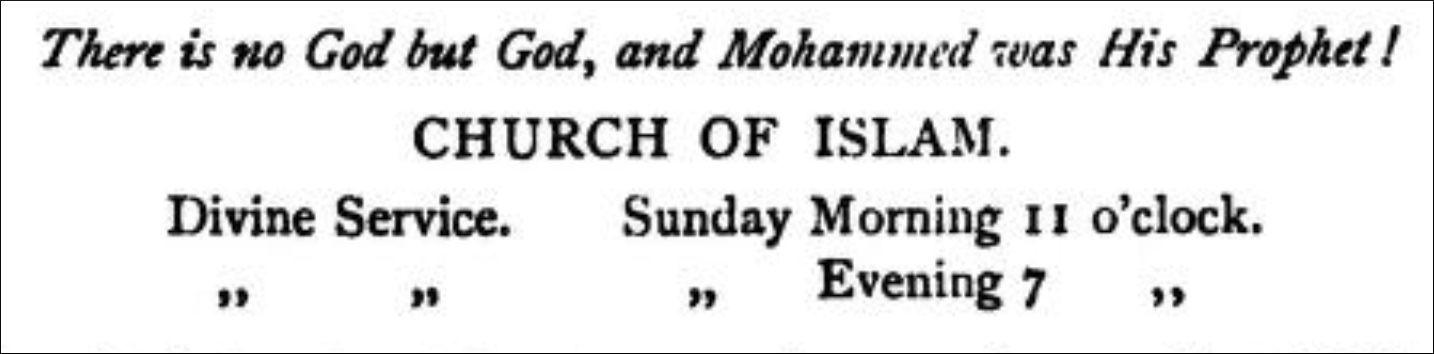
I called the President’s attention to the words “Mohammed was His Prophet,” and asked whether it was a mistake [396/97] or not. I was told that “is” would be at once substituted for “was,” as the Faithful believe that Mohammed not only “was” but “is” - the Prophet of God. The word was an unfortunate painter’s error. Inside the Institute are various rooms, such as a library, a museum, and a small lecture hall, where the members meet for the study of the Koran, for instruction in Eastern languages, and for social meetings of various kinds. Though it was the “Day of the Assembly,” the President courteously showed me through the rooms, and then took me to see the Pro-Mosque where Divine Worship is held.
The so-called mosque is just an oblong building in the rear of the Institute, erected in what was formerly the garden of the house. It will hold, probably, about 150 people, and is fitted up very plainly with somewhat uncomfortable benches, the only ornamentation being several pairs of Burmese curtains, with here and there an Indian durie, or prayer-mat, on the floor. At one end of the building is a small platform with a reading-table, on which rests a copy of the Koran, while at the other end a portion is railed off as sacred ground where only the Faithful are allowed to enter, without shoes on their feet, as they wish to offer prayer and praise to Allah.
On the following Sunday I was present at two public services. The morning meeting was very thinly attended, only nine members being in their places, and no outsider save myself. At the evening meeting there was a congregation of fifty-seven, of whom twelve were Lascars from the ships in the Mersey.
There is, of course, no priesthood in Islam, though in the East there are readers of the Koran, and doctors of the law, who are virtually priests, and who usually lead the Faithful in their devotions. I was told that in Liverpool the plan is for the Faithful in monthly assembly to choose certain of the members of the Institute to conduct the religious meetings for the following four weeks.
The honour is duly shared in turn, and no one receives [397/98] payment for service thus rendered. This practice of non-payment is founded upon that passage of the Koran which says: “Whosoever striveth to promote the true religion striveth for the advantage of his own soul, for God requireth not aid from any of His creatures;” and that other passage which declares, “I ask not of you any reward for this my preaching, besides the conversion of him who shall desire to take the way which leads unto his God.”

The rest of the account is generally unfavourable, since Pool was unable to stomach the view of Christ as just another prophet, and, moreover, far from perfect in himself; he also flinched from the "cruel laws" of Islam (398). Fanaticism of this kind alarmed him deeply. But the account does contain a valuable description of Quilliam himself:
Mr. Quilliam is a thin, somewhat sharp-featured, delicate-looking man, of the medium height, with a good voice, a ready utterance, and a pleasant manner. His delivery is usually quiet and deliberate, but now and again he waxes warm and passionately eloquent. His great fault, however, is his one-sided presentation of truth, even though he knows that something can be said on the other side. In short, he is a solicitor — an advocate in the pulpit as well as before the magistrate’s bench. [399]
Quilliam's eldest son Robert, then still a boy, is described as "handsome and gallant" (401). All in all, Pool's concluding chapter, "Islam in England," is of considerable interest, especially when seen in the context of future developments. — Jacqueline Banerjee
Related Material
Bibliography
Pool, John J. Studies in Mohammedanism: historical and doctrinal: with a chapter on Islam in England. London: Constable, 1892. Internet Archive, from a copy in the Salar Jung Museum, Hyderabad. Web. 26 April 2026.
Created 28 April 2026
Last modified 12 July 2026