
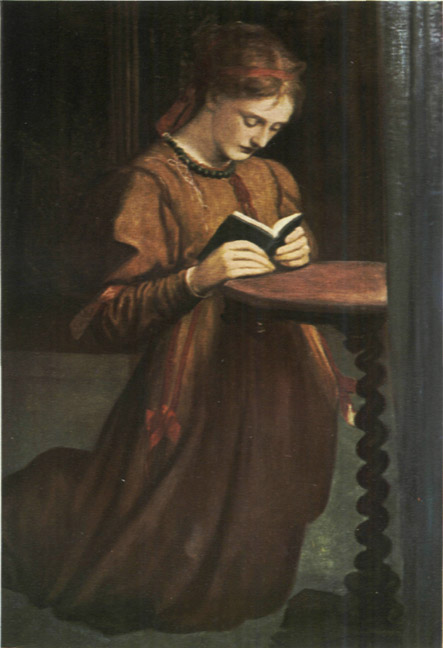
The first image is of G.F. Watts's painting, Prayer. Click on this and the other images to enlarge them, and for more information where available.
CONSECRATION HYMN
Take my life, and let it be
Consecrated, Lord, to Thee.
Take my moments and my days;
Let them flow in ceaseless praise.
Take my hands, and let them move
With the impulse of Thy love.
Take my feet, and let them be
Swift and beautiful for Thee.
Take my voice, and let me sing
Always, only, for my King.
Take my lips, and let them be
Filled with messages from Thee.
Take my silver and my gold;
Not a mite would I withhold.
Take my intellect, and use
Every power as Thou shalt choose.
Take my will, and make it Thine;
It shall be no longer mine.
Take my heart, it is Thine own;
It shall be Thy royal throne.
Take my love; my Lord, I pour
At Thy feet its treasure-store.
Take myself, and I will be
Ever, only, all for Thee.
Written February 4, 1874.
Commentary

Havergal in c. 1875, courtesy of the National Portrait Gallery, London.
In the winter of 1874, the poet and hymn-writer Frances Ridley Havergal (1825-1878), whose portrait is shown on the right here, was visiting friends in Stourport-on-Severn. She was staying with the Rogers family at their large and pleasant residence called Areley House, not far from her childhood home in Astley. She had been confirmed in the previous year, when she was 18, and the Rogers household was a high-minded one like her own, with the eldest son Joseph Edmund, who was still seventeen, destined to become Vicar of St Nicholas, Great Yarmouth, and an honorary canon of Norwich. It was end of her stay that she was inspired to write "the consecration hymn 'Take my life'," as she described it herself later:
I went for a little visit of five days. There were ten persons in the house, some unconverted and long prayed for, some converted but not rejoicing Christians. He gave me the prayer, "Lord, give me all in this house!" And He just did. Before I left the house every one had got a blessing. The last night of my visit, after I had retired, the governess asked me to go to the two daughters. They were crying, but then and there both of them trusted and rejoiced; it was nearly midnight. I was too happy to sleep, and passed most of the night in praise and renewal of my own consecration, and these little couplets formed themselves and chimed in my heart one after another, till they finished with, "Ever, ONLY, ALL for Thee!" [qtd. in Grierson 148]
Interestingly, Havergal's biographer Janet Grierson tells us that when Havergal gave a commentary on the subject of consecration later, in a book entitled Kept for the Master's Use, and used couplets from the hymn at the head of the chapters, she changed the verb "Take" to Keep": she had realised that commitment of this kind was "not so much a step as a course" (qtd. in Grierson 148).
As for the choice of tune, we have the the hymn-writer's explanation for that, too.
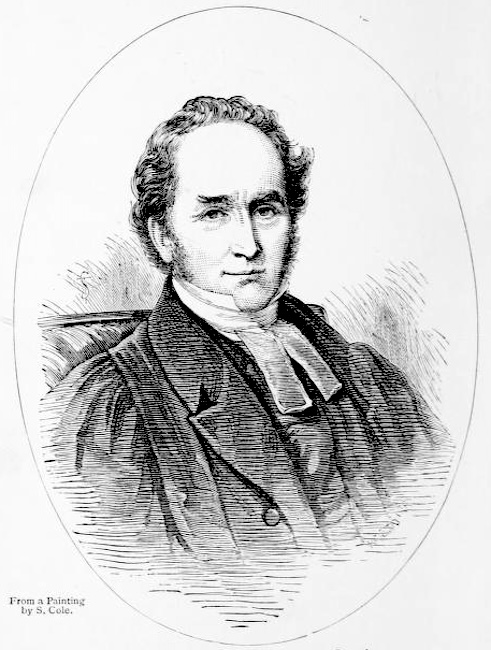
W.H. Havergal (frontispiece to Crane).
Frances Havergal's father, William Henry Havergal (1793-1870), whose career in the church was interrupted by a carriage accident, had devoted part of his time to composing sacred music, and when this hymn was included in Charles B. Snepp's bumper Songs of Grace and Glory in 1876, a compilation on which her own name appears in smaller print as co-editor, the tune "Patmos" is specified (see hymn no. 1072, p. 404; a version printed in six quatrians and, strangely, dated 1873). This tune was a composition of her father's. The fact that it was her own choice was confirmed a few years later, when she wrote to the composer and publisher Charles Henry Purday (1799-1885) in December 1878, in connection with another compilation, this time entirely of her own hymns:
The only tune I do not like, and cannot possibly sanction, in your Songs of Peace and Joy, is the setting of my Consecration hymn, “Take my life,” to that wearisomely hackneyed kyrie of Mozart. It does not suit the words either, and I was much vexed with Mr. Mountain for printing it with it in his Hymns of Consecration, and it would just spoil your book to let it pass. I particularly wish that hymn kept to my dear father’s sweet little tune, PATMOS, which suits it perfectly. [311]
Purday complied, and this and the hymn that comes next ("Our King") are set to her father's tunes. Moreover, Purday adds notes at the foot of each to say that "the late Canon Havergal's" settings have been requested by the hymnologist herself (pp. 62 and 66).
Information about the hymn's biblical source is also given here. Purday prints the text that appeared above the poem on its first publication by Snepp, in the Appendix to the original edition of Songs of Grace and Glory (London: James Nisbet, 1874), as well as in the extended edition. This refers to an episode in the Old Testament, 2 Samuel, 19, 30, in which Saul's grandson, Mephibosheth, realises and shows plainly that personal possessions mean nothing to him beside his allegiance to King David. It is not a very well-known passage but the meaning is appropriate here, as worshippers singing this familiar hymn pledge to commit all potential for engagement with this world, their very beings, in fact, to the service of God.
T.H. Darlow captures this meaning perfectly when he prefaces the poem, in his biography of Havergal, not with that or any other biblical text, but instead with words slightly adapted from the Prayer after Communion in the Church of England's Book of Common Prayer: "Here we offer and present unto Thee, O Lord, ourselves, our souls and bodies, to be a reasonable, holy, and lively sacrifice unto Thee" (214). Yet the hymn was not only popular in the Anglican context. It became so well known that it was even sung in Britain's first makeshift mosque in Liverpool, in a bid to make the newly-introduced faith seem more familiar.
Part of its success as a hymn is undoubtedly due to the repetition which tends to mar Havergal's poetry, but is here used very effectively to build up the feeling of commitment gradually but with gathering conviction to the climactic last couplet. This couplet then becomes an exultant dedication of the whole self, and all that belongs to it, to God. The Rev. Ronald Bayne, who was less complimentary about her general skill as a poet, was right to say in his entry on her in the Oxford Dictionary of Biography, "some of her hymns are excellent, and will permanently preserve her name" (180). Havergal's Consecration Hymn can still be found in Hymns Ancient and Modern (new standard edition), no. 249 in the section on "The Christian Life," under the running heading for nos. 242-251, "God and the Soul." It is undoubtedly the work for which she is best known.
Related Material
Bibliography
Bayne, Ronald [RB]. "Frances Ridley Havergal, 1836-1879, Poet and Hymn-Writer." Dictionary of National Biography. Edited by Lesley Stephen and Sidney Lee. Vol. XXV (Harris-Henry I): 180. New York: Macmillan/London: Smith, Elder, 1891: 118. Internet Archive, from a copy in Stanford University Library. Web. 30 May 2026.
Calhoun, David B. "Frances Ridley Havergal (1836-1879): "Always, Only for My King." C.S. Lewis Institute. Web. 31 May 2026. https://www.cslewisinstitute.org/resources/frances-ridley-havergal-1836-1879-always-only-for-my-king/
Crane, Jane Miriam. Records of the Life of the Rev. W. H. Havergal. London: Home Words, 1882. Internet Archive, from a copy in the Library of Princeton Theological Seminary. Web. 31 May 2026.
Darlow, D. H. span class="book">Frances Ridley Havergal: A Saint of God. London: Nisbet & Co., 1927. Internet Archive, from a copy in the General Theological Seminary Library, New York. Web. 31 May 2026.
Grierson, Janet. Frances Ridley Havergal: Worcestershire Hymn-Writer. Bromsgrove: Havergal Society, 1979.
Havergal, F.R. Letters by the Late Francis Ridley Havergal. Edited by Maria Vernon Graham Havergal. London: Nisbet & Co., 1885. Internet Archive. Web. 31 May 2026.
"The Reverend Joseph Rogers, MA." Home Words, 1896: 154-55. Google Books. Free to read. Web. 31 May 2026. https://www.google.co.uk/books/edition/Home_Words_for_Heart_and_Hearth/wxoMPBhOdhcC?hl=en&gbpv=1
Snepp, Charles B. and F.R. Havergal. Songs of Grace and Glory: hymnal and musical treasures of the Church of Christ from many centuries. London: Nisbet & Co., 1876. Internet Archive. Web. 31 May 2026.
"Take my Life and Let It Be, (Patmos)." Small Church Music. Free download. Web. 31 May 2026.
Created 31 May 2026