
In transcribing the following paragraphs from the Internet Archive online version of the Gazetteer’s entry on Durham, I have expanded the abbreviations for easier reading and added paragraphing, subtitles, and links to relevant material on this site, including Victorian images and modern photographs. The illustration is in the original. The Gazetteer has 1856 on the title-page for this volume, but the statements in this essay date it to 1851 — George P. Landow]
DURHAM [originally Dunholme], an ancient and celebrated city and parliamentary borough in England, capital of County Durham, on the Wear, 230 miles north by west London. It stands on seven eminences, along the summits of which the streets generally run. Of these there are nine that may be considered principal streets, besides several smaller, and a number of lanes, courts, &c. The first are tolerably straight, and well kept. The houses are built, some of brick, and some of stone; many of them are very old, and extremely irregular in form and dimensions, those of modern erection are more uniform. The city is partially paved and flagged, well supplied with water, and lighted with gas.
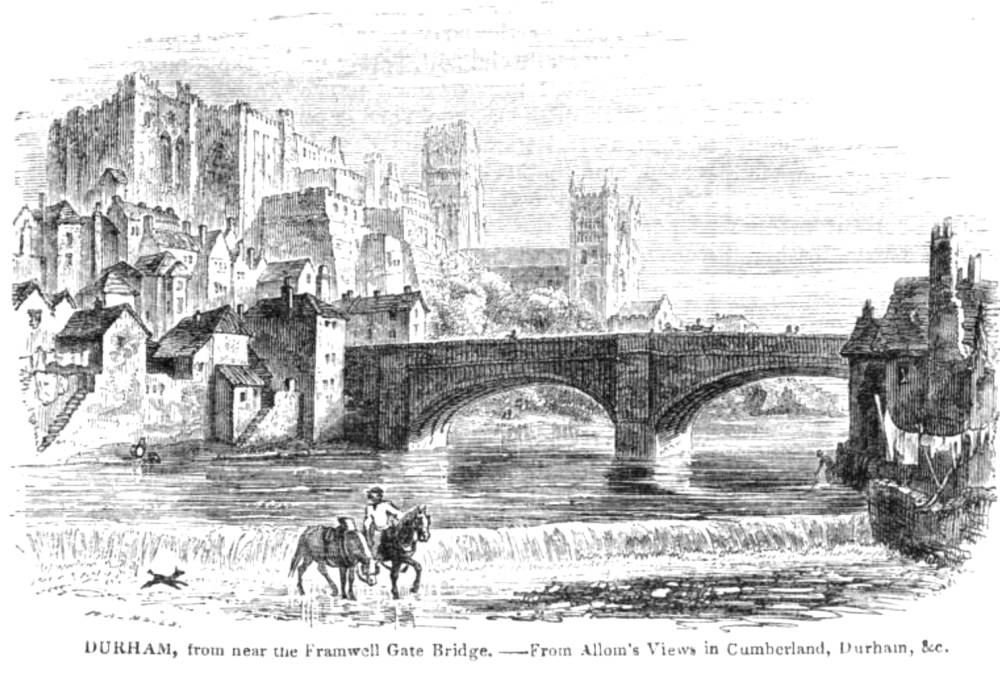
Durham from near the Framwell Gate Bridge. — From Allen’s Views in Cumberland, Durham, etc.. Click on image to enlarge it.
The principal public buildings, exclusive of the ancient castle, the cathedral, and other churches, are the towuhall, a handsome edifice, in the Tudor baronial style; the new hall, a spacious room, 70 feet long, 35 feet broad, and 51 feet high; the county prisons, lately much enlarged; and a new grammar school. There are in all six churches in the city, besides the cathedral, together with chapels for Wesleyans, New Connection Methodists, Primitive Methodists, Independents, Roman Catholics, and a meeting-house for the society of Friends,
The educational institutions comprise the university, grammar-school, diocesan training school, blue coat, national, and infant schools, a Roman Catholic free and charity school. The university was founded in 1833, chiefly for students in theology. A new college, called Hatfield Hall, has been attached to the former, in which students can be educated on much cheaper terms than in the university. An additional college, on similar terms to Hatfield Hall, was opened in October 1851. There are in the city a mechanics institute, an athenaeum, an infirmary, and a number of minor charities.
The only manufactures of any importance carried on, are those of carpeting and mustard, for the last of which articles Durham has been for a long time much celebrated. The vicinity abounds in beautiful public walks, commanding a great extent and variety of picturesque scenery.
But the great attractions of Durham are its famous cathedral, and ancient castle. The former occupies the summit of a penin sula overlooking the Wear on the east and west, and having rapid descents to the river, which are covered with hanging woods and gardens, having a singularly pleasing effect. The aspect of this venerable structure is peculiarly grand and impressive. The general character of the larger portion is Norman, of a very bold style, with insertions in all the English styles. Three magnificent, and elaborately ornamented towers spring up from the body of the building, one from the centre, 212 feet high; and two, together, from the west end, 143 feet high each. The entire length of the edifice is 420 feet It was founded by bishop William de Carilepho, assisted by Malcolm, King of Scotland, on August 11, 1093. The castle, formerly the residence of the bishops of Durham, stands north from the cathedral, on the summit of an artificial mound. The original building is Norman, but many of the additions are of much later dates. It is believed to have been founded by William the Conqueror, in 1072, but it is considered doubtful whether any part of the original keep, with exception of the foundation, now remains. The greater por tion of the existing building is supposed to have been erected in 1350.
Durham returns two members to the House of Commons. Registered electors (1851), 1116. Pop. (1841), 14,151; (1851), 12,942.
[Information for this entry provided by a Local Correspondent.) [III, 887-88]
Bibliography
Blackie, Walker Graham. The Imperial Gazetteer: A General Dictionary of Geography, Physical, Political, Statistical and Descriptive. 4 vol South London: Blackie & Son, 1856. Internet Archive online version of a copy in the University of California Library. Web.9 November 2018.
Last modified 28 January 2019