
The essay first appeared in the Pre-Raphaelite Society Review, Vol. XXXIII (Spring 2025). Reproduced here with the permission of the author and editor, it has been slightly adapted to suit our own format. Click on the images to enlarge them or for more information about them (in this version, the first three are taken from our own website), and click on the superscript numbers to be taken to the notes. — JB
s a result of European involvement in trade in the Indian subcontinent, handwoven and embroidered Kashmiri shawls became fashionable in Europe during the latter half of the eighteenth century and throughout the nineteenth century.1 The Kashmiri shawl was desirable in part for its beautiful patterns, but also its luxurious softness, lightness, and warmth – for it was made from fleece that had been combed from the downy undercoats of domesticated Himalayan mountain goats: fleece from wild animals was used to make Kashmiri shawls, but for practical reasons, most came from domesticated goats (Dusenbury 44). The fleece is known in Persian and Kashmiri as pashm, and thus, the cloth that is made from it is known as pashmina (a word that has since been adopted into English, see Cohen, "What is a Kashmiri shawl," 18, and Zutshi 422). British manufacturers picked up on the Kashmiri shawl fashion from the 1770s, producing textiles which mimicked Asian designs, but which were made from inferior fibres so that they could be sold at competitively lower prices (Maskiell 43-44). Due to their fashionability, Kashmiri shawls and their imitations made frequent appearances within European paintings. Paintings can be useful sources for considering the cultural history of the shawl as they provide some of the only available visual evidence that we have of how shawls were consumed and worn (and of who consumed and wore them). Yet excepting Jennifer van Schoor’s PhD thesis, there has been little art historical investigation into the visual representation of Kashmiri shawls and their imitations within paintings (van Schoor; Quaile 2015, and Quaile 2023, 49-62).
Kashmiri-style shawls appear in several paintings by Pre-Raphaelite artist William Holman Hunt (1827–1910): they are worn by female sitters in Hunt’s The Awakening Conscience (1853), Portrait of Fanny (1867–68) and The Children’s Holiday (also known as Portrait of Mrs. Thomas Fairbairn and Her Children) (1864–65). The first and third paintings – a moral picture and a portrait, respectively – were both sponsored by the Manchester businessman, art collector and patron, and exhibition organiser Thomas Fairbairn (1823–91).2 As paintings are products of their sociocultural context, the selection and representation of objects in a painting is influenced by factors including the painting’s genre, intended audience, and patron(s). A painted textile could be based on a real textile, or it could be an amalgamation of different textiles, or it could be fictional. However, through my research I have concluded that garments depicted in Hunt’s paintings refer to types of shawls that Victorians would have recognised and likely show the actuality of the garments which Hunt used as reference. Hunt was trained in textile production and went to great lengths to secure particular garments for his paintings. As Linda Parry explains, Hunt was the son of a textile warehouse-manager (who had inherited the business from his father before him), and as a youth was given the necessary training to enter textile manufacturing (57). From 1841–43, Hunt worked as a pattern designer for Richard Cobden & Co. Muslin and Calico (Parry 59). Once Hunt had become a successful painter, he designed and sewed costumes himself – several of which feature in his paintings (Parry 62). Parry observes that “Hunt clearly enjoyed selecting which costumes and textiles to use in his paintings, and he began to collect historical and modern examples for reference. He also had clothes made up for his models to wear as soon as he could afford to do so” (62).
Parry remarks that one garment within Hunt’s paintings can be "definitively’ matched to a garment in the collection of his textiles that is now held by the Royal Ontario Museum (ROM) in Toronto, Canada – that is, the smock within The Hireling Shepherd (1853), which Hunt worked on with his Pre-Raphaelite Brother, Frederic George Stephens (1827–1907) (64, 70-71). Parry observes that "[a]ll of the details, colour, size and embroidered smocking patterns portrayed in the painting are identical to the actual garment" (64). Kashmiri shawls are not represented in the ROM collection of Hunt’s textiles; but due to the precision of the smock’s reproduction, it can be assumed that textiles within other paintings by Hunt also allude to real textiles. After studying shawls in four large museum collections (two onsite and two virtually), and many smaller collections, I was unable to locate a textile that precisely matched the shawl in The Children’s Holiday through either onsite or online research; however, the depicted shawl fits written descriptions and bears visual and material similarity to extant period shawls. This supports Hunt’s reputation for conscientious articulation of textiles within his paintings, to the degree that Victorians would have recognised them and read cultural symbolism in them.
The Children’s Holiday (1864–65) was created after a critical moment in British-Indian relations: the Indian Rebellion of 1857 (also known as "the Uprising" or "Revolt" of 1857; commonly known as "the Indian Mutiny" in British accounts). This event led to the dissolution of the East India Company and the reconfiguration of colonial governance under the British Crown by 1858 – a regime that became known as the British Raj, which lasted until 1947. In 1877, Queen Victoria was formally presented as the heir to the Mughal Empire when she was declared Queen-Empress of India. As we will see, this history has particular implications for the reading of The Children’s Holiday.
By the 1850s, the aristocracy had rejected the shawl fashion, though the upper-middle class still favoured the shawl as a status symbol (Daly 243). A luxury shawl is worn by the upper-middle-class subject in The Children’s Holiday. Allison Fairbairn (née Callaway, 1827–1907) is depicted alongside her five young children. As mentioned, the portrait was completed for her husband (m. 23 March 1848) and Hunt’s patron Thomas Fairbairn, who had also sponsored Hunt’s painting The Awakening Conscience (1853). Painted at Burton Park in Sussex (which Thomas Fairbairn acquired in 1861), The Children’s Holiday was probably intended to hang at the head of the staircase, and now hangs in a stairwell in Torre Abbey Museum, Torquay (Barringer et. al., 148; Bronkhurst). In the image, Mrs. Fairbairn serves tea to her children, who are at play on the grounds of the Fairbairns’ estate.
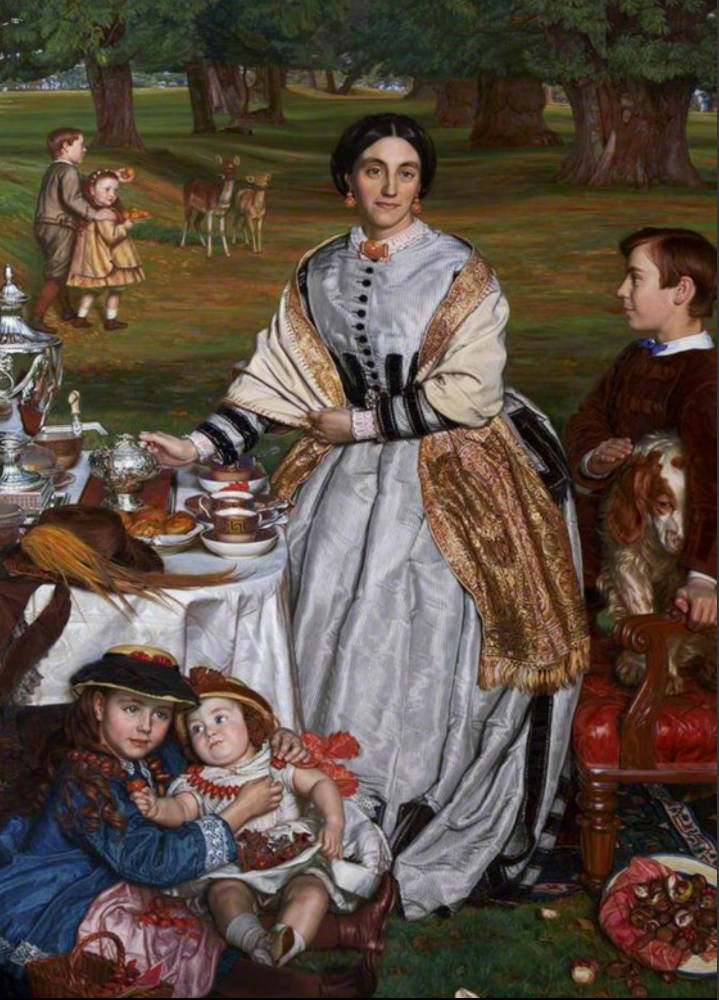
William Holman Hunt, The Children’s Holiday, or Portrait of Mrs. Thomas Fairbairn and Her Children, 1864-65. Oil on canvas.
Most of the paintings that Fairbairn bought from or commissioned of Hunt share the theme of an illicit sexual union (Arscott 166). Caroline Arscott notes that this theme’s mirror image – that of the sanctity of marriage and of the home – appears repeatedly in Fairbairn’s letters to the Times under the pen name "Amicus," which were part of his efforts to crush unionism in Manchester during the early 1850s. As Arscott writes, Thomas Fairbairn regarded communist politics as a threat to the social fabric and thus considered a virtuous woman’s "moral influence" within the domestic sphere – as modelled by his wife Allison Fairbairn in The Children’s Holiday – to be a tonic for such politics (167-68). As Tim Barringer explains, the reading of Allison Fairbairn as ideal mother and wife is supported by the objects in the painting (148). She stands over a Turkish carpet, next to a cushioned red leather chair and a table which is covered by a white (presumably satin) tablecloth. On the table are a Russian samovar, a tea service and china, and a broad-brimmed hat adorned with a bird’s tail feathers. Barringer describes these items as "newly purchased commodities in the latest style, objects of the kind that Thomas Fairbairn would have inspected as a juryman on the committees of the International Exhibitions of 1851 and 1862" (148). Arscott compares these domestic "interior" trappings to those in The Awakening Conscience, noting that while Allison Fairbairn’s homemaking skills are displayed as exemplary, those of the woman in The Awakening Conscience are presented as lacking (Arscott 170).
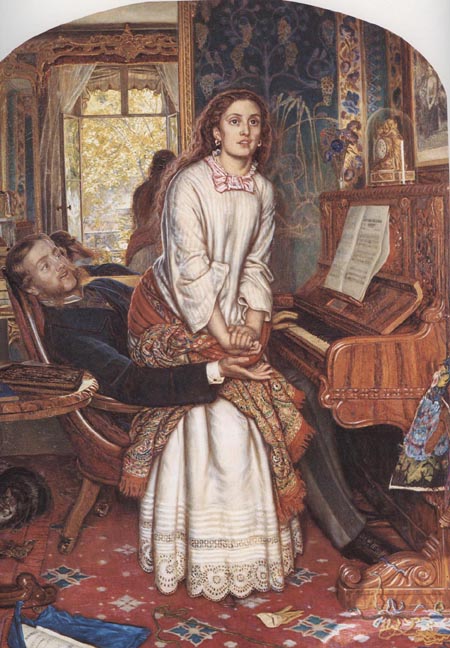
William Holman Hunt, The Awakening Conscience, 1853-54. Oil on canvas.
Allison Fairbairn’s shawl is long with a white background, a gold and black buta pattern along its borders, and a gold fringe – colours that match those of the china next to her (in Kashmir and India, buta, meaning "flower," refers to the stylized plant motif that frequently appears on the shawls, see Maskiell 29). This shawl is not represented in Allison Fairbairn’s last will and testament, proved on 11 March 1907. If Allison Fairbairn did own such a shawl, it may have been worn out or given to one of her daughters. Whether or not Allison Fairbairn owned such a shawl, as Thomas Fairbairn was a man of great wealth and social position, his wife could only be depicted wearing what Victorians would have recognised as an Indian shawl. Despite British officials’ concerted promotion of domestic products, Indian shawls remained the most valued due to their costliness, social exclusivity, and promise of authenticity (Maskeill 50). Even when bought second-hand, Indian shawls were only affordable to the upper and upper-middle classes (Chaudhuri 235). The expense of the depicted shawl is declared by its materiality. First, it is long, and predictably, longer shawls typically cost more than shorter shawls: in France, if a long shawl was torn, it might be cut lengthwise in half and sold as two smaller shawls – each for half the price of a long shawl (Lévi-Strauss 37). Second, this shawl’s gold colour and apparent lustrousness suggest that it is composed partly of silk or even of gold-wrapped silk thread (van Schoor 281; on metal-wrapped silk thread, see Cohen, "Materials and making," 23-26). This type of embroidery is known as zardozi, from the Persian zar, meaning gold, and dozi, meaning sewing, while the wire is referred to as zari (Mohsini 23).
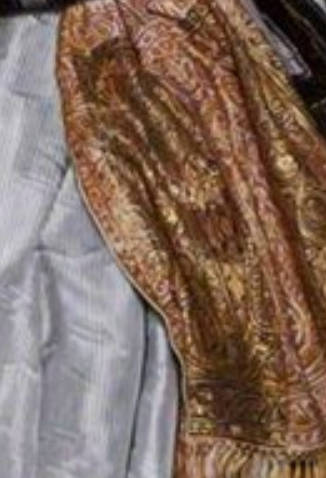
Detail of Hunt's The Children's Holiday.
This implies handmade construction, which is at odds with how Allison Fairbairn’s husband made his fortune – that is, through mechanized manufacturing. Arscott writes that well before the portrait was commissioned, Thomas Fairbairn was known for his "campaign to cut wages, deskill the workforce and improve the profitability of his firm" (167). And, as mentioned previously, during the early 1850s Fairbairn crushed unionisation in Manchester, partly through publishing newspaper articles under the pseudonym "Amicus." Ironically, as Amicus, Fairbairn also deplored the cheap imitation textiles for which British manufacturers were known (6). Although Fairbairn was in engineering rather than textile production, this opinion on textile manufacturing, so at odds with his own business practises, would suggest cognitive dissonance. Most Britons did not have the luxury of Fairbairn’s wealth and therefore the ability to dismiss cheaply produced British textiles. While the lower middle classes resorted to buying industrially-manufactured imitations, "authentic" handmade Indian products – which cost far more, and to which greater social prestige was accorded – were within the Fairbairns’ grasp. The hierarchy of authentic products over imitations thus corresponded with the British class hierarchy (Choudhury 189-212). The shawl that Allison Fairbairn wears in this portrait overtly expresses her husband’s power and wealth.
We can guess the price of such a shawl by consulting advertisements of similar products from the time. The exchange value of Kashmiri shawls was important to women nineteenth-century British women since their inheritance rights to real property was limited (Maskiell 38). In 1852, near the time of the Fairbairns’ marriage (1848), "[t]he genuine Cashmere shawl of the finest quality" typically sold for between £100 and £200 in London ("Selected Extracts," 26). In 1860, a gold-embroidered "real Indian Cashmere shawl" studded by 16 diamonds was advertised by Amott Brothers and Co. for £200 in London – though it was claimed to be worth about £525 ("Advertisements & Notices," 34). Therefore, a gold-embroidered Indian shawl such as the one evoked in The Children’s Holiday could have cost £200 or more. Allison Fairbairn could have owned such a shawl as, at the time of her husband’s death in 1891, his wealth was £72,661 2s. 8d (Bronkhurst). To put Thomas Fairbairn’s wealth in greater perspective, the average annual earnings of manufacturing workers in the United Kingdom was £34.65 in 1891 (Allen 131, Table 6A.5.). It is conceivable that, even between the late 1840s and the mid-1860s, a shawl which cost several hundred pounds would have been within Thomas Fairbairn’s purchasing power: he was made a partner in his father’s firm in 1841, became the senior partner in 1853 when his father retired, and was its sole proprietor by 1859 when his brother withdrew from the business (Arscott 162-63). Furthermore, as a businessman and art patron, collector, and exhibition organiser, Thomas Fairbairn would have had easy access to goods such as an expensive Indian shawl. Examples in the Victoria and Albert Museum include V&A IS.9-1880, 0254(IS), and 9643(IS): the fringe of IS.9-1880 and the scrolling floral motifs in the embroidery of 9643(IS) – particularly the broad leaves – are notably similar those on Allison Fairbairn’s shawl.
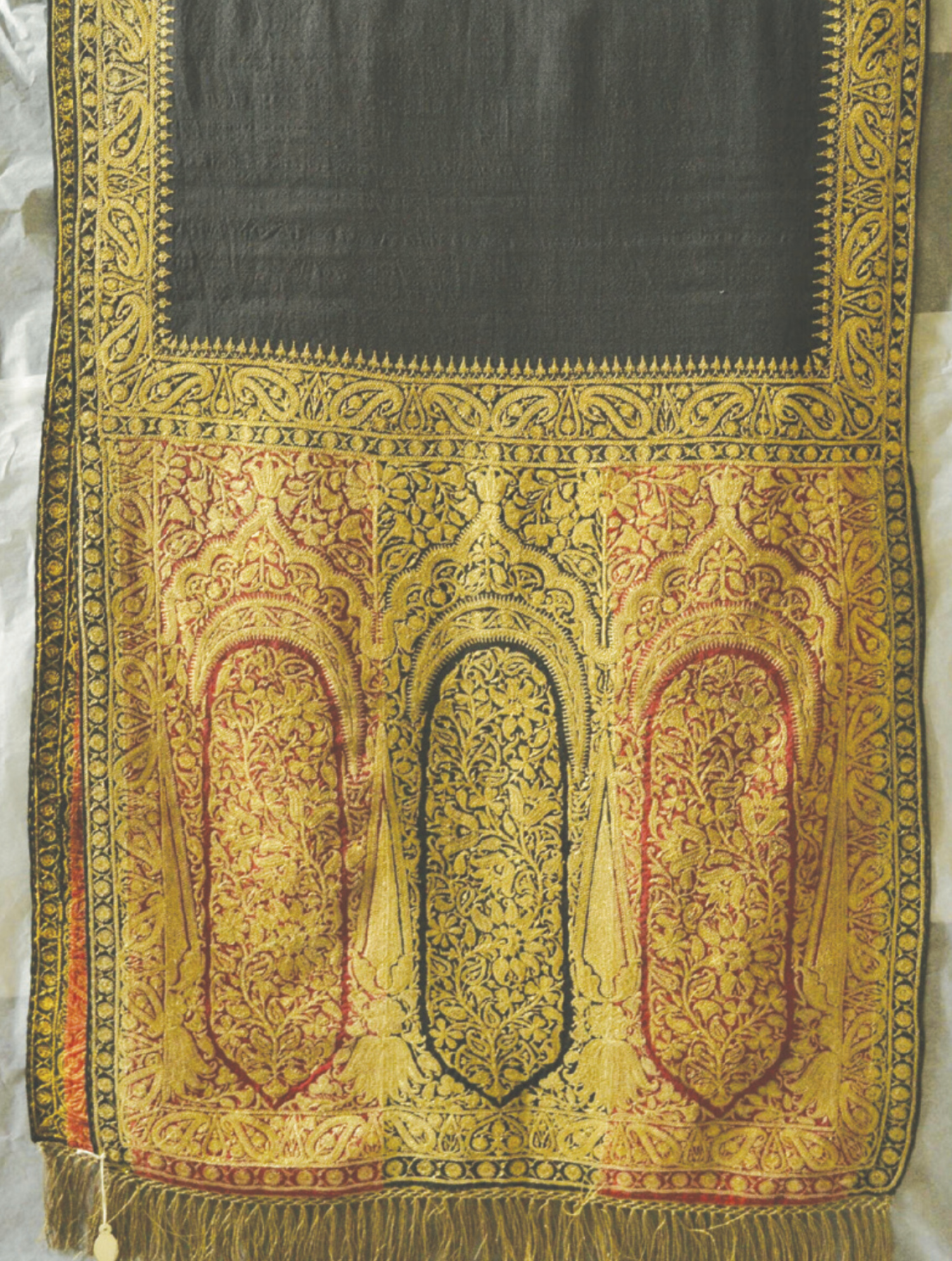
Shawl, Delhi, c.1855. Woven wool, with gold-wrapped thread couching using silk. 0234(IS). © Victoria and Albert Museum, London.
The Victoria and Albert Museum has several Indian shawls with gold- and silver-wrapped silk embroidery on pashmina wool, though none of these were completed on white pashmina like the Fairbairn shawl. V&A 0234(IS), for example, has a similar design layout, though it was completed on a black ground with borders of black and red, while Allison Fairbairn’s has a white ground with borders of white and black (see "Shawl, Delhi"). The gold fringes on the two shawls are also similar. White clothing conveyed wealth and status because it was more difficult to clean. Likely, the colour of the Fairbairn shawl also contributes to the painting’s portrayal of Mrs. Fairbairn as the perfect mother and wife. Long, white-centred shawls were made throughout the shawl’s term in fashion but were particularly prevalent during the 1850s and 1860s. By this time, white symbolised purity, virtue, and matrimony. The white wedding dress was popularized by Queen Victoria at her wedding in 1840 and was reiterated by her daughter-in-law Princess Alexandra at her wedding in 1863. To support British industries, both dresses were made of lace from Honiton, Devon.
In France and Britain, from the early nineteenth century "Cashmere" shawls were worn to weddings (Alfrey 28-29). Furthermore, both the Queen and the Duchess of Kent encouraged the association of Kashmiri and imitation-Kashmiri shawls with christenings when they wore "rich shawl[s] of Paisley manufacture" at the Prince of Wales’s christening in 1842 ("The Christening of the Prince of Wales," 3). By the 1860s, white-centred shawls were common gifts for weddings and baptisms in both France and Britain (Alfrey 28-29; see also p.32). Into the 1890s, long after it had ceased to be fashionable, the Queen gave Kashmiri shawls as wedding gifts to brides of society marriages ("Daily Notes," 4). The association of white "Cashmere" shawls with wifehood and motherhood was therefore well-established by the time Hunt painted The Children’s Holiday, and for Victorians would have symbolised Mrs. Fairbairn’s capability as a wife and mother. This makes Mrs. Fairbairn’s shawl the symbolic opposite of the red shawl in The Awakening Conscience, whose colour – which was associated with passion (Parry 60) – imbues it with a radically different sexual connotation (that is, licentiousness).
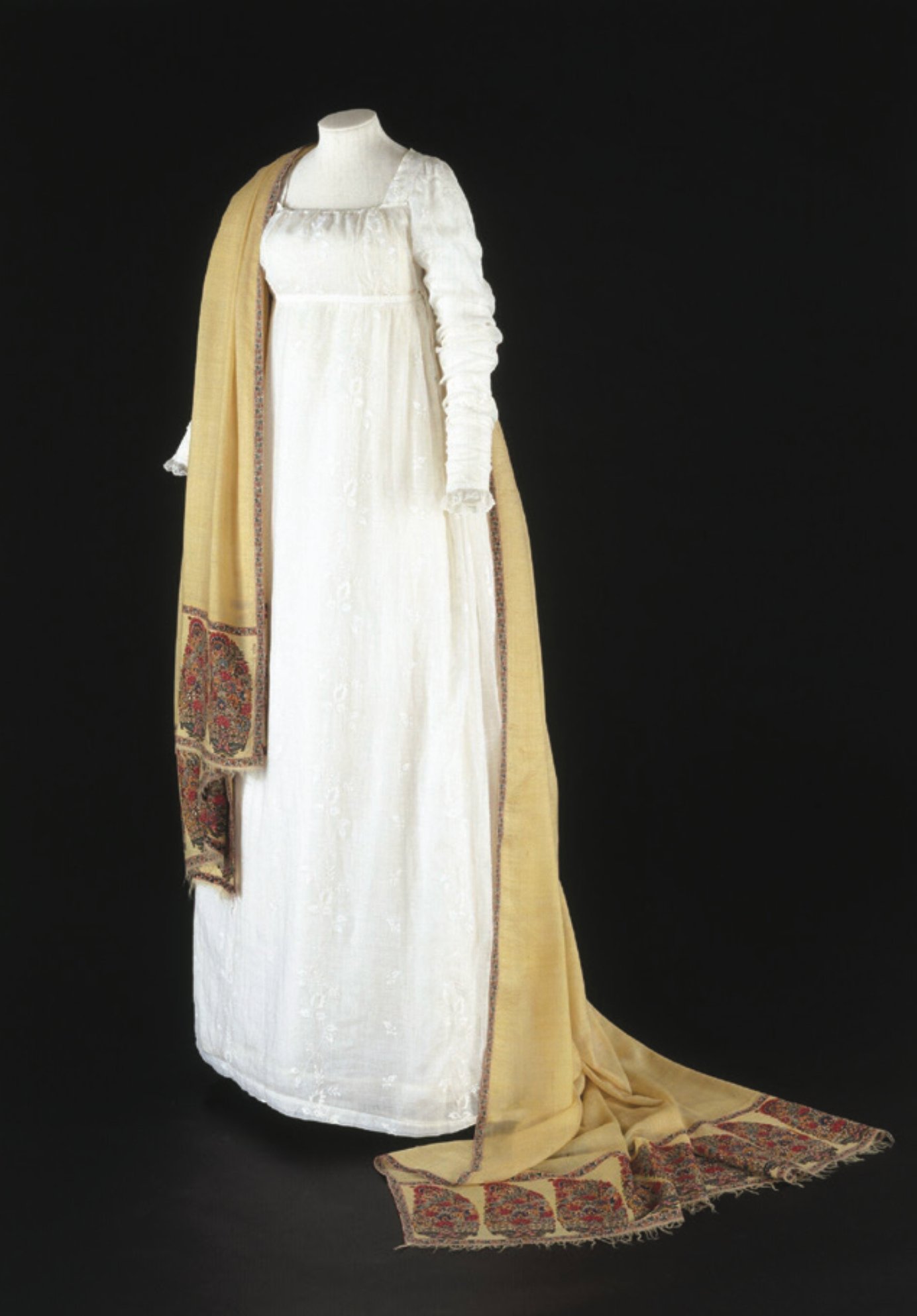
Shawl of pashmina wool, made in Kashmir, c.1780. IS.83-1988. © Victoria and Albert Museum, London.
Significantly, a newspaper article which describes shawls given as bridal gifts to the Princess of Wales in 1863 notes that the Queen gave the Princess "gold-woven tissues of Delhi" ("The Bridal Gifts," 12).3 In the mid-nineteenth century, Delhi was famous for its zardozi pashmina shawls, which makes Delhi the likely source of the shawl referenced in The Children’s Holiday.4 Muslim artisans in Old Delhi had been applying zardozi to textiles for centuries. In the case of pashmina shawls, it is unclear whether the grounds were made in Delhi (possibly by Kashmiri migrants) or whether they were made in Kashmir and subsequently embroidered in Delhi.5 The former seems likely, since Maskiell notes that zardozi would have been used on pashmina ground cloth during the Mughal era as khil’at ("robes of honour") – garments that were customarily given from one person to another to establish a hierarchical relationship, with the recipient’s acceptance of the gift indicating their submission. British East India Company officers adopted the custom of giving khil’at from the late eighteenth century, and continued this into the mid-nineteenth century — although according to Bernard Cohn, under the British the meaning of this ritual changed from being "mystical" to merely "contractual" (171-72).
Given this history, a shawl such as Allison Fairbairn’s could have been regarded as a politically symbolic extension of a Mughal court aesthetic – the British having by this time succeeded the Mughals as imperial rulers of India. The significance of this lies not only in Allison Fairbairn’s race and nationality, but in her identity as a manufacturer’s wife rather than nobility. By this time, the British had restructured global trade by taking raw materials from India for manufacturing in Britain, and selling finished British products back to India at lower prices thanks to Britain’s mechanised industrial production (Maskiell 49-50). This put most of the profit into British hands, led to mass unemployment among India’s artisans, and resulted in the deindustrialisation and ruralisation of Indian society as more Indians moved to work in agriculture to provide raw materials for the British imperial economy (Tharoor 5-9). As we know, Allison’s husband Thomas Fairbairn supported free trade and imperial expansion (van Schoor 274). Upper-middle-class Britons such as the Fairbairns indulged in the material luxuries of Empire even as Empire brought suffering to the lands and people who produced those goods. This painting, which represents Allison Fairbairn in a "Mughal" shawl, testifies to the ascension of British industrial capitalists and their role in cementing Britain’s imperial power.
Some artists – such as William Holman Hunt – are known to have meticulously reproduced textiles in paint. As I have demonstrated through this case study, delving into the symbolism of these depicted textiles can yield valuable information about gender ideals, global trade, and cultural and Imperial politics. Furthermore, comparison with primary records of similar textiles and similar existing examples within museum collections can reveal more about the sitters’ relationships, social status, consumption, and wealth.
__________________Author’s Note: This article is adapted from a chapter in my Social Sciences and Humanities Research Council of Canada (SSHRC)-funded MA thesis, “Wrapped in Import: Kashmiri Shawls in British Paintings of the Long Nineteenth Century” (Queen’s University, Canada, 2015). Supported by a Bader Fellowship in Art History from Queen’s University, Canada, further research was completed in the UK (2018) during my doctoral studies. Earlier versions of this essay were presented at the Dressing Global Bodies Conference, University of Alberta (2016) and the PRS Graduate Network online seminar series (2025). I am grateful to the SSHRC and the late Dr Isabel Bader and Dr Alfred Bader for funding my research, and my MA and PhD supervisor, Professor Emerita Janice Helland, for advising me, for first drawing my attention to this topic and painting, and (on a matter of detail) for information about Dame Allison Fairbairn's will. I also thank the staff of Torre Abbey for their assistance.
Notes
1 The Kashmir region has been administered partly by India and partly by Pakistan since the former was partitioned and the latter was established in 1947. This article differentiates between shawls that were made in Kashmir (following Michelle Maskiell’s terminology, "Kashmiri shawls") and those that were made elsewhere in northwest India, such as Punjab and Delhi, by migrant Kashmiri weavers ("Kashmiri-type shawls"). "Imitation-Kashmiri shawls" refers to European imitations of Kashmiri and Kashmiri-type shawls. For more on this history and terminology, see Maskiell 27. I have created another term, "Kashmiri-style shawls," to refer to shawls of the Kashmiri style whose origin is unidentified.
2 Thomas Fairbairn joined his father’s engineering firm, William Fairbairn & Co., in 1840. He was a member of the Royal Commission for the Exhibition of 1851 and chairman of the Manchester Art Treasures Exhibition of 1857 (Bronkhurst).
3 "Gold Delhi Shawls" were sold in London by the Great Shawl and Cloak Emporium, as is reflected in newspaper advertisements. For example, "India Shawls," The Lady’s Newspaper (14 May 1853), 316. Physician and writer on India John Forbes Watson (1827–92) wrote that these Delhi shawls were made from pashmina, "worked with silk and embroidered with gold lace" (220).
4 In her PhD thesis, Mira Mohsini claims that zardozi was brought to Delhi by Muslim migrants following the Delhi Sultanate’s establishment in the early thirteenth century, and that the craft was patronized by the Mughal court from the sixteenth century and later by the British (60-70). Steven Cohen likewise states that "metal-wrapped thread was not used in India extensively, if at all, before contact with the Islamic world," though "no example from earlier than the seventeenth century has survived" ("Materials and Making," 24).
5 Kashmiri shawl artisans had worked in cities outside Kashmir from at least as early as the sixteenth century, when the Mughal Emperor Akbar (r. 1556–1606) established imperial workshops for Kashmiri shawl cloth manufacture at Lahore, Patna, and Agra (Maskiell 33). During the famine of 1834, many Kashmiri people also emigrated to Punjab (Dusenbury 52, 70).
Bibliography
“Advertisements & Notices.” Daily News (London). 1 August 1860): 8.
Alfrey, Penelope. "The Social Background to the Shawl." The Norwich Shawl: Its History and a Catalogue of the Collection at Strangers Hall Museum, Norwich.] Edited by Pamela Clabburn. London: The Stationery Office, 1995.
Allen, Robert C. “Real Incomes in the English-speaking World, 1879–1913.” Labour Market Evolution. Edited by George Grantham and Mary MacKinnon. London: Routledge, 1994.
Amicus. “British Manufactures.” The Times. 16 January 1856: 6.
Arscott, Caroline. "Employer, husband, spectator: Thomas Fairbairn’s commission of The Awakening Conscience." The Culture of Capital. Edited by Janet Wolff and John Seed. Manchester: Manchester University Press, 1988.
Barringer, Tim, Jason Rosenfeld, and Alison Smith, eds., with contributions by Elizabeth Prettejohn and Diane Waggoner. Pre-Raphaelites: Victorian Avant-garde. London: Tate, 2012.
“The Bridal Gifts to the Princess of Wales.” The Times. 15 April 1863: 12.
Bronkhurst, Judith. “Fairbairn, Sir Thomas, second baronet (1823–1891).” Oxford Dictionary of National Biography. Oxford: Oxford University Press, 2004. Web. 28 December 2014. https://doi.org/10.1093/ref:odnb/62808
Chaudhuri, Nupur. "Shawls, Jewelry, Curry, and Rice in Victorian Britain." Western Women and Imperialism: Complicity and Resistance. Edited by Chaudhuri and Margaret Strobel. Bloomington, IN: Indiana University Press, 1992.
Choudhury, Sushitra. “‘It Was an Imitashon to be Sure’: The Imitation Indian Shawl in Design Reform and Imaginative Fiction.” Textile History 46, no. 2 (November 2015): 189-212.
“The Christening of the Prince of Wales.” The Morning Chronicle. 26 January 1842: 3.
Cohen, Steven. "Materials and Making." The Fabric of India. Edited by Rosemary Crill. London: V&A, 2015.
Cohen, Steven. "What is a Kashmir Shawl?" Kashmir Shawls: The Tapi Collection. Edited by Steven Cohen. Mumbai: Shoestring, 2012.
Cohn, Bernard S. "Representing Authority in Victorian India." The Invention of Tradition. Edited by Eric Hobsbawm and Terence Ranger. Cambridge: Cambridge University Press, 1983; repr. 2013., pp.171-72.
“Daily Notes.” The Yorkshire Herald, and The York Herald. 11 September 1894: 4.
Daly, Suzanne. "Kashmir Shawls in Mid-Victorian Novels." Victorian Literature and Culture 30, no. 1 (2002).
Dusenbury, Mary M. Flowers, Dragons, and Pine Trees: Asian Textiles in the Spencer Museum of Art. Manchester, VT: Hudson Hills Press, 2004.
Lévi-Strauss, Monique. The Cashmere Shawl. London: Dryad, 1987.
Maskiell, Michelle. "Consuming Kashmir: Shawls and Empires, 1500–2000." Journal of World History 13, no. 1 (Spring 2002).
Mohsini, Mira. Becoming an “Asli Karigar”: The Production of Authenticity Among Old Delhi’s Muslim Artisans. PhD thesis, School of Oriental and African Studies, University of London, 2010.
Parry, Linda. "Textile Background: Cloth and Costume." Holman Hunt and the Pre-Raphaelite Vision. Edited by Katharine Lochnan and Carol Jacobi. Toronto: Art Gallery of Ontario, 2008.
Quaile, Sheilagh. “A Victorian Fashion in Edwardian Portraits: The Paisley Shawl in Paintings by Francis H. Newbery,” in “Victorian Clothing and Cloth,” special issue, Victorian Review 49, No. 1 (Spring 2023): 49-62.
_____. Wrapped in Import: Kashmiri Shawls in British Paintings of the Long Nineteenth Century. MA thesis, Queen’s University, 2015.
“Selected Extracts.” The Englishwoman’s Domestic Magazine. 1 May 1852: 26.
"Shawl, Delhi, c. 1855, woven wool, with gold-wrapped thread couching using silk." Victoria and Albert Museum. https://collections.vam.ac.uk/item/O478553/shawl-unknown/
"Shawl of Pashmina Wool, c. 1780." Victoria and Albert Museum. https://collections.vam.ac.uk/item/O482095/shawl-unknown/
Tharoor, Shashi. Inglorious Empire: What the British Did to India. London: Scribe, 2018.
van Schoor, Jennifer Ann. The Indian Cashmere Shawl and Social Status in British Art, 1760–1870. PhD thesis, Birkbeck College, University of London, 2019. Web. 24 January 2020. https://eprints.bbk.ac.uk/id/eprint/40406/1/VAN%20SCHOOR%20J.A.%20%E2%80%93%20PHD%202019-vol%201.pdf
Watson, J. Forbes The International Exhibition of 1862: A Classified and Descriptive Catalogue of the Indian Department. London: Spottiswoode, 1862.
Zutshi, Chitralekha. “‘Designed for eternity’: Kashmiri Shawls, Empire, and Cultures of Production and Consumption in Mid-Victorian Britain,” Journal of British Studies 48, no. 2 (April 2009).
Last modified 3 March 2026