
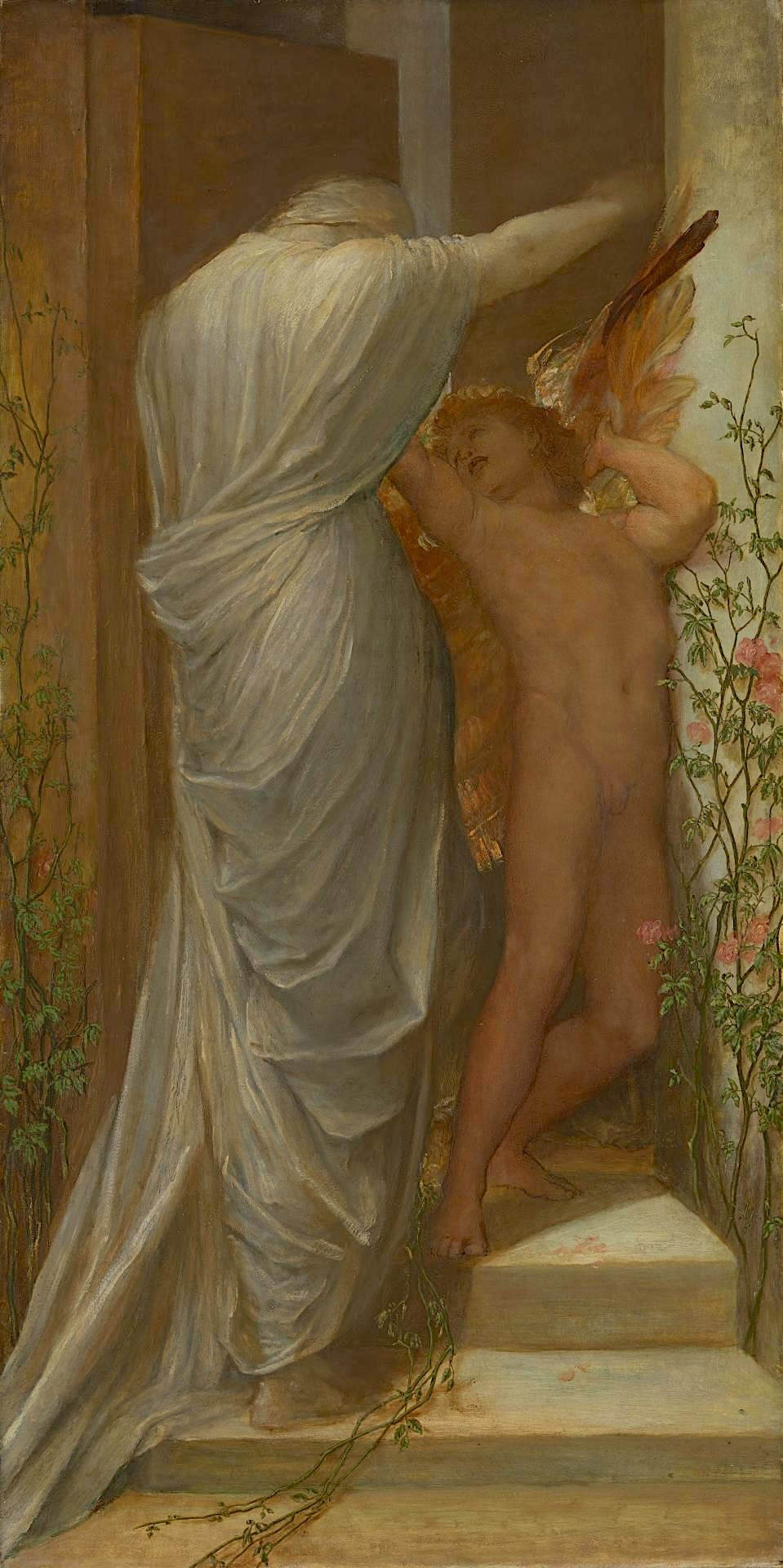
Love and Death by George Frederic Watts RA (1817-1904). c. 1887. Oil on canvas. 114.3 × 57.3 cm. Collection: National Gallery of Victoria, Melbourne, purchased 1888, along with Watts's portrait of Tennyson, from the Centennial Exhibition in Melbourne in 1888. Reproduced here from the digital public domain gallery Artvee.
There are several versions of this painting: the grand metaphysical and deeply emotive subject preoccupied the artist over many years. The larger one in Bristol Museum & Art Gallery dates from 1875, and has a fallen stem from the climbing rose on the steps, together with the heads of several shed roses (not just rose petals). Love's wings are richer in colour. Larger still is the one that the artist himself presented to the Whitworth Collection in Machester (the very first item in the collection), which shows a dove below the steps. According to an account provided by the Whitworth’s Visitor Team, this one, "although not the earliest ... can be regarded as the principal one." Another version in AGSA, the Art Gallery of South Australia, is dated 1901, and here again there is a variation in the way the fallen roses are depicted — the stem trailing on the steps is completely absent.
When the first work of this title was shown at the Grosvenor Gallery in 1877, at the opening exhibition there, a young Oscar Wilde of Magdalen College, Oxford, was bowled over. The gallery in Melbourne quotes a few lines from his comment, but it is worth reading in full:
On entering the West Gallery the first picture that meets the eye is Mr. Watts’ "Love and Death,” a large painting, representing a marble doorway, all overgrown with white-starred jasmine and sweet brier-rose. Death, a giant form, veiled in grey draperies, is passing in with inevitable and mysterious power, breaking through all the flowers. One foot is already on the threshold, and one relentless hand is extended, while Love, a beautiful boy with lithe brown limbs and rainbow-coloured wings, all shrinking like a crumpled leaf, is trying, with vain hands, to bar the entrance. A little dove, undisturbed by the agony of the terrible conflict, waits patiently at the foot of the steps for her playmate; but will wait in vain, for though the face of Death is hidden from us, yet we can see from the terror in the boy’s eyes and quivering lips, that, Medusa-like, this grey phantom turns all it looks upon to stone; and the wings of Love are rent and crushed. Except on the ceiling of the Sistine Chapel in Rome, there are perhaps few paintings to compare with this in intensity of strength, and in marvel of conception. It is worthy to rank with Michael Angelo's a “God dividing the Light from the Darkness." [119]
Note that the dove mentioned by Wilde has disappeared in the Melbourne version.
Both versions, however, have the same figures, depicted with the same "elaborated mode of application" — the oil paint appearing "impacted" and the composition as a whole articulated with "dragged and scumbled marks" (Corbett 110). This was the time and the place for such experimentation, with the gallery exhibiting works of which the establishment (in other words, the Royal Academy) would not have approved, notably Whistler's "most abused ... colour symphonies" (Wilde 124) — which were too much even for the avant-garde Wilde, who reserved his highest praise for "the originative and imaginative genius" of Watts (119). Wilfrid Scawen Blunt, like Wilde, was deeply impressed by Watts's endeavour to give "abstract concepts ... corporeal form" (61), and later critics have also appreciated Watts's success in conveying his lofty concepts through the visible heft of the artistic medium.
The Whitworth's Visitor Team presents a positive interpretation of Love and Death which takes its cue from the artist himself: "Watts described this painting as 'the progress of the inevitable but not terrible Death, who partially but not completely overshadows Love.' The picture is not so much a memento mori as it is an image of consolation for an age continually faced with the presence of death in everyday life." But not everyone would get this impression from it. The figures themselves present an unbearably poignant contrast: the warm-fleshed cupid with his shimmering wings, framed by climbing flowers at the doorway, appears helpless in the face of the overbearing intruder wrapped in the greenish-grey of decay, as in a winding sheet, one bare arm of the same sickly hue revealed. It seems, first and foremost, a powerful and very sobering realisation of the inescapable human lot of love and loss, and is no less striking (if less comforting) when seen in this way.
Related Material
Bibliography
Blunt, Wilfrid Scawen. "England's Michaelangelo": A Biography of George Frederic Watts, OM., R.A. London: Hamish Hamilton, 1975.
Corbett, David Peters. The World in Paint: Modern Art and Visuality in England, 1848-1914. University Park, PA: Penn State University Press, 2005.
George Frederick Watts (shows an image of their version of Love and Death). AGSA (The Art Gallery of South Australia). Web. 7 December 2025.
"George Frederic Watts 'Love and Death' (1887-88)." A Place between the Trees. Web. 7 December 2025. https://aplacebetweenthetrees.com/2019/02/21/george-frederic-watts-love-and-death-1887-88/
""G.F. Watts: Love and Death." National Gallery of Victoria, Melbourne. Web. 7 December 2025.
Love and Death. The University of Manchester, The Whitworth. Web. 7 December 2025.
Love and Death: G.F. Watts (Bristol Museum and Art Gallery). Art UK. Web. 7 December 2025.
Wilde, Oscar. "The Grosvenor Gallery." The Dublin University Magazine, July 1877: 118-26. Google Books. Free Ebook. Web. 7 December 2025.
Created 7 December 2025