
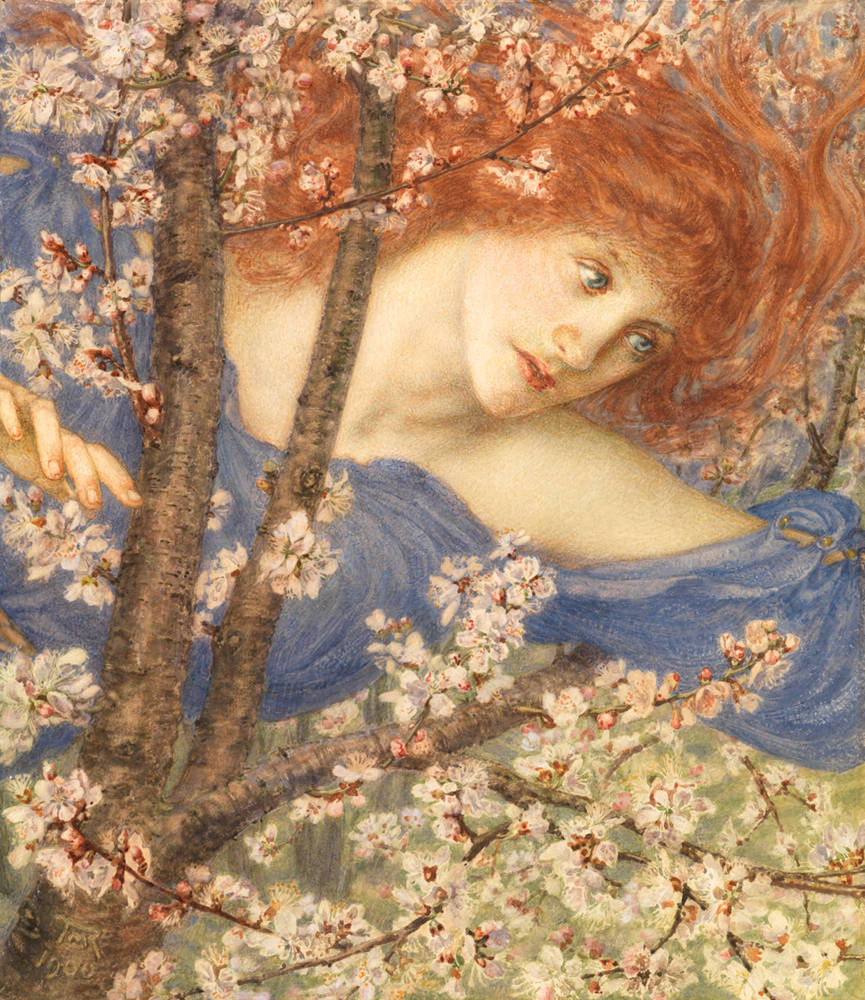
Phyllis Deserted - Become the Spirit of the Almond Tree, by
Thomas Matthews Rooke, RWS (1842-1942). Watercolour on paper. 13 x 15 inches (37.5 X 33 cm). Private collection, image courtesy of the Maas Gallery, London. Provenance: The artist's family. Exhibited: Royal Water-Colour Society, 1900.
Commentary by Dennis T. Lanigan
In Greek mythology, Phyllis was the daughter of a Thracian king who fell in love with Demophoön, the son of Theseus, King of Athens. Following the conquest of Troy, Demophoön stopped at the Thracian court on his way home to Greece. The king agreed to let Demophoön marry his daughter and to give him part of his kingdom. Demophoön then sailed back to Athens, promising to return. He delayed there so long, however, that Phyllis feared he would never come back and, in her despair, committed suicide by hanging herself from a tree. The gods, filled with pity, transformed her into an almond tree at the place she was buried. When Demophoön did eventually return he found her grave and, in his grief, hugged the almond tree. The tree, which had previously been bare, blossomed into flower as a sign of forgiveness. Although Phyllis emerged from inside the tree to forgive Demophoön, she was unable to regain human form.
Rooke exhibited this picture, surely one of the most beautiful of his late Pre-Raphaelite works, at the Royal Water-Colour Society in 1900. In Rooke's painting a red-haired Phyllis in a purple-blue gown can be seen among the branches of the flowering almond tree. Rooke was not the only member of the Pre-Raphaelite circle to paint this subject. The two best-known versions are by Rooke's mentor Edward Burne-Jones. Burne-Jones exhibited his highly controversial watercolour Phyllis and Demophoön at the Old Water-Colour Society in 1870. He was asked, however, by the organizing committee to withdraw the work, supposedly over controversy about the nakedness of Demophoön that had shocked visitors, but possibly also because the model for Phyllis was Maria Zambaco with whom he was conducting a not-so-secret passionate affair. In this work Phyllis can be seen clinging to Demophoön as she emerges out of the almond tree. In 1882 he exhibited a later, more Michelangelesque-inspired version, entitled The Tree of Forgiveness at the Grosvenor Gallery. John William Waterhouse painted Phyllis and Demophoön in 1897, again showing Phyllis emerging from the almond tree. But in this case she is looking down at a kneeling Demophoön. Louise Jopling's painting Phyllis of 1883 is in the collection of the Russell-Cotes Museum, Bournemouth.
Contemporary Reviews of the painting
When the painting was exhibited at the Royal Water-Colour Society the critic of The London Evening Standard praised Rooke's Phyllis writing: "Mr. Rooke is to be congratulated also on the beauty of head and hand among blossoming almond boughs" (5).
The Maas Gallery, London has most generously given its permission to use in the Victorian Web information, images, and text from its catalogues. The copyright on text and images from their catalogues remains, of course, with the Maas Gallery. Readers should consult the gallery website (link) to obtain information about recent exhibitions and to order their catalogues. [GPL and JB]
Bibliography
Maas, Rupert. British Pictures. London: Maas Gallery, 2019, cat. 8, 13.
Old Master, 18th & 19th Century Art. London: Rosebery's Auctions (20 March 2019): lot 317.
"The Royal Water-Colour Exhibition." The London Evening Standard (27 April 1900): 5.
Created 21 April 2020
Last modified (commentary added) 19 January 2026