
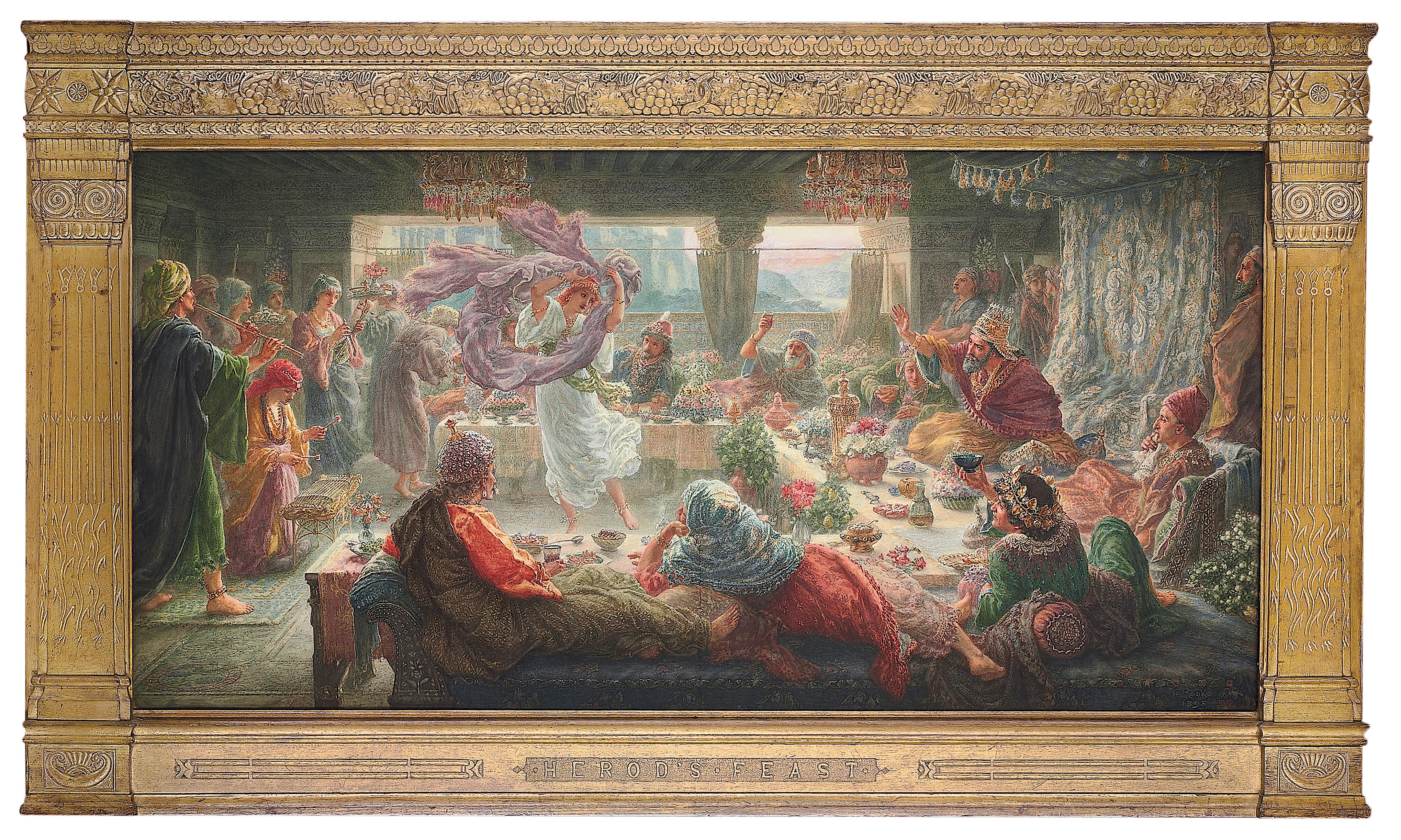
Herod's Feast, by Thomas Matthews Rooke, RWS (1842-1942). 1895. Pencil and watercolour, with gum arabic, heightened with gouache and with scratching out, on paper. 29½ x 61½ in. (75 x 156.2 cm.). Private collection, ©2010 Christie's Images Limited, reproduced here by kind permission (right click disabled; not to be downloaded).
Herod's Feast is one of the most important watercolours Rooke ever painted and the picture was widely exhibited at the time. It was shown in London at the Royal Society of Painters in Water Colours in 1895, no. 72, and later that same year at the Liverpool Autumn Exhibition of Pictures at the Walker Art Gallery and the International Exhibition in Rome. In 1899 it was shown at the Autumn Exhibition of the Royal Birmingham Society of Artists, and in 1907 at the International Exhibition, Christchurch, New Zealand.
This is another of the religious pictures which had formed such an important part of Rooke's oeuvre ever since the start of his career. As early as 1877 he had exhibited The Story of Ruth at the Royal Academy. The painting illustrates the famous biblical story of Salome's dance told in the Gospels of Matthew XIV, 1-12, and Mark VI, 14-29. Although Salome was not mentioned by name in the Bible, she was named by Josephus in his Jewish Antiquities.
The painting shows King Herod and his guests at his birthday celebration feast, seated or lying on couches before a low table in his palace. Herod, in the centre right, raises his right hand in praise of Salome's performance of her dance. Salome is in the centre, dressed in white, with swirling purple draperies as part of her dance. Her mother Herodias is presumably one of the women reclining in the foreground. The painting is in its original frame, presumably of Rooke's own design. When Rooke's watercolour sold at Christie's in 2010 their experts revealed that, according to a letter from Rooke of which a transcript survives, "he was inspired to paint the picture by hearing Sir George Macfarren's oratorio St John the Baptist at Exeter Hall in the Strand. First performed in 1873, the piece was one of the most popular productions of this blind composer and friend of Mendelssohn."
The subjects of both Salome's dance and Salome with the severed head of John the Baptist were popular, not only amongst the Old Masters, but particularly artists associated with the European Symbolist Movement, including Gustave Moreau's famous work L'Apparition, which had been shown at the Grosvenor Gallery in 1877. The symbolists, however, tended to focus on the more gruesome incident of Salome with the head of John the Baptist. It is of course possible that Rooke may have discussed with Burne-Jones the notorious play Salome by Oscar Wilde that was published with Aubrey Beardsley's decadent illustrations in 1894, the year prior to Rooke's painting. Victorian artists who also painted images of the notorious femme fatale Salome include Frederic Leighton's Salome Dancing of c.1863, Robert Fowler's The Dance of Salome of 1885, G. F. Watts's two quite different versions of The Daughter of Herodias, and A. S. Coke's The Daughter of Herodias of 1881.
Contemporary Reviews of the Painting
When this picture was shown at the exhibition of the Royal Society of Painters in Water Colours in 1895 it received poor reviews. The critic of the Art Journal merely remarked: "Mr. T.M. Rooke in Herod's Feast, not so good as he has done" (192). F. G. Stephens in the Athenaeum criticised the painting's execution, handling, and finish:
Herod's Feast (152) is an ambitious subject, such as Mr. T. M. Rooke often selected in former days, but has seldom essayed of late, and, besides, it is on a larger scale, and there is a greater number of figures, than we have recently found Mr. Rooke introducing. The most important figure in an overcrowded composition is the not too beautiful Salome. Her draperies are flying in a suggestive and natural way as she dances with great spirit before the Tetrarch, who surely was not as stupid as Mr. Rooke thinks. The courtiers and women who recline at the tables are commonplace, and the picture, being exceptionally confused and wooly, is flat withal, and greatly in need of massing. The execution, handling, and finish, or what does duty for finish, are rather loose and lack research. [542-43]
The picture was also reviewed in local papers when it was shown at the provincial centres.
Bibliography
"Art Notes and Exhibitions."The Art Journal LVII (1895): 191-92.
"The Exhibition at the [Birmingham] Society of Artists." The Owl (15 September 1899: 7.
"Our London Letter." Sheffield and Rotherham Independent (19 April 1895): 4.
"Royal Society of Painters in Watercolours." The Standard (22 April 1895): 3.
"Royal Society of Watercolour Painters." The Glasgow Herald (19 April 1895): 9.
Stephens, Frederic George. "Fine Arts. The Society of Painters in Watercolours." The Athenaeum No. 3522 (27 April 1895): 542-43.
Created 17 January 2026