
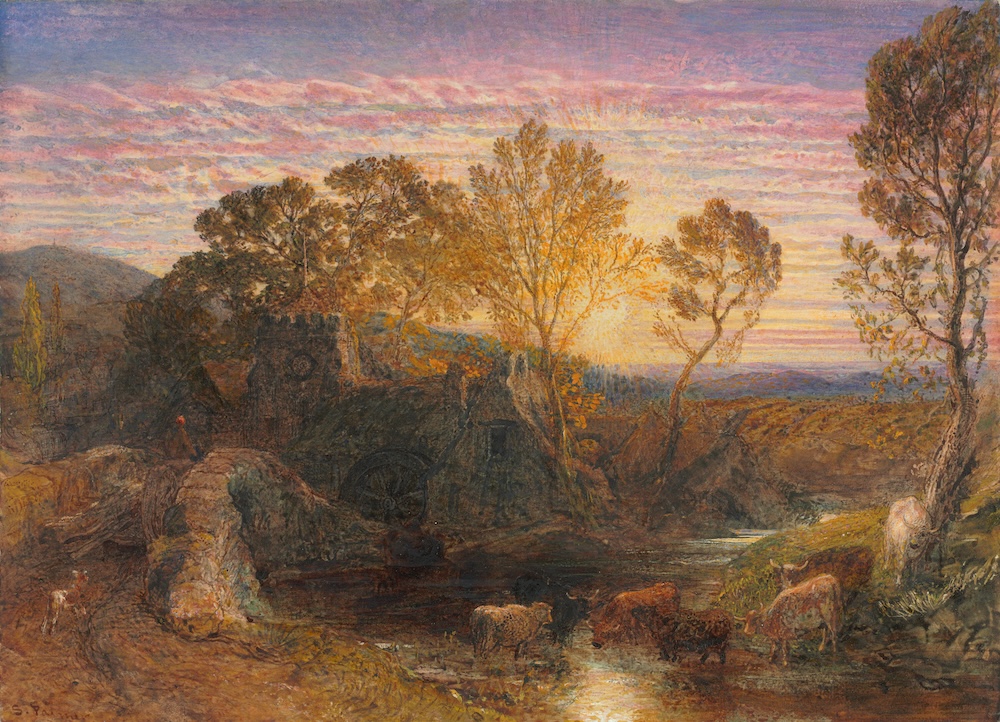
The Golden Hour, by Samuel Palmer (1805–1881). 1865. Watercolour and gouache with graphite and scraping; sheet: 25.6 x 35.4 cm (10 1/16 x 13 15/16 in.). The Cleveland Museum of Art, The Severance and Greta Millikin Purchase Fund, 2009.3. Image identified as being in the public domain.
The work was shown in the Watercolour Room of the Royal Academy (140) in 1891 accompanied by the lines:
Though heaven and earth with August glow
Our island streams unstinted flow.
The museum note suggests that the work was painted towards the end of Palmer's life, but he was only about 60 when he was painting it, and it is more accurate to say (as the note continues) that by this stage the artist had begun "to focus primarily on naturalistic landscapes that he hoped would be commercially successful in order to contend with the practical responsibilities of married life and family." Here, he paints the same kind of rich sunset that he would paint later in Going to Evening Church (1874). The museum note adds, "An autumn sky heavy with rows of cumulus clouds shimmers in a pattern of pink and amethyst, as slivers of golden light emanate from the setting sun. The idyllic landscape is an elegy not only to a passing day, but to the brevity of life itself."
Helpfully picking out the details, Raymond Lister's note in the Catalogue Raisonée reads:
An English idyll, lightly painted with much dappling of texture. The bars of cirrus and the setting sun, the cottage (a memory of the Shoreham years), the stone bridge with a labourer, his dog and a wain passing across it, the ancient church, and the cattle contentedly paddling are all skilfully woven into a composition which conveys a romantic picture of the English countryside. [203]
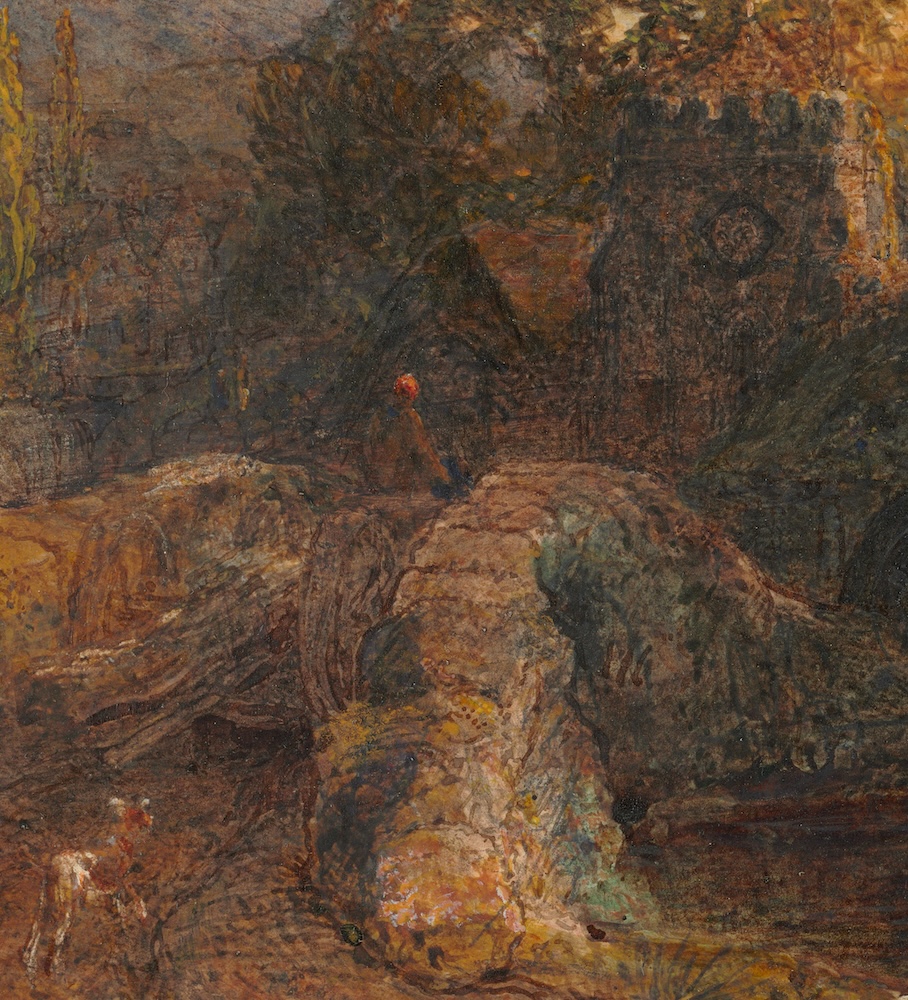
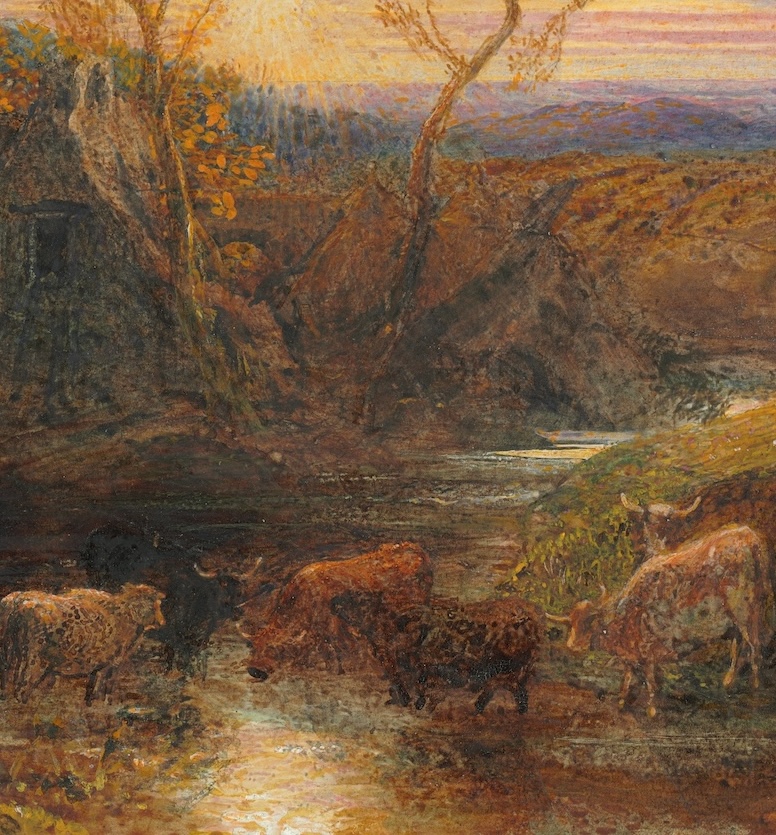
Closer views. Left: The bridge and the church. Right: The stream.
Indeed, the church and cottage are so much a part of the landscape that it is easy to miss them, only the cottage gable and the crenelated tower of the church, with its flagpole, giving clues as to their presence. The labourer crossing the bridge on his wain is almost indistinguishable from his surroundings too, except for the point of colour in his cap, and the hints of the wheels so close to the stone edges of the bridge. Even the cattle and dog are tinged with the shades of sunset. Neither of the comments given above mentions the glinting, winding stream (apart from Lister's pointing out that some of the cattle are "paddling" — presumably, drinking — there).
It is tempting to identify the place as a scene in the Darent Valley in Kent, which is often called "Palmer Country," and has possible sources for the stone bridge and historic church. But it is probably a vision of the ideal.... a very beautiful, nostalgic, intensely personal vision of Home Counties countryside. — Jacqueline Banerjee
Bibliography
Exhibition of Works by the Old Masters, and by the Deceased Madsters of the British School; including a collection of water colour drawings illustrating the progress of the art of water colour in England. London: Clowes and Sons, 1891. Google Books. Free to read.
The Golden Hour. The Cleveland Museum of Art. Web. 11 February 2026.
Lister, Raymond. Catalogue Raisonné of the works of Samuel Palmer. Cambridge: Cambridge University Press, 1988. no.646, p. 203.
Created 11 February 2026