
The essay first appeared in the Pre-Raphaelite Society Review, Vol. XXXIII (Spring 2025). Reproduced here with the permission of the author and editor, it has been lightly edited and adapted to suit our own format. Click on all the images, except the one of the film still, to see larger pictures and more information about them on our own website. — Simon Cooke

ince its publication in 1603, Hamlet has remained a powerful source of inspiration for subsequent generations of writers. Numerous derivative works of this Shakespearean text have emerged, presenting its story from alternative perspectives or relocating it to different settings, serving as either sequels, prequels, or alternative retellings to the original play. Moreover, Shakespeare’s portrayal of Ophelia has sparked significant debate among critics because of her complex status as a female figure in the play. Over the years, her portrayal has undergone continual transformations: from being seen as a victim of a male-dominated society she has come to seem a feisty protagonist with the ability to inflict immense suffering on her adversary. However, the Pre-Raphaelite Brotherhood played a crucial role in redefining the portrayal of Ophelia, recognising her as the epitome of ideal womanhood: she became a symbol of beauty amidst the intense debates surrounding the position of women in the nineteenth century (see Falchi 175).
Ophelia's presence in the play is limited: she appears in only five out of Hamlet's twenty scenes, although Polonius and Laertes mention her in two additional scenes. Yet artists and filmmakers have continued to find inspiration in her, while literary critics ranging from Structuralists, Deconstructionists and Poststructuralists to psychoanalysts and New Historicists have discussed her extensively.
Initially, Shakespeare presents Ophelia primarily as Polonius's daughter, defined relationally within a patriarchal hierarchy. This particular element may appear inconsequential, but it is evident that Ophelia is subservient to the patriarchal structure of society. Her portrayal is characterised by compliance and lack of resolve. She is uncertain about whether to trust Hamlet’s love or her father’s statements. According to Anna Jameson, ‘she says very little, and what she does say seems rather intended to hide than to reveal the emotions of her heart’ (262). Ophelia begins to lose her senses due to Hamlet’s ill treatment. His behaviour is, in fact, a reflection of the aggression he feels towards his mother. Ophelia is largely constructed as a passive, mostly silent character who nonetheless harbours a desire for agency. She breaks her silence when madness strikes her, and her words reveal a lot about the play. In Shakespeare's time, Ophelia was considered a paradigm of erotomania or love-melancholy, a condition whose symptoms — intense sadness, obsessive thoughts and hallucinations — were thought to be caused by unrequited or excessive love, and to particularly affect women. In the eighteenth century her part was often cut or censored because of the lewdness of these mad songs, which were condemned as unsuitable and indecent. For that reason, Falchi observes,
the moments before her death were typically considered appropriate for Victorian standards, as ladies could draw from them a vital lesson on the lessons of abandoning themselves to their own passions [since] the anticipation of Ophelia’s tragic ending would have satisfied the converted desire for pathos. [176]
Arguably, there has been an increasing interest in Ophelia since the eighteenth century, when commentators seemed so uncomfortable with Shakespeare’s presentation of her. What the Pre-Raphaelites intended to offer was a distinct portrayal of Ophelia in their paintings, and their very different interpretations of Ophelia titillated the Victorians. She emerged as a paragon of femininity for these artists, not only embodying purity but also serving as a pattern for several virtues. This depiction of her in pre-Raphaelite art, to some extent, influenced how she was later portrayed in modern English literature. Both Shakespeare’s original text and pre-Raphaelite paintings have shaped Ophelia’s portrayal, offering an alternative perspective on her, or, to a significant extent, inspiring contrasting depictions of her.
The Pre-Raphaelite fascination with Ophelia can be traced to a convergence of several influential factors. Firstly, during the Victorian era Hamlet held a revered status in literary and cultural circles. The play’s themes of love, loss, and tragic fate resonated profoundly with the romantic and emotional currents that the Pre-Raphaelite Brotherhood sought to encapsulate in their artistic endeavours. Ophelia, as a tragic heroine, became a poignant symbol of the emotional turbulence and fragile beauty that captivated the imagination of the Pre-Raphaelite artists. Kaara Peterson and Deane Williams argue that
Ophelia is not the subject of these artistic explorations, then, but John Everett Millais is, as the artist-renderer, with Ophelia remaining as an index for Pre-Raphaelite notions of feminine beauty, death, lack of agency.... Millais’ floating Ophelia becomes a marvellous accident of her painters’ aesthetic prescriptions that later artists seek to interrogate critically, just as the Pre-Raphaelite movement had done before them. [8]
Secondly, Ophelia provided a fertile thematic ground for Pre-Raphaelite painters to explore their core aesthetic principles. The movement rejected prevailing academic norms, opting instead for a return to the detailed and vibrant style of the Italian Renaissance. Ophelia’s narrative allowed them to delve into themes that were central to their artistic vision, such as beauty, nature, and melancholy. Her story became a canvas upon which they could project their fascination with the mediaeval past and their critique of the perceived superficiality of contemporary art. Furthermore, Ophelia’s connection to water and flowers added a layer of symbolism that deeply appealed to the Pre-Raphaelites. Water, often associated with purity and transformation, provided a dynamic element in the compositions. In some of these paintings, the depiction of Ophelia floating in a stream or surrounded by water lilies not only conveyed her tragic end but also allowed artists to showcase their technical prowess in rendering the play of light and reflections on water surfaces.

J. E. Millais, Ophelia, 1851–2, watercolour. Courtesy of Peter Nahum at the Leicester Galleries.
Moreover, fluidity permeates the depiction of Ophelia’s drowning and indicates a loss of her sense of self. The portrayal of the female figure in the artwork shows her suspended in the stream, encompassed by an array of flowers (which heralded and foreshadowed psychic disturbance and instability). Flowing water represents the fluidity of Ophelia’s emotions and the depth of her inner turmoil, while the flowers symbolise her fragile and transient nature. Flowers, laden with symbolic meanings, allowed the Pre-Raphaelite artists to infuse their works with layers of visual and emotional complexity. By entwining Ophelia with blossoms, a visual poem is created where each bloom can be seen as a metaphor for various aspects of her character and the themes explored in Hamlet. Hence, the Pre-Raphaelite fascination with Ophelia was a result of the perfect alignment between the character’s tragic narrative, the thematic richness it offered, and the technical opportunities it presented. Through their depictions of Ophelia, the Pre-Raphaelite artists not only paid homage to Shakespearean drama but also articulated their distinctive blend of romanticism, symbolism, and meticulous craftsmanship. Over time, then, the Shakespearean fair Ophelia evolved into a ‘Cubist Ophelia,’ a multi-faceted, complex heroine who represents not only the victims of patriarchal dominance but also a version of
Firstly, John Everett Millais’s portrayal of Ophelia stands as an iconic masterpiece within the realm of Pre-Raphaelite art. As a result of his desire to achieve his ideal of a perfect imitation of nature and the original text, Millais depicts Ophelia in the immediate moments preceding her death, immersed in nature and water. Most of the flowers in the painting appear in Shakespeare's text, either in Gertrude’s speech or Ophelia's snatches of song; those that do not are included because of their symbolic meaning, such as the forget-me-nots, the pansies, representing unrequited love, and the poppy, representing Sleep, brother of Death, which reflects Ophelia’s floating into oblivion without suffering.
The sitter for Millais’s painting was the painter and poet Elizabeth Siddal, wife of Dante Gabriel Rossetti. In the circle of Pre-Raphaelite artists and their associates, there was a commonly recognized connection between Elizabeth Siddal and Shakespeare’s character Ophelia. This connection likely stemmed from Siddal’s melancholic beauty, delicate health, and tragic life – qualities that mirrored Ophelia’s fragility and descent into madness. Millais, by choosing Siddal as the model for his painting of Ophelia, almost certainly referenced or played upon this symbolic link. Elizabeth Siddal represents a real-life embodiment of Ophelia in the eyes of the Pre-Raphaelite group and this connection was reflected or subtly implied in Millais’s image of the drowning character.
The association between Siddal and Ophelia also served as a wellspring of inspiration for Rossetti’s paintings and poetry. He crafted a pen and black ink depiction of Act III, Scene I, in 1858 (The British Museum, London). Certain aspects of Rosetti’s depiction of Ophelia appear to indicate that Rossetti regarded Ophelia as the catalyst for Hamlet’s insanity. Rossetti’s ink sketch of Ophelia resembles the iconography he uses in The Annunciation (Tate Britain, 1850), drawing a visual and thematic parallel between Ophelia’s temptation and Mary’s perfect chastity. In this comparison, Ophelia becomes a kind of anti-Madonna figure, caught in a world that offers no redemption. Unlike Mary, whose purity is affirmed through divine communication, Ophelia receives no such response; Hamlet, the man she looks to, offers only confusion and cruelty, leaving her isolated and unheard.
Rossetti drew or painted several related art works depicting Ophelia and her encounter with Hamlet. In each of these, he challenges the conventional portrayals of Ophelia as a passive victim, instead presenting her as a complex and autonomous character navigating the intricacies of her own emotions. Through the meticulous use of non-verbal cues, Rossetti invites viewers to delve into the psychological depths of the characters, prompting a re-evaluation of the Victorian idealisation of Hamlet and Ophelia. All of the images stand as a testament to Rossetti’s ability to convey profound emotional narratives through the subtleties of visual art, offering a fresh perspective on one of Shakespeare’s most resonant scenes.


Rossetti's studies. Left to right: a) Hamlet and Ophelia — Compositional Sketch, 1854, pencil on paper. Photo © Birmingham Museums Trust. (b) The First Madness of Ophelia (Horatio Discovering the Madness of Ophelia), 1864, watercolour. Collection: Gallery Oldham. (c) Hamlet and Ophelia — Compositional Study, 1865, pen and brown ink on pencil and paper. Photo © Birmingham Museums Trust.
After Siddal’s death, Rossetti painted more Ophelias with her features, notably in 1864 and 1866 (Ashmolean Museum, Oxford). Particularly haunting is the scene from Act IV in The First Madness of Ophelia (1864, Oldham Art Gallery). There, as David Sonstroem explains (95–97), Ophelia appears as a pitiable, mad, and disquieting young woman, being drven out of view, with Claudius and Gertrude looking at her as a ‘poor wretch.’ Her eyes look out of the canvas, accusing her own painter of driving her to madness. The watercolour medium allows for a delicate and nuanced exploration of Ophelia’s mental state, with Rossetti employing a meticulous approach to capture the emotional intricacies of the character. The composition likely reflects Rossetti’s deep engagement with the psychological aspects of Ophelia’s descent into madness. The use of watercolour, with its translucent and fluid qualities, adds a layer of fragility to the portrayal, echoing the delicate state of Ophelia’s mind. The scene unfolds with a sense of intimacy as Ophelia is comforted amidst her nonsensical utterances, creating a stark contrast between her vulnerable state and the regal presence of the king and queen. In the first painting, Rossetti focuses on the emotional undercurrents in Shakespeare’s text, emphasizing the tragic disconnect between Hamlet and Ophelia, even in moments of physical closeness. Furthermore, this painting represents the psychological complexity of Hamlet’s character, torn between his love for Ophelia and his mission to avenge his father’s death. Ophelia’s position in the painting reflects her increasing fragility, as she is caught in the crossfire of Hamlet’s inner turmoil.
Rossetti’s depiction of Ophelia’s first madness is rich in literary symbolism. The wildness of her appearance and surroundings reflects the breakdown of her mind, a theme central to Shakespeare’s portrayal of the character. Her connection to nature, particularly through the flowers, underscores her innocence and the purity of her love, which are ultimately destroyed by the harsh realities of the world around her. Rossetti delves deeply into Ophelia’s psyche, emphasizing her emotional turmoil and isolation. The painting is a poignant exploration of the destructive power of unrequited love and the inevitable collapse of a fragile mind under immense pressure.
In his later work, Hamlet and Ophelia (1866), Rossetti revisits the interaction between Hamlet and Ophelia. The scene is more intense, with Hamlet’s posture and expression reflecting greater conflict and Ophelia’s demeanor showing more pronounced distress; the composition reflects the growing emotional and psychological distance between them. Rossetti captures the moment when their relationship is irreparably damaged by Hamlet’s actions and words, leading Ophelia further into madness. Here, Rossetti emphasizes the tragic inevitability of their relationship’s collapse. The work serves as a visual metaphor for the destructive power of Hamlet’s indecision and Ophelia’s vulnerability. The tension between them is symbolized through their physical distance, despite being in the same frame. Hamlet’s darker clothing contrasts with Ophelia’s lighter dress, highlighting the dichotomy between his dark thoughts and her innocence.
John William Waterhouse depicted Ophelia in three of his paintings, but it is the second one from 1894 that embodies the conventional style of the Pre-Raphaelite Brotherhood. He portrays a young woman from the Middle Ages or Romantic era, wearing a historically accurate outfit that corresponds to the time of Arthurian adventures. Waterhouse’s allegiance is to the imaginative and romantic style of the Brotherhood, a group that aimed to resist progress and the industrialised contemporary world (Benton & Butcher 54). In each of the three versions, the conversion of Ophelia is grounded on a drowning scene absent from Shakespeare’s play and achieved by destabilising the original text. The painter transforms the scene of Ophelia’s drowning into a subjective and mental creation in Waterhouse’s visual target texts. In the absence of a direct portrayal of the character’s death by the playwright, the painter constructs specific representations of the character. The painter’s portrayal and the literary text implicitly convey a time that powerfully emphasises a high level of destabilisation, effectively filling the gap in the play (the drowning scene).
Although there are similarities in the theme of conversion in the three paintings, the subsequent stage of conversion varies significantly between each picture. This leads to a series of visual moments that specifically address the arrangement of time and space, the character, and the details. Waterhouse decided to romanticise their portrayal of the young Ophelia, and, thus, she became an idyllic youthful beauty surrounded by magnificent nature. All these Ophelias seem to be a representation of the heroine’s ordinary and sweet life in the countryside before her downfall into madness. Waterhouse’s painting resembles Millais’s because he wanted to highlight her association with water (nature), melancholy, grief, and her final destiny, death (see Falchi 176).
Visual Intertextuality in Claire McCarthy’s Ophelia
In 2018, Claire McCarthy adapted Lisa Klein’s ‘young adult’ novel Ophelia (2010) for the big screen. Klein’s novel boldly reimagined Shakespeare’s tragedy by foregrounding and centring its heroine’s narrative (ICF Films). McCarthy's film, bearing the same title, draws inspiration from Klein’s novel and features depictions of Ophelia alongside the Pre-Raphaelites and serves as another excellent example of intertextuality, particularly pictorial intertextuality. Notwithstanding the fact that the film recounts Hamlet’s story, it is Ophelia who is given agency to express her own point of view, ‘giving greater complexity to her as a three-dimensional character, formerly only limited, subordinate, and tragic’(Ue 208). As McCarthy admits, her intention is for this retelling to give much more gravitas to Ophelia than she was afforded in Shakespeare’s original storyline. It is [her] hope that ‘an audience can re-experience the Hamlet that they know and love with added delight and whimsy due to the shift in the narrative axis’ (Ue 208). Likewise, the camera angles emphasise that Ophelia is experiencing the action from her point of view. This alteration allows Ophelia to engage in her own character development within the film, rather than being portrayed as a passive observer as in previous adaptations. This iteration departs from the traditional linear structure of introduction, climax, and conclusion. Instead, it adopts a circular framework, beginning with Ophelia's apparent drowning – or, as the film unfolds, a ruse to portray her suicide in the river — and loops back to that moment after narrating the events that led to it. This method retells the narrative for an audience already familiar with the source material, aiming to present an alternative perspective on the text. Lavinia Hulea reflects on McFarlane and Hutcheon’s arguments, arguing that
[A] target text relying on a literary source text must reinterpret the source text and not only reproduce it, but their theoretical approach also differs in terms of alteration of the source text: where McFarlane sees the target text as entirely different, Hutcheon implies that the source text continues to be recognizable within the target text. [944]
The contrast between literature and painting in their treatment of time reveals a fundamental difference in how each medium engages with the concept of persistence and temporal experience. A painting captures a single moment or brief interval, encapsulating the experience of time within a fixed visual frame. This aligns with Gotthold Ephraim Lessing’s argument, as discussed by Joseph Frank, that the plastic arts - such as painting - are inherently spatial in form. According to Lessing, this spatiality allows for the presentation of visible aspects of objects juxtaposed in an instant of time. The visual medium of painting, therefore, deals with time in a way that is constrained to a single, unchanging moment, preserving the temporal snapshot within a spatially oriented composition. In contrast, literature, as a medium reliant on the progression of language, unfolds over time and space. This dynamism allows for a narrative to develop, transitions to be observed, and ideas to evolve as the reader progresses through the text. Unlike painting, which is experienced in a singular temporal instance, literature engages with time by allowing it to transpire gradually. Words and sentences are read sequentially, creating a temporal experience that is both linear and cumulative. This quality of literature exemplifies its dynamic nature, as it operates within the temporal flow, facilitating the potential to observe and appreciate transitions, character developments, plot progressions, and thematic evolutions.
Marshall McLuhan’s and later Jay David Bolter and Richard Grusin’s concepts of remediation further elucidate this contrast by highlighting how each medium interacts with and transforms other media within a broader media context. McLuhan posits that every medium is an extension of human senses, reshaping our perception and interaction with the world. Bolter and Grusin expand on this by emphasizing that each medium is a product of remediation, which occurs as new media emerge and reconfigure the role and function of existing media. The relationship between literature and painting can be understood through this lens, where each medium influences the other, transforming how time and space are perceived within the cultural and artistic landscape. For instance, literature can evoke vivid visual imagery that rivals the immediacy of painting, while painting can suggest narratives that unfold in the viewer's mind, akin to the temporal progression in literature. However, the distinctive characteristics and limitations of each medium – literature's temporal dynamism and painting's spatial staticity – define how they engage with time and persistence. This difference underlines the unique capabilities and artistic expressions inherent in each form, illustrating the broader notion that media continuously interact, influence, and transform one another, shaping our understanding of art, time, and experience in the process.
Klein’s intermedial conversation with Pre-Raphaelite paintings, as well as the film industry’s appropriation of that discourse, point to a multidimensional intertextuality between the visual and cinematic spheres. According to Lara-Rallo, ‘Challenging the notion that intertextuality ought to be limited to exclusively textual works [...] demonstrates this renewed interest in the imaginative potential of aesthetic cross-fertilisation’ (97). We can view Shakespeare's text as provoking two responses: first, the text’s vivid imagery lends itself to transformation into pictorial imagery, resulting in Pre-Raphaelite paintings; second, its complex figuration of Ophelia provides rich ground for novelists such as Klein to turn the female love interest into a protagonist who writes her own story. The cinematic version then incorporates Klein’s text and some Pre-Raphaelite paintings, combining visual and linguistic elements to form a new image.
As a result, McCarthy’s adaptation is inspired by its source material: depictions of Ophelia in Pre-Raphaelite painting and Lisa Klein’s novelized Ophelia. On the one hand, Klein’s novel offers McCarthy a dynamic perspective in which Ophelia’s character gradually alters throughout the novel, eventually attaining the ability to direct and plot own ‘suicide.’ On the other hand, Millais’s Ophelia (1851) keeps the heroine immobile, since the canvas freezes in time the moment of Ophelia’s tragic demise, making it difficult for the viewer to determine the cause that precipitated her decline. Millais’s Ophelia is to be pitied, not judged. Notably, Millais depicts a moment left undramatized by Shakespeare’s play because in Hamlet Ophelia’s death occurs offstage and its events are not seen but only heard through Gertrude’s narration. Thus, I contend, by visually evoking two Ophelias that are simultaneously dynamic and lifeless; subject and object; active and passive; self-determining and victim of fate; McCarthy’s film adaptation offers viewers an altogether unique Ophelia.
It can be further argued that McCarthy’s film employs pictorial-filmic intertextuality as a central mechanism to construct the narrative and enrich its portrayal of the novel’s characters. McCarthy portrays Ophelia as a complex and multi-layered entity, influenced by various artistic representations across media like paintings, literature, and theatre. I will examine five cases in which Pre-Raphaelite representations of Ophelia in painting are cinematically transformed by McCarthy’s adaptation. Hence, I propose McCarthy’s Ophelia becomes a tapestry of visual cues and symbolic gestures, creating a rich and nuanced portrayal of femininity, vulnerability, and resilience. By presenting Ophelia as a palimpsest, the film invites viewers to engage with familiar archetypes and motifs in new and thought-provoking ways. Through this interplay of visual elements and cultural references, McCarthy's film transcends traditional storytelling boundaries, offering a captivating exploration of the human experience. Media interact directly or indirectly, continually transforming one another within the broader medial context.
To begin, let us consider the Millais’s renowned Ophelia (1852). In this painting, Millais portrays the lamentable submersion of Ophelia in a river. Due to his aspiration to attain an exact replica of the Shakespearean text and the natural world, Millais portrayed Ophelia in the moments immediately preceding her demise – drenched in water and nature. A significant portion of the floral elements depicted in the painting find their origins in the Shakespearean text, either through Gertrude’s speech or Ophelia’s snatches of song. Those that do not, such as forget-me-nots and pansies, serve as symbolic representations of unrequited love. Furthermore, the poppy, which mirrors the painless demise of sleep, represents the brother of Death. In comparison, in Klein’s novel, she has Ophelia narrate her suicide:
I tried to feel the potion working. Nothing happened yet. I sought some pleasant sensation, a comforting memory, but felt only growing panic. Suddenly I feared the coming oblivion. [...] My breath grew short as terror rose in me. I pushed against the earth, trying to stand, and found my fingers tangled among the cool, waxy leaves of the mallow plant that clung to the marshy verges of the river. [...] The branch bent under my weight as if delivering me to the deep, and I murmured, ‘I come to you, waters of death and life. Take me from this world of madness and strife.’[Klein 135]
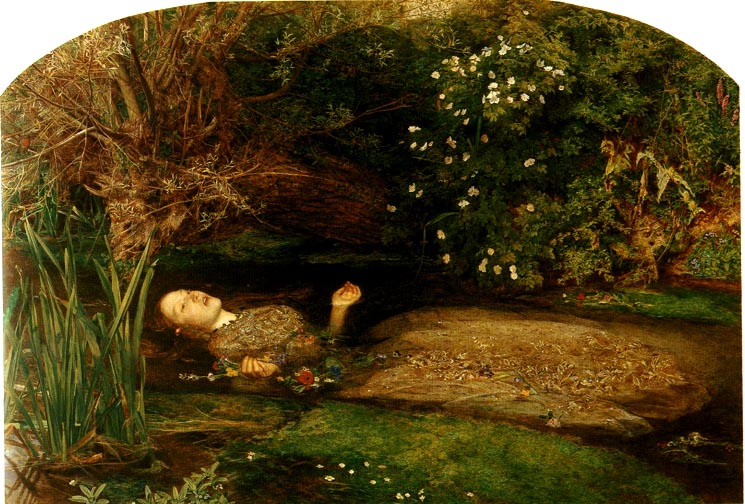

Left: Ophelia by Millais, 1851-52, oil painting. Courtesy of Tate Britain. Right: A still from McCarthy’s film, included in this version for purposes of critical analysis.
Ophelia’s self-narration, along with Millais’s painting, is reconstructed in the opening scene and first lines of McCarthy’s film. The film opens with a shot of Ophelia half-submerged and suspended in a river with flowers clasped in her left hand, strongly evocative of Millais’s painting, while actor Daisy Ridley is heard speaking in a haunting voiceover: ‘You may think you know my story. Many have told it. It has long passed into history ... into myth,’ suggesting that this adaptation told in Ophelia’s own words offers the viewer privileged access into Ophelia’s story and inner life as opposed to the misconceptions, or skewed narratives that came before.
The second of our Pre-Raphaelite paintings cinematically recreated is Gather Ye Rosebuds While Ye May or Ophelia (1908, Private Collection) by John William Waterhouse. Waterhouse captures Ophelia in a state that seems to foreshadow her tragic end, as she is on the verge of losing herself to the overwhelming emotions that lead to her death. The artist portrays Ophelia holding of a bouquet of flowers, and the setting of this scene is the nuptials of Queen Gertrude. Waterhouse’s title alludes a famous line from Robert Herrick’s poem, which urges the reader to seize the day (Carpe Diem) and make the most of their youth. This creates a poignant contrast with the fate of Ophelia, who is unable to grasp the joys of life, and ultimately succumbs to tragedy. In this case, the allusion implies the possibility of agency - a chance to change her destiny. But, tragically, the possibility remains unrealized. This visual reference is echoed in the film adaptation where the mise-en-scène and Ophelia’s styling consciously evoke Waterhouse’s painting, reinforcing the thematic tension between youthful potential and inevitable decline.
Conversely, Arthur Hughes's painting Ophelia (1865, Manchester City Art Gallery) draws inspiration from a scene from Hamlet alluding to Act IV Scene V, shortly after Hamlet has murdered Polonius, during which Ophelia utters the following:
And will he not come again?
And will he not come again?
No, no, he is dead;
Go to thy deathbed;
He never will come again … [HamletIV, V, 213–217]

Arthur Hughes, Ophelia, 1852, oil painting. © Image courtesy of Manchester Art Gallery.
Despite the allusion to an event taking place within the castle, Hughes has portrayed Ophelia mere minutes before her drowning, as she gathers wildflowers in front of a decaying willow tree that extends into a significantly larger body of water. Ophelia wistfully looks over the shoulder as if she has seen or is expecting to see her lover return – her longing stares out of the canvas. Water is hardly discernible amidst the dense shade; only a limited number of vividly reflected objects on its surface indicate its nature. Although Hughes's attention has marginally deviated from the tragic pinnacle of the story, understanding it still requires an equivalent degree of familiarity with the original theatrical production.

Miss Kemp as Ophelia, 1843-47, photograph by Hill and Adamson.
Departing from this analysis is Waterhouse’s La Belle Dame Sans Merci (1893, Hessian State Museum, Darnstadt), the final painting. This work refers to John Keats’s eponymous poem, as suggested by its title. As is common knowledge, this text recounts the story of a ‘faerie’ who seduces a knight with her singing and eyes and sentences him to an ordeal more dire than death. The portrayal of this faerie has generated an aura of iconic status that has served as a wellspring of creativity for artists who have fashioned an iconography offemme fatale. Although the scene from the film is entirely unrelated to the poem’s plot, there are some visual parallels: for example, the action unfolds in the woods, which serves as a backdrop for the developing drama and imbues the encounter with an air of enigma and unpredictability – a motif that appears in both the painting and the poem. Moreover, the characters’ clothing in the film bears resemblance to the garments donned by the lady and the knight in Waterhouse's painting, thereby strengthening the correlation between the two artistic creations.
In conclusion, portrayals of Ophelia in Pre-Raphaelite art are not a mere reflection but transformative reinterpretations of a Shakespearean heroine that significantly influence how Ophelia is depicted in (modern and) post-modern adaptations. Klein’s use of intertextual conversation between Pre-Raphaelite paintings and their film translation suggests a sophisticated and intricate process of combining visual and cinematic references. The text by Klein and the paintings mentioned earlier combine to create a visual novel. Consequently, McCarthy’s film adaptation continues to merge, navigate and venture through Klein’s visual imagery and a world of Pre-Raphaelite paintings. This multifaceted, symbiotic relationship between stage, page, canvas and screen ultimately challenges conventional notions of rigid disciplinary and medial boundaries.
Related Material
Bibliography
Benton, Michael, and Butcher, Sally. ‘Painting Shakespeare.’ Journal of Aesthetic Education 32, 3 (1998): 53–66.
Falchi, Simonetta. ‘Re-mediating Ophelia with Pre-Raphaelite Eyes.’ Interlitteraria 2 (2015): 171–178.
Hulea, Lavinia. ‘Ekphrasis and Reversed Ekphrasis as Adaptation Process.’ Journal of Romanian Literary Studies 6 (2015): 939–944.
Jameson, Anna. Characteristics of Women: Moral, Poetical and Historical. Virginia: Broadview Editions, 2005.
Klein, Lisa. Ophelia. London: Bloomsbury, 2007.
Lara-Rallo, Carmen, ‘Ekphrasis Revisited: Crossing Artistic Boundaries.’ In Relational Designs in Literature and the Arts. The Netherlands: Brill, 2012. 97–108.
Peterson, Kaara L. and Williams, Deanne., eds. The Afterlife of Ophelia. London: Palgrave Macmillan, 2012.
Showalter, Elaine. ‘Representing Ophelia: Women, Madness, and the Responsibilities of Feminist Criticism.’ In Shakespeare and the Question of Theory. London: Routledge, 2004. 77–94.
Sonstroem, David. Rossetti and the Fair Lady. Middleton, CT: Wesleyan University Press, 1970.
Ue, Tom. ‘Madness and Metaphor in Lisa Klein’s and Claire McCarthy’s Ophelia.’ The Shakespearean International Yearbook. London: Routledge, 2020. 203-216.
Created 4 March 2026
Last modified 15 March 2026