
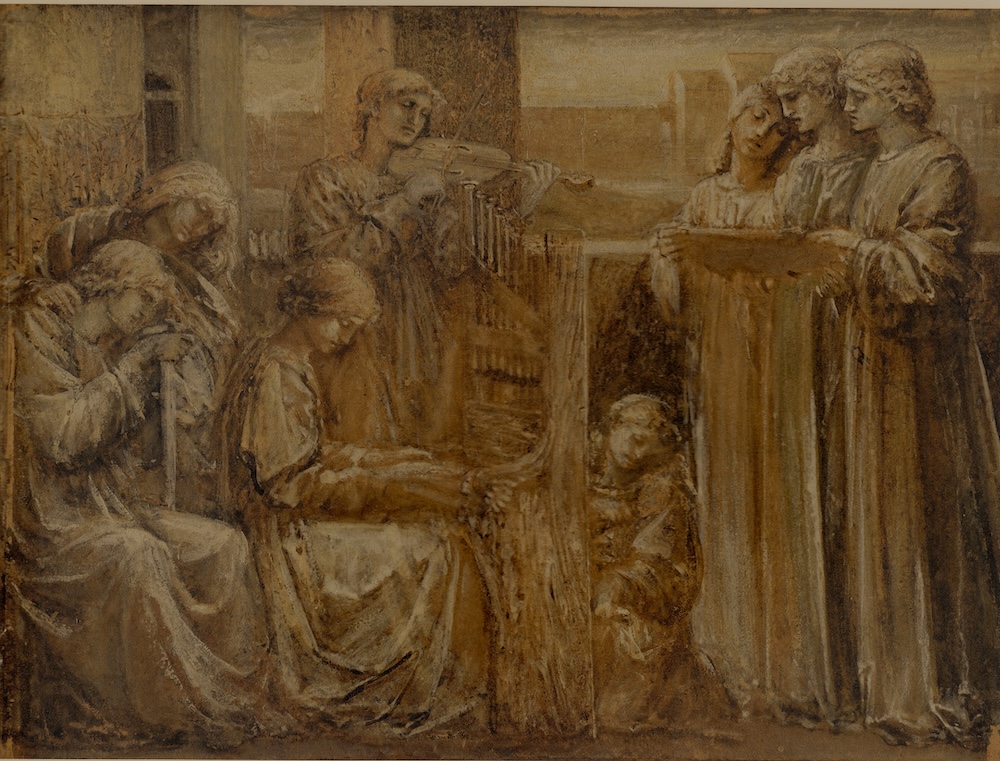
Study for St. Cecilia. c. 1875. Watercolour, gouache and ink with scraping en grisaille on brown paper. 9 1/2 x 12 3/4 inches (24.2 x 32.3 cm). Collection of the National Gallery of Canada, accession no. 49763. Image courtesy of the author. [Click on this and the following images to enlarge them.]
According to legend Cecilia was a Christian noblewoman of Rome who, despite her vow of virginity, was forced by her parents to marry a pagan nobleman named Valerian. During the wedding, Cecilia sat apart singing to God in her heart and for that reason she was later declared the patron saint of musicians. When the time came for her marriage to be consummated, Cecilia told Valerian that watching over her was an angel of the Lord, who would punish him if he sexually violated her but would love him if he respected her virginity. When Valerian asked to see the angel, Cecilia replied that he could if he would go to the third milestone on the Via Appia and be baptized by Pope Urban I. After following Cecilia's advice, Valerian saw the angel standing beside her and crowning her with a chaplet of roses and lilies. Both Valerian and Cecilia we later martyred for their beliefs. The story of Saint Cecilia appears to be one that fascinated artists of the Pre-Raphaelite circle. The first, and perhaps the most famous image of her, is Rossetti's wood engraving for "The Palace of Art" for the Moxon Tennyson. Oher artists who produced versions of St. Cecelia included Elizabeth Siddal, Edward Burne-Jones, Simeon Solomon, Arthur Hughes, J. M. Strudwick, John Atkinson Grimshaw, J. W. Waterhouse, Marie Spartali Stillman, Sidney Meteyard, and E.R. Frampton. The Pre-Raphaelite painting closest in design to Murray's drawing, however, is J. M. Strudwick's Summer Songs of 1901.
This watercolour and gouache en grisaille drawing is totally characteristic of Murray's drawing style in the 1870s and 1880s. A very early study for this subject, likely his first idea for this subject, is in the collection of Scott Thomas Buckle:
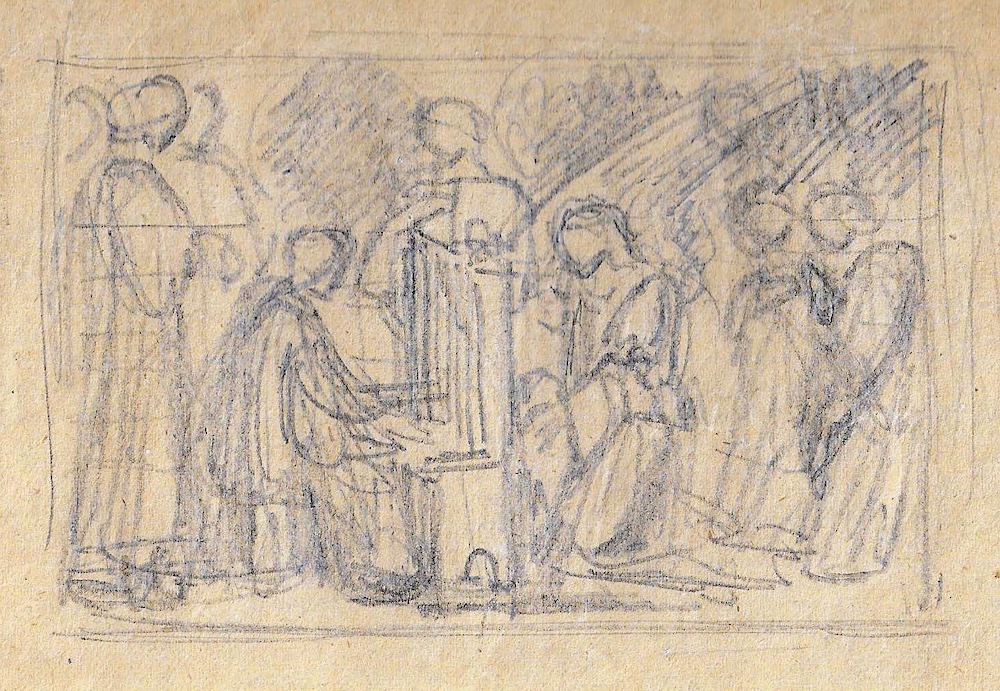
Very Early Study for St. Ceclia. Graphite on paper. 4 7/8 x 6 1/8 inches (12.5 x 15.4 cm) – image size. Image courtesy of the collector, Scott Thomas Buckle.
A slightly more finished drawing, a leaf from a sketchbook, was in the collection of the late David Elliott, the artist's grandson. This sketch is dated May 1875:
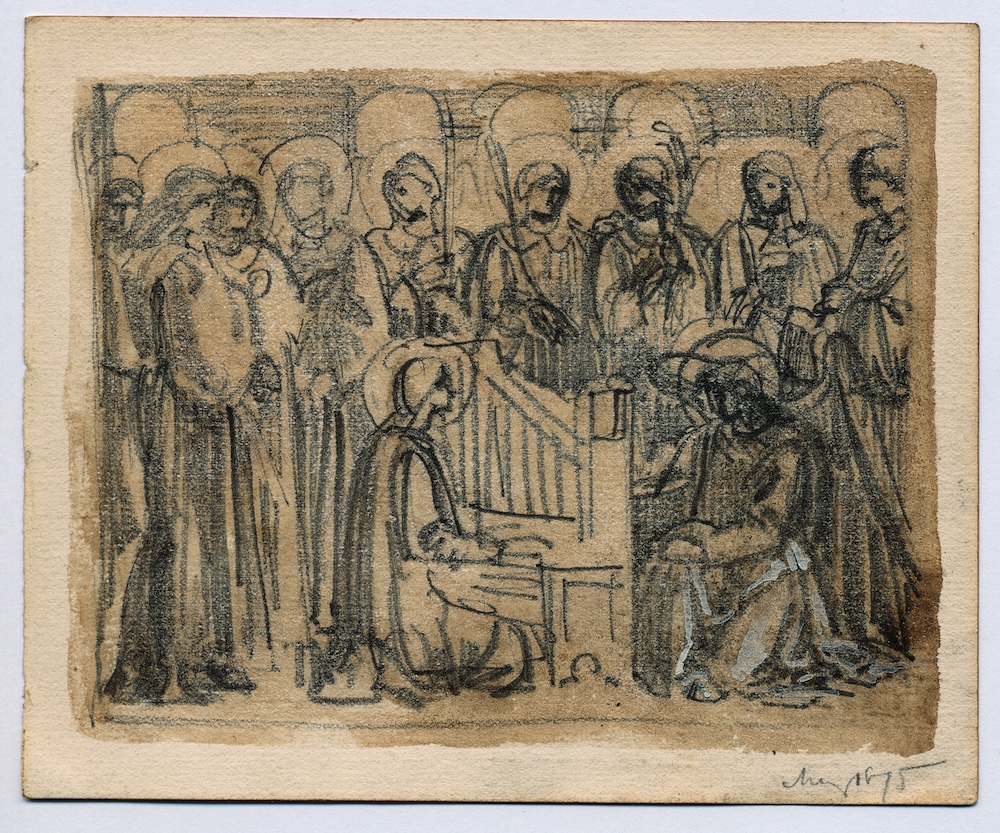
Early Study for St. Cecilia. Graphite on paper. 4 x 5 1/2 inches (10 x 14 cm). Ex-collection of the late David Elliott, who provided the image.
A more elaborate and finished mixed media study, 9 ¼ x 12 ½ inches, is known to exist based on a photograph in the Witt Library. This drawing sold at Christie's, London, on 9 November 1976, but its current whereabouts is unknown. Elliott did not think a finished painting was ever produced. This series of preparatory studies is a good indication, however, of the care Murray took when working up his compositions. Stephen Wildman has perceptively noted that Murray's use of watercolour heightened with white gouache has been compared to Andrea Mantegna's painted simulations of relief sculptures: "for preliminary drawings of classical figures, echoing Andrea Mantegna's fictive relief sculptures with their incisive line and flowing folded drapery" (164).
Bibliography
Lanigan, Dennis. Beauty's Awakening. Drawings by the Pre-Raphaelites and Their Contemporaries from the Lanigan Collection. Ottawa: National Gallery of Canada, 2015, cat. 45, 118-19.
Wildman, Stephen. Waking Dreams. The Art of the Pre-Raphaelites from the Delaware Art Museum. Alexandria, Virginia: Art Services International, 2004, cat. 34, 164.
Created 24 February 2026