
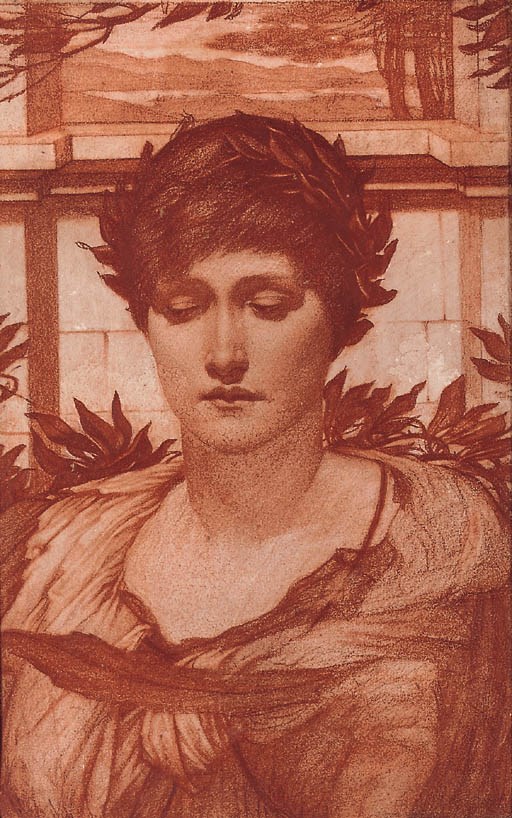
A Sibyl. Red chalk on paper. 13 ½ x 8 ¾ inches (34.3 x 22.3 inches). Private collection. Image ©2008 Christie's Images Limited. Right click disabled; not to be downloaded.
When this drawing sold at Christie's in 2008 their expert, likely John Christian, felt Meteyard's choice of subject matter had been influenced by Edward Burne-Jones: "He was strongly influenced by the art of Burne-Jones and many of his works have the same sense of slight wistfulness and a tendency towards symbolist or mythological themes. The figure in the present drawing, with its exquisite detail and dignified tone, has traditionally been identified as one of the ten sibyls of classical literature, although in the absence of further attributes a precise identification cannot be suggested" (95). The model for A Sibyl may again be Kate Eadie. Although Burne-Jones may be the principal influence in Meteyard's A Sibyl, his handling of red chalk it is more reminiscent of works by Edward Robert Hughes.
In ancient Greece the Sibyls were prophetesses or oracles and seers who augered at holy sites. Initially there was only one Sibyl, but by the first century BC there were at least ten of them, including the Delphic Sibyl, the Persian Sibyl, the Libyan Sibyl, the Cimmerian Sibyl, the Samian Sibyl, the Hellespontine Sibyl, the Phrygian Sibyl, the Tiburtine Sybil, the Erythraean Sybil, and the Cumaean Sibyl. Although pagan oracles, the Sibyls also featured in Christian art, such as in Jan and Herbert Van Eyck's altarpiece in Ghent The Adoration of the Mystic Lamb, and in Michelangelo's frescoes for The Sistine Chapel.
Bibliography
British Art on Paper. London: Christie's (28 November 2000): lot 25, 27. https://www.christies.com/en/lot/lot-1939035
British Art on Paper. London: Christie's (10 December 2008): lot 79, 95. https://www.christies.com/en/lot/lot-5161476
Created 31 March 2026