
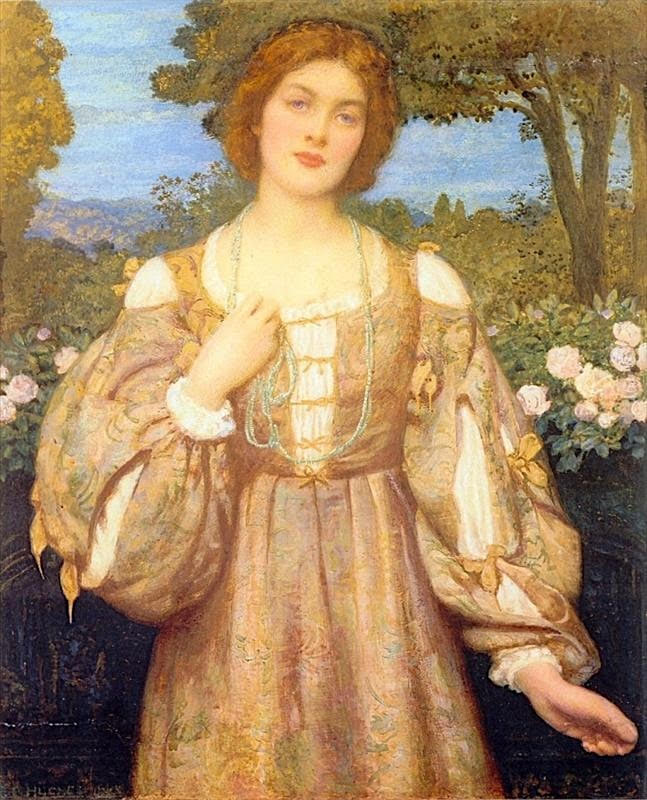
Monna Giovanni. 1907. Watercolour and gouache on paper. 12 ½ x 10 ¼ inches (32 x 26 cm). Private collection, image courtesy of Sotheby's. [Click on the image to enlarge it.]
The story of Monna Giovanni is told in Novel IX on the Fifth Day in Giovanni Boccaccio's The Decameron. In this tale Federigo di Messer Filippo Alberighi fell in love with a beautiful Florentine, a married woman, Monna Giovanna, and tried so hard to win her love that he impoverished himself. Soon he had nothing left but a little estate, on the rents of which he lived very modestly, and a single falcon, which was reputed to be the best in the world. On the death of her wealthy husband Monna Giovanna went to stay in the summer on a nearby estate. When her only and much-loved son fell ill, he told her that the only thing that would restore him to health was the gift of Federigo's prized falcon. The next day Monna Giovanni and a companion visited Federigo, who, since he had nothing suitable to entertain her, killed and roasted the falcon in her honour. Of course, he was unable to comply with her request, and she left in despair: soon afterwards, the son indeed died. Nevertheless, urged by her brothers to remarry, and remembering Frederigo's great generosity in killing to falcon to entertain her, Monna Giovanni decided to take him as her husband.
Monna Giovanni was exhibited at the Royal Society of Painters in Water Colours in 1907. In this work Hughes is clearly still influenced by Pre-Raphaelitism, even though in the other work he showed that same year, Heart of Snow, shows him to be under the spell of Symbolism. Hughes's watercolour really does not illustrate Boccaccio's story at all. It merely shows a beautiful woman, dressed in a magnificent Italian Renaissance-style gown, standing and fingering the beads of her necklace with her right hand. Rose bushes and a garden fill the midground with a row of distant hills in the background. This is typical of works by pre-Raphaelite painters where titles from literature, history or classical mythology were added to images of "stunners" to make the works more saleable. Examples can be found in the works of artists such as D. G. Rossetti (Monna Vanna), Frederick Sandys (Miranda) and F. W. Burton (Shireen). Stylistically, however, Hughes's watercolour more closely resembles the work of Marie Spartali Stillman in a painting like Luisa Strozzi or John William Waterhouse, such as his Gather Ye Rosebuds While Ye May of 1908.
Bibliography
19th Century British & European Paintings. London: Philips (3 April 2001): (?) lot 37, 39, or 44.
Victorian Pictures. London: Sotheby's (29 March 1995, lot 63, 28.
Created 9 May 2026