

. R. Hughes was born in Clerkenwell, London, on 5 November 1851, the elder son of Edward Hughes Snr., a clerk, and his wife Harriet Foord. His uncle was the Pre-Raphaelite painter Arthur Hughes who was to exert a major influence on his artistic development. E.R. Hughes lived with his uncle's family for a period in the 1860s, perhaps because his father was in financial difficulties. Edward took his first artistic training from his uncle and then from his mid-teens at Heatherley's School of Fine Art in London, entering in 1866. During his time there he became friends with fellow student Charles Fairfax Murray, a friendship that was to last a lifetime. Hughes became a probationer at the Royal Academy Schools on May 29, 1868.
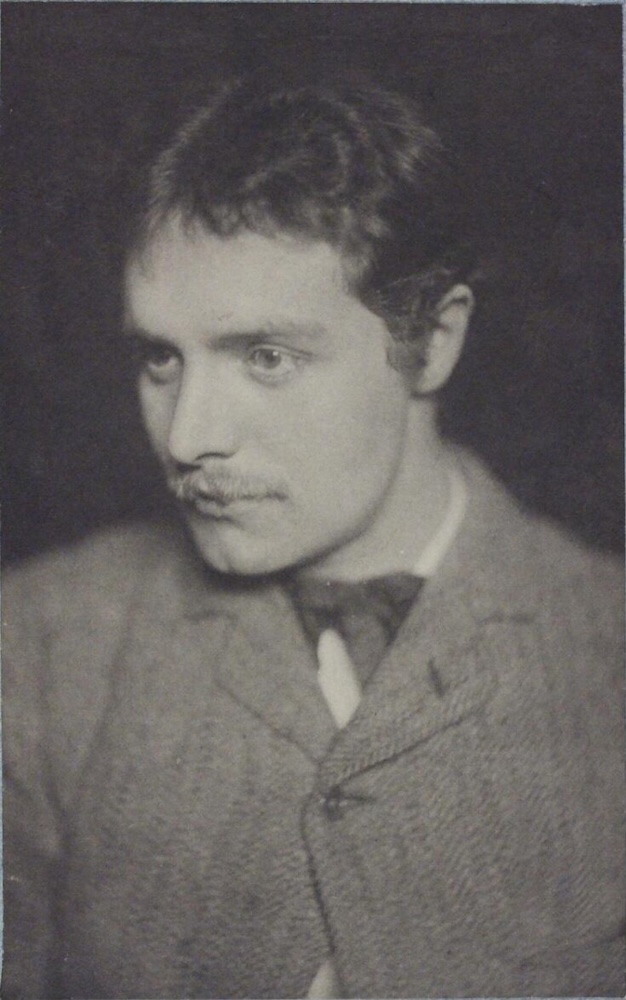
E.R. Hughes, c. 1890, photographed by Frederick Hollyer
[Click on the image for more information]
His time there was fruitful. He had come to know and become friends with Simeon Solomon by 1869. In 1870 he was awarded the Royal Academy silver medal for drawing from the Antique. He first exhibited at the Royal Academy that same year. He began exhibiting at the Dudley Gallery in 1871. He later exhibited at a number of other London venues during his career, including the Grosvenor Gallery, the New Gallery, and the Royal Institute of Oil Painters. As Hughes came more and more to work primarily in watercolour, he was elected an Associate Member of the Royal Watercolour Society in 1891 and a Full Member in 1893. From 1901-1903 he served as Vice-President of the R.W.S. He also exhibited at provincial centres in Birmingham, Edinburgh, Liverpool, and Manchester and at International Exhibitions in Venice, Munich and Duesseldorf.
From the early 1870s he had spent several months of the year working as a portrait painter in Birkenhead, and portrait painting became one of his specialties. He was engaged to the daughter of George Macdonald, before her early death from consumption in 1878. On December 17, 1883 Hughes married Emily Eliza Davies; the couple never had children. In 1886 he spent a year in Paris at the Académie Julian training under Benjamin Constant.
Hughes became a member of the Art Workers' Guild in 1888 and served on their committee from 1895-1897. He showed in the First Art Workers' Guild Exhibition of Members' Work in December 1895. He contributed to the Art Workers' Guild masque Beauty's Awakening performed at the Guildhall of the City of London on 29 June 1899. By 1909 he was a member of the Society of Painters in Tempera. In the early 1890s Hughes started to do some work as a book illustrator. In 1900 he began instructing life drawing at evening classes at the London County Council Central School of Arts & Crafts, where he served for some years. Hughes acted as a studio assistant from 1888 to 1905 for William Holman Hunt, helping him with such important paintings as The Lady of Shalott and the third and final version of The Light of the World. Hughes lived for a time at 8 Edith Villas, North End Road, West Kensington, in London but retired to St. Albans in Hertfordshire in the summer of 1913. He died here the following year at his home No. 3 Romeland on 23 April 1914 from complications following unsuccessful surgery for an attack of appendicitis. He was cremated at Golders Green and his ashes were buried in Hatfield Road Cemetery, St. Albans.
Bibliography
Christian, John. The Last Romantics. The Romantic Tradition in British Art. London: Lund Humphries, 1989. 95.
Engen, Rodney. "The Twilight of Edward Robert Hughes, RWS." Watercolours and Drawings V (1990): 34-37.
Osborne, Victoria Jean. "A British Symbolist in Pre-Raphaelite Circles: Edward Robert Hughes RWS (1851-1914)." M. Phil. thesis, University of Birmingham, 2009. https://etheses.bham.ac.uk/id/eprint/1465/1/Osborne10MPhil_A1b.pdf
Created 30 April 2026