

Portrait photograph of Georges Seurat
(frontispiece, Cousturier).
Georges-Pierre Seurat is widely known as the creator of Pointillism, a type of Impressionism in which the paint is applied to the canvas in dots of juxtaposed colour that mix – theoretically, at least – in the observer’s eye. In a short life of just 31 years Seurat pioneered this new mode of representation, producing around 50 finished paintings. His best-known works are vivid renditions of everyday Parisian life, Au Dimanche à la Grand Jatte (1884–6, Art Institute of Chicago) and The Bathers at Asnières (1883–4, National Gallery, London), but a significant portion of his paintings were landscapes and, especially, seascapes. Around twenty of these marine pieces are drawn together for the first time in Seurat and the Sea at the Courtauld Institute, London (13 February–17 May 2026).


Left: A Sunday on La Grande Jatte — 1884 (1884-86), oil on canvas, 207.5 x 308.1 cm (81 3/4 x 121 1/4 inches), from the Helen Birch Bartlett Memorial Collection, Art Institute of Chicago, identified as being in the public domain. Right: Bathers at Asnieres (1884), oil on canvas, 201 x 300 cm., courtesy of the National Gallery, London, downloaded via Art UK for purposes of non-commercial research.
Seurat’s subjects are coastlines, ports and seaside towns on the northern French coast, and in each case he explores how the landward interacts with the openness of the water and the sky. The effect is one of overwhelming lightness and brightness, of luminosity that is projected from the white underpainting and through the shimmering gauze of tiny dots of paint; although there are shadows, the palette is always in a high register, with light blues and greens contending with yellow and even pink. Seurat’s tones were influenced by contemporary experiments with chromatics and his colours are always surprising, and sometimes strange. This approach modifies the Impressionist technique and is in many ways quite unlike Monet and Renoir’s evocation of a changing atmosphere; here, on the contrary, the effect is one of stillness and permanence that is heightened by Seurat’s highly-formalized treatment of architecture, dock-lines and the sails of boats, each of which is abstracted into a shape rather than a specific object. The absence of people in most of the paintings adds to the sense of meditative reflection and forms a strong contrast with the social commentaries (which are nuanced along class-lines) of the Jatte and the Bathers.
There is plenty to admire here, particularly Le Bec du Hoc, Grandcamp (1885, Tate Gallery, London), in which the headland, mapped in tiny points of pigment, reaches out dynamically into an emollient blue sea. The Channel at Gravelines (1890, Indianapolis Museum), figured as a serene curve of land and sea, modulated by cool tones and a series of boats poised in space, is similarly a dazzling piece of composition. The other paintings are visual confections too – super-refined arrangements in colour that seem to occupy a space between what is seen and how the brain processes the visual impression: science at the service of art. The Japanese influence is equally pronounced, and the sinuous pattern making in the treatment of trees and clouds is reminiscent of the emerging style of Art Nouveau. The Courtauld exhibits the paintings to great effect in two rooms, and the exhibition provides a sense of how the artist arrived at his finished canvases by displaying some of his preparatory oil-sketches.


Left: Le Bec du Hoc, Grandcamp (1885), oil on canvas, 207.5 x 308.1 cm (81 3/4 x 121 1/4 inches), courtesy of the Tate, London, reproduced under the terms of the Creative Commons Attribution-NonCommercial-NoDerivatives licence (CC BY-NC-ND). Right: The Channel at Gravelines (1890), oil on canvas, 28-7/8 x 36-1/4 in. (canvas) 36-1/8 x 43-3/4 x 1-13/16 in. (framed, Optium), public domain artwork from the Indianapolis Museum of Art collection downloaded via the Newfields’ Open Access program.
Yet, for this observer at least, Seurat’s works do not rise above the status of interesting experiments in perception. For sure, they prefigure the workshop-approach of Modernism and are certainly a part of the unshackling of realism as an end in art. But there is a certain coldness and detachment about them, a bloodless ghostliness that might be viewed as alienating. The absence of figures – which Ruskin insisted were essential to our emotional identification with a landscape – further adds to the sense of intellectualism which ultimately pays little regard to painting’s role to make us see the world afresh, rather than just reconstruct it in our minds. I could not help thinking of James Joyce’s notion of the artist as one detached from his creation, ‘within or behind or beyond or above his handiwork, invisible, refined out of existence, indifferent …’ Seurat seems to be just that sort of artist, an impression confirmed by seeing Van Gogh’s Peach Trees in Blossom (1889, Courtauld) directly outside the exit from the Seurat display: Seurat’s art is always an idea of his motif, Vincent’s an overwhelmingly emotional engagement with the physical facts of life.
Such pallid intellectualism is carried forward to Seurat’s disciple, Paul Signac, but it is interesting to find that Seurat had an impact on Victorian painting too. French influence can of course be traced in several aspects of Victorian art, notably in Whistler’s response to the idiom pioneered by his associate Manet, and Seurat was an important influence on the work of Lucien Pissarro. Lucien’s father Camille was a friend and associate of Seurat, so it is not altogether surprising to find that Lucien, who lived in England from the 1890s, should experiment with Seurat’s Pointillist technique.
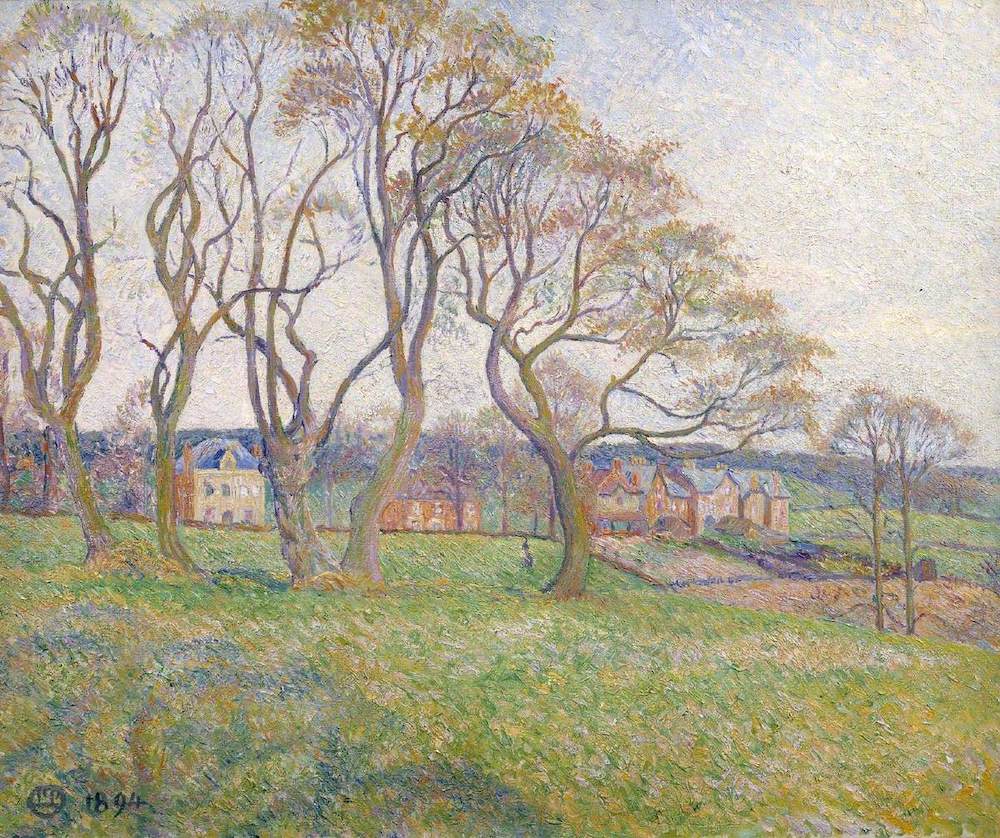
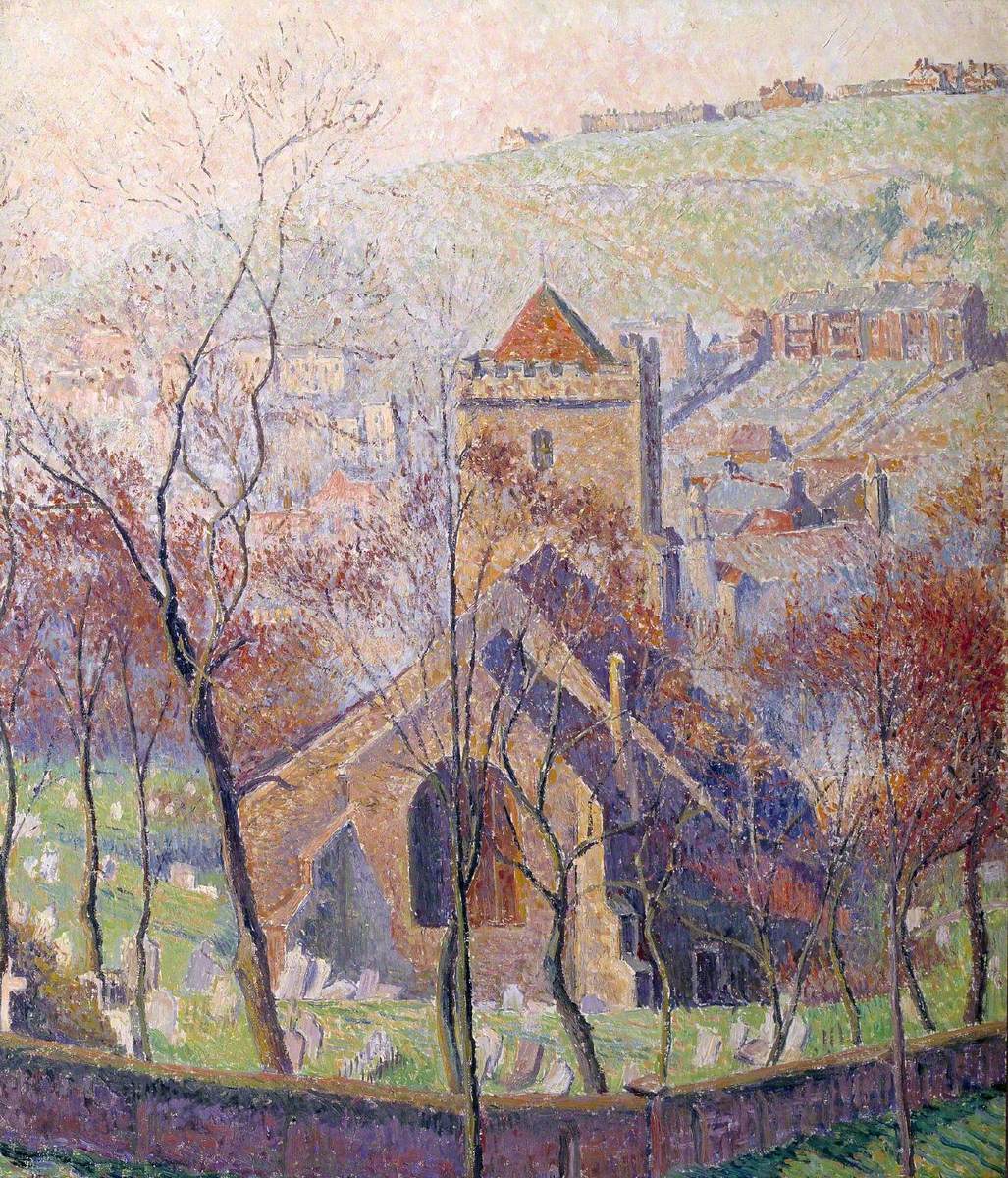
Two Pointillist painting by Pissarro. Left: The romantic April, Epping. Right: All Saints’ Church. [Click on these for more details.]
Pissarro’s adoption of the mode can be seen in several of his English subjects. April, Epping (1894, Tate) is a slightly-less methodical deployment of the dot-approach, and the same Divisionism can be traced in All Saints’ Church, Hastings: Sun and Mist (Tate, 1918). What differentiates these pictures, however, is a much greater sense of everyday experience being privileged over experimentation or abstraction: feeling for the scene is put in advance of the painting’s formal properties, which in Seurat’s images are so often an end in themselves. As so often happens when we compare French and British painting of the nineteenth century, the Victorians prefer the content over the artwork’s formal qualities – a tendency that has never, I think, ever entirely disappeared from the British tradition.
Bibliography
Bathers at Asnieres. Art UK. Web. 13 April 2026.
Le Bec du Hoc, Grandcamp. Art UK. Web. 13 April 2026.
The Channel at Gravelines, Petit Fort Philippe. Newfields Collection. Web. 13 April 2026.
Cousturier, Lucie. Seurat. Paris: G. Crès & cie, 1926. Internet Archive, from a copy in the Solomon R. Guggenheim Museum Library. Web. 13 April 2026.
A Sunday on la grande jatte. Art Institute of Chicago. Web. 13 April 2026.
Created 13 April 2026