
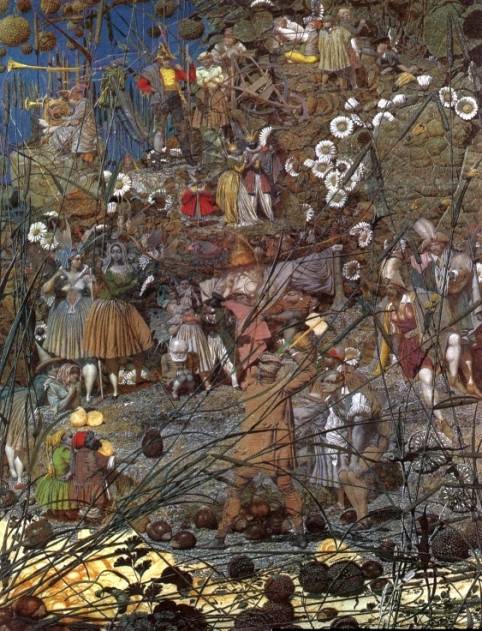
The Fairy-Feller's Master-Stroke by Richard Dadd (1819-87). 1855-64. Oil on canvas. 21.25 X 15.5 inches. Collection: Tate Britain, accession no. T00598; present improved image kindly provided by Simon Cooke.
This small oil-painting, the first of Dadd's canvases to become widely known, captures a single tense moment amongst the "little folk" on the forest floor. With his back to us in the foreground, down amongst the thin spiked grass, pebbles, daisies, hazelnuts, prickly plane-tree fruits and so on, the Fairy Feller or woodcutter has raised his axe to split an upright nut, apparently to serve as Queen Mab's new chariot (see Lambourne 202, and Romeo and Juliet, I, 3, l.68).
In front of him is the figure whom Dadd saw as "The Patriarch," hand also raised, about to give the signal for the blow. This figure wears an enormous wide-brimmed, triple-tiered hat, along which a number of even tinier figures are ranged — including Queen Mab herself in her present carriage. The curve of the carriage is discernible just above and to the left of the Patriarch's raised hand. Above these tiny figures, in the centre, stand a clearly recognizable couple, Oberon and Titania. Many more diminutive beings inhabit the canvas, from an insect herald (a cross between a dragonfly and a grasshopper, facing out of the picture, upper left) to an apothecary with pestle and mortar (upper right, felt to represent Dadd's chemist father) and the peasant in his smock next to him. Beside the Feller himself, hands on knees and face raised, waiting with particular intensity for the blow to fall, is a fair-haired young man with one sleeve pulled up over the elbow and brown breeches, ready to care for the chariot's horses. Amongst the others nearby is a grim, elf-like old man with a white beard, watching the proceedings with glaring eyes — this figure appears to be judging how accurately the blow will fall. Amusingly, Dadd identified him as a pedagogue.
The painting is more than an intriguing, crowded canvas. It was deeply significant for Dadd: a gifted miniaturist who was particularly fond of Shakespeare's fairy descriptions, he worked on it for up to nine years while incarcerated in Bethlem (or Bedlam). He left a cryptic poetic commentary on it, entitled "An Elimination of a Picture and Its Subject — called the Feller's Master Stroke," and it appears to have been an expression of his deeply troubled mind — specifically, it would seem, a re-enactment of that momentous split second before he acted on his impulse to attack his father, an event that tragically sealed the fate of both father and son.
What makes the painting so poignant is the sense that this pause is recognised as fleeting. The fateful act of violence is already inevitable. As Sigma Polk says, when looking at (for example) the speckling of dewdrops on leaves and elsewhere, and the repetition of spherical shapes, "Dadd has succeeded in lending simple blades of grass an incredible energy and sense of motion." It is the tension between momentary statis and this unstoppable drive towards enactment that gives the painting its disturbing power.
Bibliography
Allderidge, Patricia. "Dadd, Richard (1817-1886)." The Oxford Dictionary of National Biography. Online ed. Web. 27 February 2009.
_____. Richard Dadd. London: Academy Editions, 1974.
Greysmith, David. Richard Dadd: The Rock and Castle of Seclusion . Worthing: Littlehampton Book Services, 1973.
Lambourne, Lionel. Victorian Painting. London & New York: Phaidon, 1999.
Polke, Sigma. "Private View: Richard Dadd." Web. 11 August 2026. https://www.tate.org.uk/tate-etc/issue-1-summer-2004/private-view
27 February 2009
Last modified 11 August 2026