
The following excerpts, with a list of related material on the Victorian Web and a select bibliography, have been put together to form a brief guide to the subject, and also to suggest how the subject extends into a wider area, as individuals beyond the immediate crime were touched by it; how the crime related to larger issues (concerning gender, for example); and how it made an impact on science, the individual imagination, literature, and even society in general.
Many thanks to Emeritus Professor François Grosjean of the Université de Neuchâtel in Switzerland, for allowing us to include part of his e-publication, "In Search of a Family Tragedy," which received favourable comment in the Times of 14 February 2026; and to Professor Béatrice Laurent for permission to adapt and print a short section of "Till Death Do Us Part (faster): A History of Arsenic Murder," by Nell Hocquel, Larissa Makhoul and Cecilia Mestre, an interesting project completed under her supervision at the University of Bordeaux, France. — JB
A Victorian Phenomenon: Extract from Poisoned Lives: English Poisoners and Their Victims, by Katherine Watson
[T]here is no doubt that the heyday of financially motivated serial poisoning was between 1840 and 1890. The earlier date is significant, for it was in the years immediately before 1840 that burial clubs began to expand at an astonishing rate. Before then, serial poisoning was rare: there were a handful of known seventeenth-century cases committed for the sake of inherited money or by persons of dubious sanity; logic dictates that there must have been others, throughout the seventeenth and eighteenth centuries, that remained undiscovered. But most poisoners tended to kill one individual for a one-time reward, or ... two or three people at one time so as to remove the financial burden they represented. It was only under the unwitting influence of the fledgling life insurance industry that serial murder became a regular feature of English society. [104]
Forensic Science and the Law: Extract from Linda Stratmann's The Secret Poisoner
Even as chemists devised increasingly sophisticated methods to detect toxins in human remains, their researches isolated and refined new and powerful methods of murder that posed fresh challenges to the analyst. Repeated attempts by parliament to restrict the availability of poisons to the public were confounded and sometimes obstructed both by the need of the poor to have easy access to cheap medicine and the means of destroying vermin, and by the professional demands of doctors and pharmacists.
The nineteenth century also saw the rise of the specialist — toxicologists and analytical chemists who were authorities on poisons, and whose antipathies and jealousies sometimes led to bitter and undignified wrangles that dented public confidence in medicine. When experts were called upon to testify at murder trials, there arose an uneasy interaction between the medical and legal professions, since the reputation of a witness could be made or destroyed in a single cross-examination. [xi]
A Case in Point: Extract from the Anonymous Account of The Most Extraordinary Trial of William Palmer
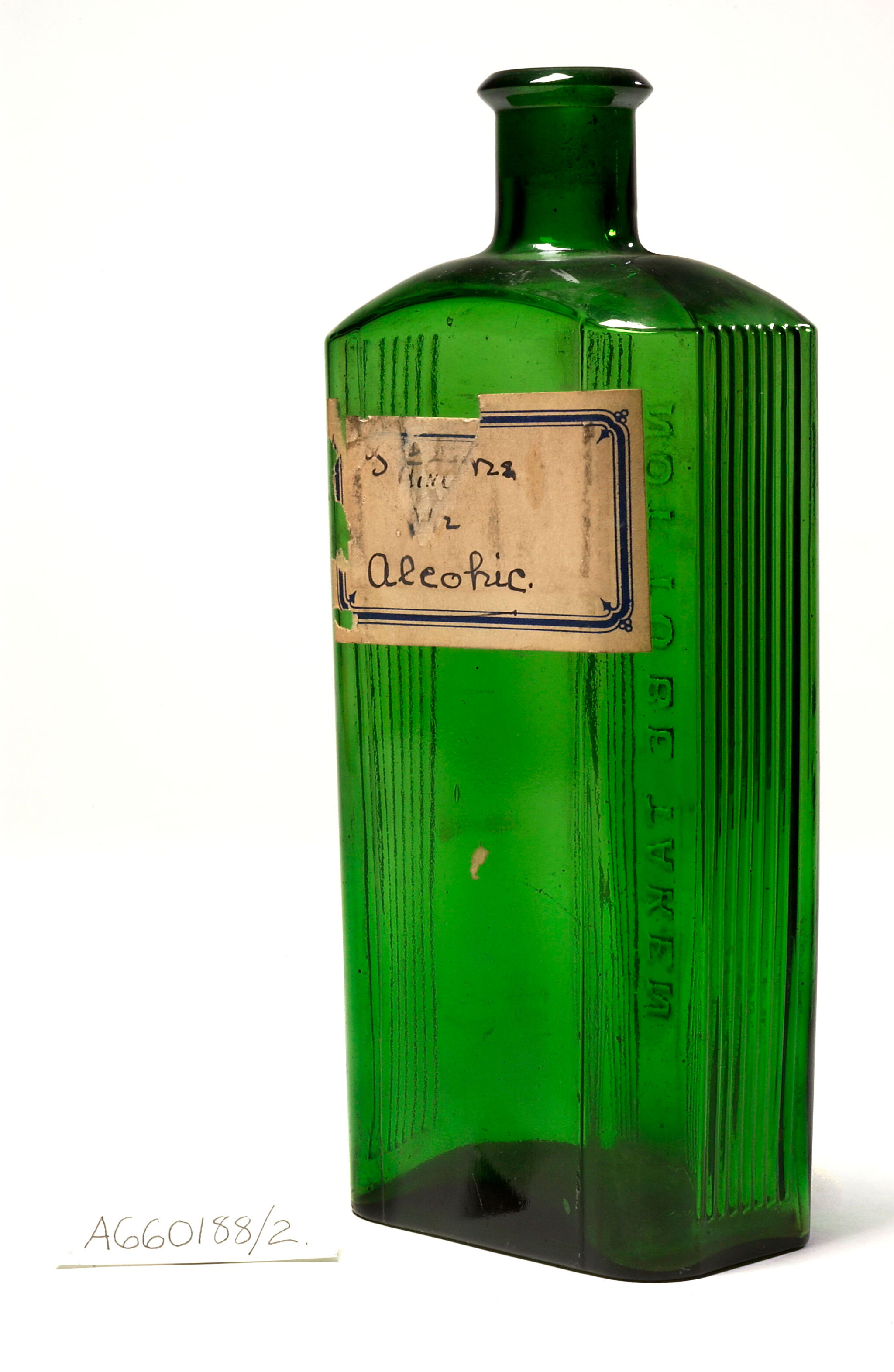
Green Glass poison bottle, from the Wellcome Collection,
reproduced on the Attribution 4.0 International (CC BY 4.0) licence.
William Palmer is a member of a wealthy family, and is thirty-one years of age. He was educated for the medical profession, was a pupil at St. Bartholemew's Hospital, London, received the diploma of the Royal College of Surgeons in 1846, and shortly afterwards settled at Rugeley, his native place. He seems, however, to have paid more attention to the "turf," and what are commonly called sporting pursuits, than to his profession, and to have confined his practice to his own family and friends.
His name appears in the "London and Provincial Medical Directory" of 1851, and again in 1855, as that of one of the persons who had neglected to inform the editor of that work of the nature of their qualifications. He married, in 1847, Anne, the natural daughter of Col. William Brookes and Mary Thornton, his housekeeper. Col. Brookes, who, after quitting the East India service, took up his residence at Stafford, died in 1834, leaving considerable property, and more than one natural child.
To Anne Thornton he bequeathed, by a will dated July 27, 1833, nine houses at Stafford, besides land, and the interest of 20,000 sicca rupees [silver currency issued by the East India Company], for herself and her children, and appointed Dr. Edward Knight, a physician of Stafford, and Mr. Dawson, her guardians and trustees. To Mary Thornton, the mother of Anne, the colonel bequeathed certain property, which was to pass to her daughter at the decease of the mother. Mary Thornton departed this life — it is said, while a guest at Mr. Palmer's house, — in 1848 or 1849.
Now, although the will of Colonel Brookes would seem clear enough to anyone who was ignorant of law, and although, in the present state of the law, as we are informed, it would be sufficient, yet it was discovered by the legal fraternity, some years since, that the language conveying the bequest to Anne Thornton was not sufficiently forcible to convey it to her absolutely, but only to give her a life interest in it, insomuch as, at her decease, it was liable to be claimed by the heir-at-law to Colonel Brookes.
Under these circumstances, there was nothing unnatural or unusual in the idea that Palmer should insure his wife's life, in order to protect himself from the inevitable loss which must ensue in case of her decease; and since her property consisted of seventeen acres of land, valued at between £300 and £400 per acre, besides nine houses, and the interest of the sicca rupees — probably altogether worth at least £400 per annum, upon which he had borrowed largely from his mother — there could be no doubt of his having such an interest in his wife's life as would justify insurance.
Accordingly, in January, 1854, he insured her life for £3,000 in the Norwich Union, and in March in the Sun for £5,000; there was also an insurance in the Scottish Equitable for £5,000. Mrs. Palmer died on September 29, 1854, leaving only one surviving child, a boy of seven years; and, as if to justify the husband in effecting an insurance, an action was brought within a month by Colonel Brookes's heir-at-law, to obtain possession of Mrs. Palmer's property.
Palmer brought up the life policies on the Sun and Norwich Union on the 16th of October, 1854, and employed Mr. Pratt, the solicitor, to obtain the money from the offices. Mr. Pratt, who seems to have acted with entire bona fides, and the caution usual among lawyers, required to be furnished with evidence of the husband's pecuniary interest in his wife's life, took counsel's opinion on every step, and obtained the £8,000 from the offices on the 6th of February, 1855; strangely enough, the £5,000 from the Scottish Equitable was paid through a banker unknown to Pratt. [1]
[Note: This was just the beginning. Due to his gambling addiction, Palmer ran through the money he gained from his policies, and fell into debt to Pratt and to two other creditors, Henry Patwick and Edwin Wright. He was finally found out not for murdering his wife and others close to him, but for poisoning a fellow-gambler, John Parsons Cook, who had won a great deal of money on the races. Palmer had promised Pratt that Cook would help to settle his debts, but, as Pratt soon discovered from sensational newspaper reports, this was not to be. Pratt's transactions had been entirely unexceptional and within the law; but, as his descendant François Grosjean discovered when he was exploring his family history, he not only suffered heavy losses himself, but was dragged into the scandal.]
How Poison Could Spread: Extracts from "A Family Tragedy," by François Grosjean
In mid-November 1855, Palmer had told Pratt that Cook had fallen ill after the Shrewsbury Races (where Cook had won a lot of money) and wrote to him a few days later that he had died on November 21 in Rugeley. Thomas Pratt now learned, to his stupefaction, that Cook had been poisoned by Palmer! A Times article of 18 December summarised all the events that had taken place in a bit more than a month: Cook's short illness, his demise, the postmortem examination of his body (which took place on November 26), the inquest that followed, and the jury's verdict that "the deceased died of poison wilfully administered to him by William Palmer." The article ended with the following: "The coroner immediately made out his warrant for the committal of Mr. Palmer to the county gaol at Stafford..."
Other shocking news was revealed: Palmer had supposedly looked after his friend at Rugeley but had, in fact, administered poison to him in the form of pills and in a broth he made him drink; after his death, he stole Cook's Shrewsbury winnings, as well as his betting book which listed additional money to be collected later; and the local doctor, an elderly gentleman named Bamford, who attended Cook alongside Palmer, revealed that several patients in Palmer's house had also died over a short period of time: his wife, Mrs. Thornton Palmer, two of their children, and a gentleman from London who was on a visit at Mr. Palmer's house. This was the start of revelations of a multiple poisoning case that was to captivate the media and the public for months, and lead to the trial of the century in England.

Palmer on trial (title-page illustration for the book).
On May 22 1856, during the trial, an opinion piece was published by The Times and had harsh words for both the borrower (William Palmer) and the lender (Thomas Pratt).... it ended with damning words concerning creditors. The press Pratt had received, and the comments made during the trial, must have had an impact on his work as solicitor and on his activities as a creditor....
Unfortunate consequences followed. On 15 May 1858 The Illustrated London News stated: "Mr. Thomas Pratt, the solicitor of Mayfair, whose name was mixed up in the monetary transactions of Palmer and Cook, of painful notoriety, has gone mad." And The Newcastle Journal gave the same information but replaced the last three words with "has become a lunatic" ....
The last five years he had lived - three dealing with Palmer and two attempting to recover - with their mixture of anxiety, despair, anger, accompanied in all likelihood by social condemnation and isolation - had simply been too much for Thomas Pratt. He was not physically well either, it would seem, and very soon after, on November 29 of that very same year, he passed away tragically in his parents' home. Even though his death certificate gives the following under Cause of Death - "Mesenteric disease atrophy certified" - his mental illness may have contributed to his early demise. He was only 38 years old! [30-33]
A Gendered Crime? Extracts from "Till Death do us part (faster): A History of Arsenic Murder," by Nell Hocquel, Larissa Makhoul and Cecilia Mestre
One of the most famous examples of a Victorian serial poisoner was Mary Ann Cotton, a benign woman in appearance who, between 1852 and 1872, poisoned about twenty people: three of them being her husbands out of the four she had wed in total, one her lover, plus eleven out of her thirteen biological children, her five stepchildren, her mother and one of her husbands' sister. Her motive was her husbands' life insurance which, with the death of all her children, she could keep entirely to herself without having to share. Moving often during those twenty years and working as a nurse, she had the good reputation of a widow who had lost her children. She was only caught after predicting the death of her healthy stepson and getting reported to the police after the child's death five days later. She was sentenced to death and hanged on 24 March 1873. Her story even inspired a well-known nursery rhyme:
Mary Ann Cotton,
She's dead and she's rotten
She lies in her bed
With her eyes wide open.
Sing, sing, oh, what can I sing?
Mary Ann Cotton is tied up wi' string.
Where, where? Up in the air
Sellin' black puddens [traditionally made with pork blood] a penny a pair. [Klein 104]
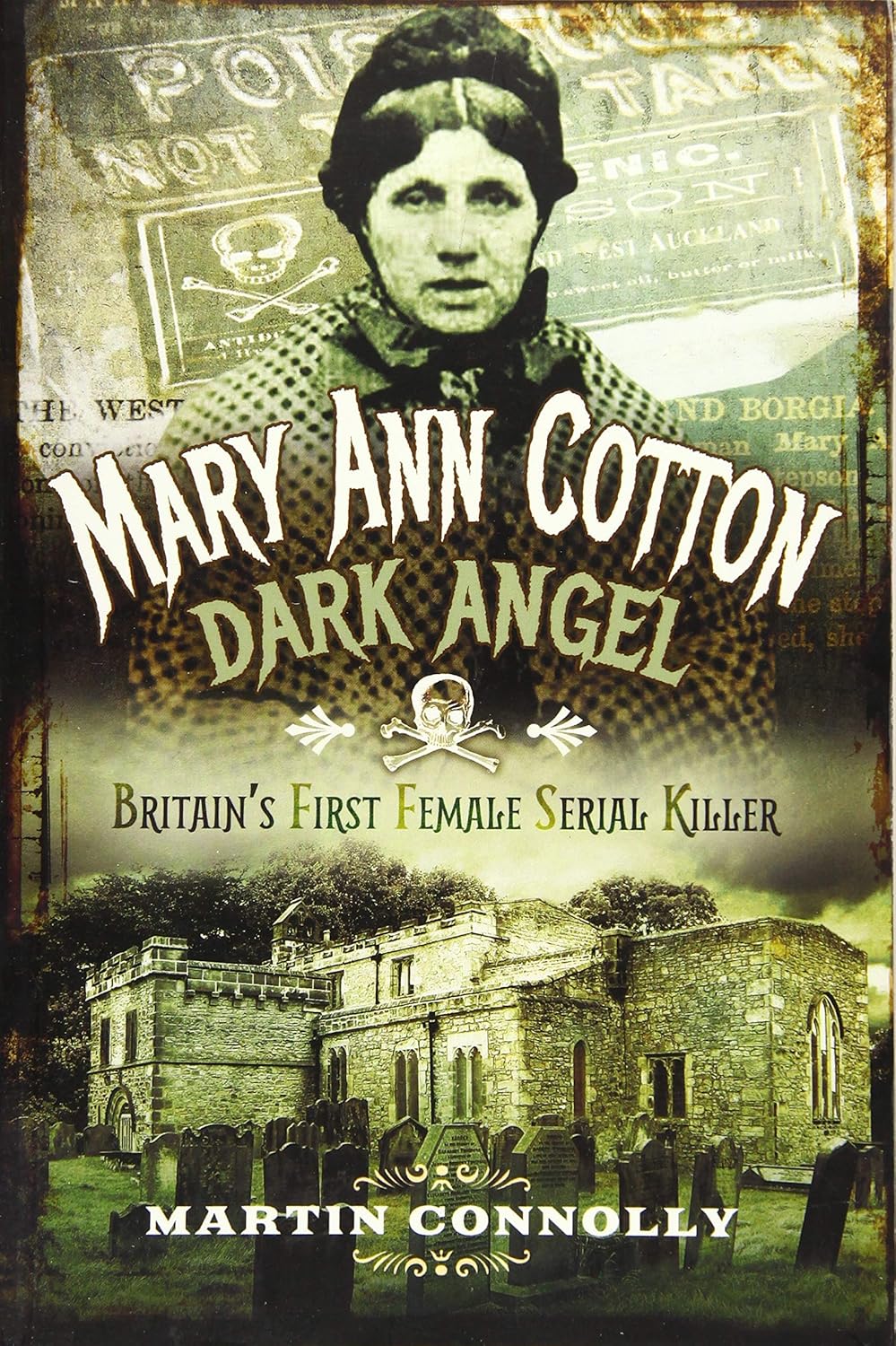
Front cover of Martin Connolly's book about the case.
Cotton is not the only example of a woman poisoner, but she was probably the most famous of them all, men and women taken together. Her fate was also a common one for the time and type of crime. The British Courts typically punished criminals with hanging or life sentences, some other female examples being Mary Ann Geering, who was hanged, and Constance Kent, Catherine Wilson and Christiana Edmunds, who received life sentences.
In fact, between 1847 and 1852 more women than men were convicted of poisoning (Wiener 2004) which explains the popular association of this crime with the female sex. Considered too weak, dainty and delicate to murder someone with their bare hands, women were also suspected of being cunning creatures, who would use poison, a sly weapon, in order to achieve their goal. Arsenic was the substance of choice: having a range of uses in every household, it could easily be hidden or mixed into food or drinks. Women could either use arsenic without getting caught, or claim that the poisoning was accidental.....
However, contrary to popular belief, multiple sources ranging from newspaper archives to court cases suggest that as time went by more men than women resorted to arsenic poisoning .... In the Westmorland Gazette and Kendall Adviser of 8 September 1855, Mr. Thomas Tutton was reported to have poisoned his own father in this way, with the object of destroying his life "in order to possess himself of the property, wherewith to sustain his extravagance" ("Horrible Occurrence near Bath"); again, on 29 August 1857, the Westmorland Gazette and Kendall Adviser published the verdict on Thomas Fuller Bacon: he had been accused of poisoning his mother Ann Bacon, for which crime he was to be "kept in penal servitude for the term of his natural life" ("The Fate of Thomas Fuller Bacon"). In the Evening News and Post's 7 December 1892 edition, a certain Joseph Conrad was described as having attempted to kill his wife with an overdose of arsenic ("A Poisoning Sensation").
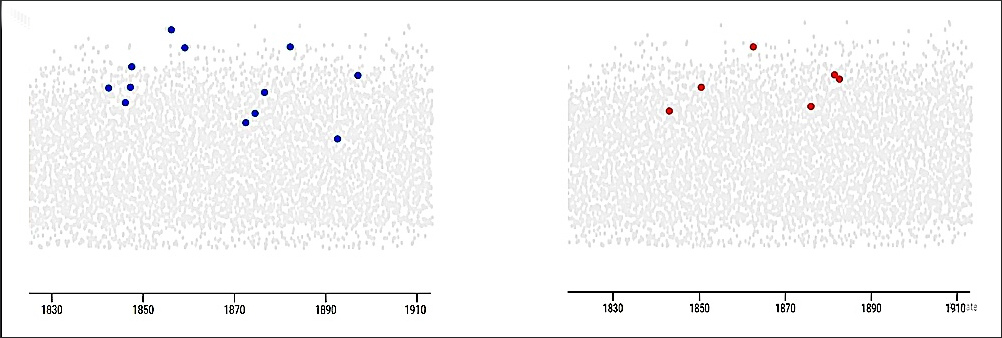
Left: Graph depicting the number of men found guilty by the Central Criminal Court between 1830 and 1910. Right: Graph depicting the number of women found guilty during the same period. Source: The Old Bailey Online.
As indicated in the caption, the graphs in the two figures above show the number of men (coloured blue) and women (coloured red) found guilty of arsenic poisoning by the Central Criminal Court of England and Wales from 1830 till 1910. The number of men held culpable at the Old Bailey was actually greater than the number of women. It is interesting therefore that the mainstream discourse has tended to focus on the use of this substance by female criminals, with the effect of playing down the role of male arsenic poisoners.
Conclusion: Poisoning and the Imagination, Extracts from Ian Burney's Poison, Detection and the Victorian Imagination
The world of Victorian criminal poisoning constituted an exemplary region of the invisible and impalpable. Conceived as an act committed in the absence of direct and visible contact between perpetrator and victim, poisoning appeared as a form of violence that operated beneath the threshold of perception. Its material effects on the body, moreover, were construed as evanescent, especially in the hands of a skilled practitioner. It was a crime that thus has to be traced out from evidence of the unseen. In this sense, poison operated inextricably at the level of the imagination as defined and debated by contemporaries. Not actually present to the senses in its substantive form, it required a faculty of mind capable of forming a concept of things not present. The poison "detective," consequently, was someone for whom an imagination could prove an asset - if one that required vigilance and restraint.... [5]
[C]ontemporary observers located criminal poisoning within a multi-layered network of historical and cultural references. Within this network of references, poison emerged as a way of reflecting on the nature of mid-nineteenth century "civilization" — what it had wrought, what challenged it, and what could be marshalled to defend it. [6]
Related Material
- Arsenic Poisoning and Napoleon's Death
- George Stiff's illustration, "Your Servant is Poisoned"
- Dickens's "Hunted Down" (1859): A First-Person Narrative of Poisoning and Life-Insurance Fraud Influenced by Wilkie Collins
- Poisoned Wallpaper
- Victorian Pharmacology IV: Zinc Chloride & Public Health
- Detectives and Detective Stories
A Select Bibliography
Bates, Stephen. The Poisoner: The Life and Crimes of Victorian England's Most Notorious Doctor [a somewhat more sympathetic look at Palmer, as acting out of desperation]. London: Duckworth, 2014.
British Newspaper Archives. https://www.britishnewspaperarchive.co.uk
Burney, Ian. Bodies of Evidence: Medicine and the Politics of the English Inquest, 1830-1926. Baltimore: Johns Hopkins University Press, 2000.
_____. Poison, Detection and the Victorian Imagination. Manchester: Manchester University Press, 2021.
Connolly, Martin. Mary Ann Cotton - Dark Angel: Britain's First Female Serial Killer. Barnsley, Yorks: True Crime (Pen & Sword), 2016.
"The Fate of Thomas Fuller Bacon." The Westmorland Gazette and Kendal Advertiser, 29 August 1857. https://www.britishnewspaperarchive.co.uk/viewer/BL/0000399/18570829/049/0008.
Fenning, Elizabeth. Circumstantial Evidence: The Extraordinary Case of Eliza Fenning.... London: Cowie and Strange; Purkess, 1829. Internet Archive. Contributed by Francis A. Countway Library of Medicine. Web. 15 February 2026.
Grosjean, François. "In Search of a Family Tragedy." https://www.francoisgrosjean.ch/A_Family_Tragedy.pdf
_____. "In Search of the General's Portrait" (indicating that the scandal surrounding Thomas Pratt also affected his distinguished father, Major General Charles Compton Pratt; see p.22 onwards). https://www.francoisgrosjean.ch/The_generals_portrait.pdf
Hocquel, Nell, Larissa Makhoul and Cecilia Mestre. "Till Death Do Us Part (faster): A History of Arsenic Murder." Unpublished project for Professor Béatrice Laurent's seminar, at the Université Bordeaux-Montaigne, France.
Klein, Shelley. The Most Evil Women in History. New York: Barnes & Noble, 2003. [Cotton is the only Victorian to be discussed here.]
McGuigan, Hugh. An Introduction to Chemical Pharmacology; Pharmacodynamics in Relation to Chemistry. Philadelphia: P. Blakiston's Son & Co, 1921. Internet Archive. Contributed by the Library of Congress. Web. 15 February 2026.
The Most Extraordinary Trial of William Palmer, or the Rugeley Poisonings (Anonymous). London: W.M. Clark, 1856. Internet Archive. Contributed by the Wellcome Library of Congress. Web. 15 February 2026.
"A Poisoning Sensation." The Evening News and Post. 7 December 1892. https://www.britishnewspaperarchive.co.uk/viewer/BL/0003283/18921207/016/0001.
Roughead, William, ed. Trial of Dr. Pritchard. Edinburgh; Glasgow: W. Hodge, [1906]. Internet Archive. Contributed by the University of California Libraries. Web. 15 February 2026.
"The Proceedings of the Old Bailey." n.d. https://www.oldbaileyonline.org/search/crime? defendant _gender=female&text=arsenic&verdict=guilty&year_gte=1837&year_lte=1901#results.
_____. "The Proceedings of the Old Bailey." n.d. https://www.oldbaileyonline.org/search/crime? defendant _gender=male&text=arsenic&verdict=guilty&year_gte=1837&year_lte=1901#results.
Stratmann, Linda. The Secret Poisoner: A Century of Murder. New Haven and London: Yale University Press, 2016 [Review].
Watson, Katherine. Poisoned Lives: English Poisoners and Their Victims. Hambledon and London: London and New York, 2004.
Whorton, James C. The Arsenic Century: How Victorian Britain Was Poisoned at Home, Work, and Play. Oxford: Oxford University Press, 2010.
Wiener, Martin J. Men of Blood: Violence, Manliness and Criminal Justice in Victorian England. Cambridge: Cambridge University Press, 2004.
Created 15 February 2026
Last modified 23 March 2026