

iolet Paget, who was known by the pseudonym of Vernon Lee, was born on 14 October 1856, at Château Saint Léonard, near Boulogne. Her parents were Matilda (née Adams), the widowed Mrs. Lee-Hamilton, and Henry Hippolyte Ferguson Paget, who were both living in France at the time.
Family Background and Childhood
Violet Paget's family background was a colourful and cosmopolitan one. Her mother Matilda was the daughter of Edwin Hamlin Adams (1777-1842), a rich merchant — incidentally and to his great miscredit, a supplier of enslaved labour — who became MP for Carmarthenshire. Matilda's first husband had been Captain Lee-Hamilton, by whom she had had a son, the future poet James Eugene Lee–Hamilton (1845-1907). The Captain died in 1852, and in 1855 Matilda married James's tutor, Henry Ferguson Paget, the descendent of a French noble family, the de Fragniers, who had settled in England at the time of the French Revolution. After marrying and becoming a naturalized Englishman while his family was living in the then fashionable resort of Southend, Henry's father, also called Henry, had suddenly moved to Warsaw, where he went to Petersburg and had an interview with the Emperor Alexander. The Emperor granted him permission "to open a University College to be entitled the Nobles' University," at which he was to be the sole Master in charge of everything, professors, lessons, and administration: the College lasted for fourteen years. The younger Henry was probably educated at this College, where he seems to have studied engineering. But the young man was then caught up in the Polish insurrections and decided to escape, at first to Germany, then to England where he supported himself by teaching (Gunn 11-12).
From the fact that he had tutored James Eugene, we can deduce that the younger Henry was a competent teacher. However, he seems to have little to do with his daughter's education and her "intense intellectuality." Violet's first biographer, Peter Gunn, wrote with conviction: "it is no exaggeration to say that she owed everything in the way of positive parental influence to the passionate character of her romantic mother" (14). Matilda, it seems, was a charming woman, always full of ideas; she played the piano well and certainly encouraged Violet's fondness of music, art, literature and foreign languages.

Violet Paget spent the first ten years of her life travelling extensively, especially in France and then in Germany, with her parents and half brother. But in 1866 her family decided, probably for economic reasons, to spend the wintry months in Italy. In Rome, where they eventually spent a prolonged period, Vernon was allowed to roam and enjoy her freedom. As she explained in the "explanatory and apologetic" preface to The Spirit of Rome: Leaves from a Diary (1906): "I was brought up in Rome, from the age of twelve to that of seventeen" (9). In the essays collected under the title Juvenilia I and II (1887), she describes Rome as a "poor and ill-kept town" from which she was "wild... to get away"; but, after attending the Christmas ceremonies in St. Peter's, she yearned for the cloistered shade "of those dark, damp little churches, resplendent with magic garlands" and also began to appreciate the pagan past of the Immortal City: "all those goddesses, and nymphs and heroes, all that white and ice cold world seemed to seek me with their blank, white glance" (Juvenilia II: 194-99).
It was during their first stay in Rome in 1867 that the young girl became the playmate of John Singer Sargent, whose portrait of her is shown on the right. Escorted by his mother, Mary Singer Sargent, certainly a very competent guide, she began to explore the intricate mysteries of the genius loci, the spirit of place. As she has tried to explain, her first reaction to Rome cannot be described as an experience of "love at first sight," or as an immediate infatuation with the Italian environment — although she also said that it was the object of her "childish and tragic adoration." Actually, her feelings had to mature through slow observation and study, till she achieved a more sophisticated and deeper form of involvement with her Italian surroundings. Then the genius loci did seize her. When she was fourteen years old and already immersed in her musical interests concerning the eighteenth century, she visited the site of the Accademia degli Arcadi, whose members used to meet in the open air in the Bosco Parrasio, at least before 1725, when the king of Portugal, John V donated to them a villa in Rome on the Gianicolo hill. There, roaming through the vast halls of the decayed villa, Violet became aware of the real meaning of the "Arcadia" as a poetical movement, fostered by Pietro Metastasio, and as a musical fashion with its preference for the voice of the "sopranista", indulging in "canzonette" full of melodious "ariette" (see her Studies of the Eighteenth Century in Italy, 7–64).
Career as a Writer: Early Works
In the same period Violet had been reading Charles Burney's A General History of Music from the Earliest Ages to the Present Period (1776-1789), his lively account of his Grand Tour, The Present State of Music in France and Italy (1771), and his Memoirs of the Life and Writings of the Abate Metastasio (1796). She therefore resolved to delve further into these studies in order to write an essay on eighteenth century Italy and its culture.
Violet pursued her research studies in Paris. At the time she was on very good terms with the novelist Mrs Henrietta Camilla. Jenkin (1807–1885) and her friend, Mrs. Cornelia de Boinville Turner (1795–1874), who counted as their guest Giovanni Ruffini (1807–1881), the Italian patriot and novelist who was to become one of Violet's best and closest friends. At the onset of the Franco-Prussian conflict, Violet returned to Rome, passing through Thun in Switzerland.
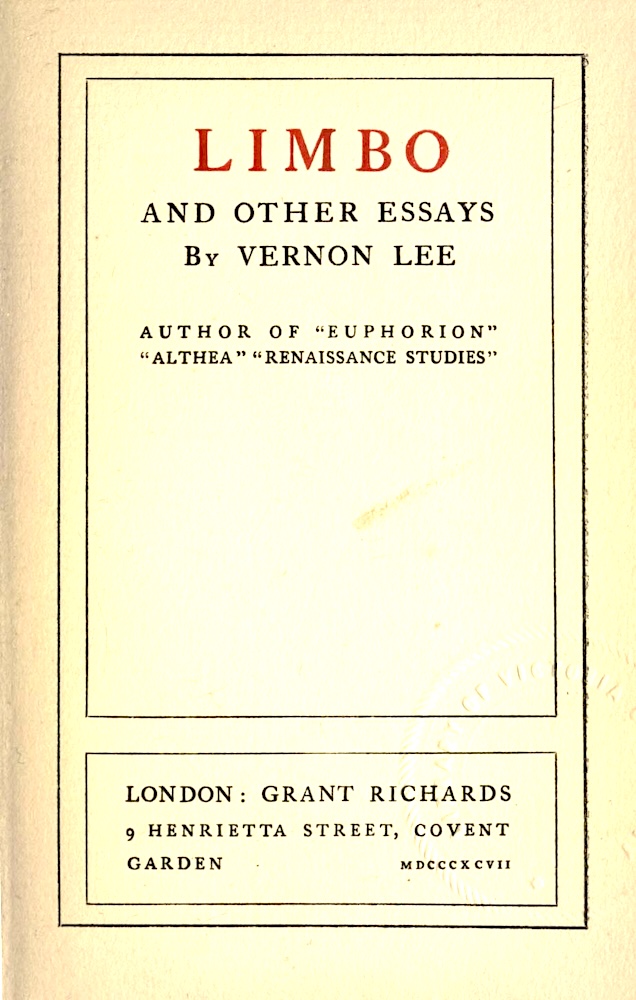
In 1872 she spent ten days in Bologna with Sargent (see The Golden Keys and Other Essays on the Genius Loci, 71–83), almost entirely occupied by her studies in various libraries and at the Conservatory. She was helped at the time by Gaetano Capocci, the choir master at the Lateran. Bologna left a lasting mrmory in her imagination. Years later, as she recalls in one of her essays on travels, Limbo (cover shown on the right, from the Internet Archive, 1897) as she was driving through Bologna her nostrils were enticed by the smell of wine and - anticipating the proustian involuntary memory- suddenly "that same smell came to my nostrils as in a dream, and with it a whiff of bygone years, the years when first I had had this impression of Italian Magic" (81).
She devoted the next six years to the cultural history of the eighteenth century because she realized that it was not enough to study one particular subject at a time, but, in order for the writer to gain a thorough understanding of the period she had to increase her reading and widen her experience to all the subjects connected with her topic: "'for'- she wrote in a letter to Mrs. Turner in 1873 - 'to hope to get at the real value of any particular branch of art seems to me preposterous without a more or less thorough acquaintance with aesthetics in general'" (Gagel 111). In 1878, when her first studies dedicated to the eighteenth century started appearing in Fraser's Magazine, she signed them with the ambiguous pen name, Vernon Lee, which she was to adopt for the rest of her life.
Even today Vernon Lee's fame rests on her first collection of essays entitled, Studies of the Eighteenth Century in Italy, published in 1880, and reprinted in 1907 with a dedication to the memory of the Italian writer and anglicist, Enrico Nencioni. In this unique scholarly achievement, Lee endeavoured to understand why Italian music and drama imposed themselves as the liviliest creative and cultural manifestations of the Enlightenment in Europe. She describes the alternate fortunes of the Accademia degli Arcadi; she retraces Dr. Burney's steps as he goes about his Italian journey in 1770, in search of material for his ponderous work on the history of music; she presents an outline of the developments of Italian opera through an account of the life of the poet and librettist Pietro Metastasio, and she compares the modern, naturalistic comedies of the Venetian Carlo Goldoni to the fantasy world staged by the other famous contemporary Venetian playwright, Carlo Gozzi. The essays were criticized, but, in general, their author was acclaimed for her cultivated and clever style. The book received a first Italian translation in 1882, after she had already published Belcaro: Being Studies on Sundry Aesthetical Questions (1881).
In this second collection of essays Vernon Lee takes her stand in the current debate on aesthetics, siding with Walter Pater against John Ruskin. In her philosophy of art, beauty emerges as the foremost element because, she argues,the contemplation of what is beautiful leads to a state of aesthetic edonism which conveys a subtle form of enjoyment. In open contrast with Ruskin, she does not believe that "the whole system of the beautiful is a system of moral emotions," but in line with art for art's sake and anticipating Oscar Wilde's aphorisms, she could assert that there was no such thing as a moral or immoral art. "Beauty is pure, complete, egotistic: it has no other value than its being beautiful" (Belcaro 205; 210). Yet, in three years' time, her aesthetics would undergo a rigorous chastisement in favour of a moralizing spirit in art. In her novel Miss Brown (1884), she actually attacks the aesthetes as exponents of the "fleshly school" of thought.
The Appeal of Decadence, and Later Writings
In 1881, however, her enthusiasm for Decadent prose was at its peak and, in the summer, while staying in Oxford, she managed to meet Pater whose decisive influence presides over the pages of her new studies dedicated to the critic from Oxford on the Antique and the Medieval in the Renaissance, issued in 1884 with the title Euphorion (Colby 60-78: "The Lesson of the Master: Pater and Euphorion"). If Apollo represents Pater's idea of the Renaissance, Dionysos with his bloody rituals corresponds to that of Vernon Lee. Mario Praz, her Florentine friend and famous professor of English culture and literature, has spoken of "affascinato orrore" or "fascinating horror"(Praz, Il patto col serpente, 280), as regards Vernon Lee's puritanical reaction to the "vicious" Italian Renaissance, but, in some instances, the critic concludes, her essays can be more illuminating than those of the excellent art critic Aby Warburg (279).
Her biographers (Gunn 108–122 and Colby 111–129) relate that in those years Vernon Lee became emmeshed in a series of obsessive and, in some cases, unlucky "passionate attachments" to women. In general, as was the case with Annie Meyer and Mary Robinson, who was her companion for six years till 1887, as soon as her friends found a male partner and married, the relationship was abruptly broken off, but these amorous jilts often made Lee suffer for long stretches of time, and fall into depression from the ensuing emotional strain. Actually, when Mary Robinson married, Vernon Lee experienced physical collapse. A new friend, Clementina (Kit) Anstruther-Thomson, then nursed her through her period of dejection and the two started living together just outside Florence, at Maiano, in the villa called "Il Palmerino," where Vernon Lee was to reside till the end of her life.
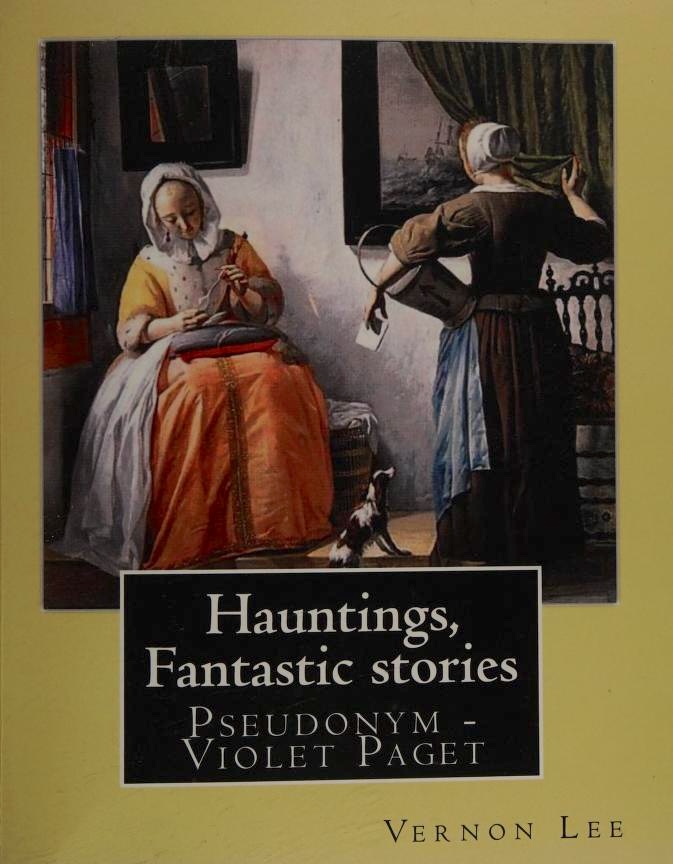
By this time, the writer had mastered different literary genres and had produced quite a few outstanding books, besides the essays. She had written two novels: Ottilie (1883) and Miss Brown (1884); a scenario for puppets: The Prince of 100 Soups (1883); a biography: The Countess of Albany (1884); dialogues: Baldwin (1886) and Althea (1894) in which she disapproves of the parasitic idleness of the privileged classes and, of particular interest, a series of fantastic stories: A Phantom Lover (1886), Hauntings (cover shown on the left, from the Internet Archive, 1890); and four modern morality tales: Vanitas (1892). Her supernatural tales were very successful. Robert Browning praised her natural power of observation, her ability of capturing the slighest psychological nuances of a landscape (what she defined as "the lie of the land"), when he mentions her name in one of the poems of Asolando (1889). Her observation was sharp; she could vivisect anything and anybody. Henry James felt ridiculed by his caricature and the description of his mannerisms in the second story of Vanitas (1892), Lady Tal, and he put an end to their friendship. She patronized Bernard Berenson and the two soon quarrelled on matters related to the aesthetics of empathy. At the same time, her long relationship with Kit, who had actively participated in her aesthetic experiments and co-authored some of Lee's writings on art, broke up.
She travelled extensively in Europe, and especially in Italy. She toured the countryside with her bicycle at a time when such Italian writers as the poets Giovanni Pascoli, Olindo Guerrini, and the novelist Alfredo Panzini were beginning to appreciate this new form of sportive travel. She enjoyed visiting new places and returning to old ones and she recorded her impressions in seven delightful travel books, published from 1897 to 1925, which explore the meaning of the signs that can be read in civilized and natural landscapes.
In the first decade of the new century, she returned to her political and polemical interests and, as a convinced pacifist, she wrote Satan the Waster in 1920, probably as a warning to the new generations, but also to allay her fears, because she expected another war. Her last works include a volume of short stories dedicated to Maurice Baring, Five Unlikely Stories (1927), and a critical study on Music and its Lovers (1932). She died on 13 February 1935, true to her ideals, as George Bernard Shaw had described them, "of Victorian cosmopolitan intellectualism" (The Nation, 27, 18 September 1920, qtd. in Colby 306). Violet Paget is buried in the Allori Cemetery in Florence.
Bibliography
Primary Sources (by date)
Lee, Vernon. Studies of the Eighteenth Century in Italy. London: W. Satchell, 1880.
_____. Belcaro: Being Essays on Sundry Aesthetical Questions. London: W. Satchell, 1881.
_____. Euphorion: Being Studies of the Antique and the Medieval in the Renaissance. London: T. Fisher Unwin, 1884.
_____. Juvenilia: Being a Second Series of Essays on Sundry Aesthetical Questions. T. Fisher Unwin, 1887.
_____. Hauntings: Fantastic Stories. London: W. Heinemann, 1892.
_____. Limbo, and Other Essays. London: Grant Richards, 1897.
_____. Genius Loci: Notes on Places. London, Grant Richards, 1899.
_____. Ariadne in Mantua: A Romance in Five Acts. Oxford: Basil Blackwell, 1903.
_____. The Spirit of Rome: Leaves from a Diary. London: John Lane, 1906.
_____. The Golden Keys, and Other Essays on the Genius Loci. London: John Lane, 1925.
_____. For Maurice: Five Unlikely Stories. London: John Lane, 1927.
_____. Arianna A Mantova / Ariadne in Mantua, bilingual text, ed.and Introduction by Rita Severi, Fondazione Marcegaglia Edizioni Postumia – Gazoldo degli Ippoliti - Cierre Edizioni – Verona, 1996.
Secondary Sources
Browning, Robert. "Inapprehensiveness" in Asolando, 1888–89. online.
Caballero, Carlo, "A Wicked Voice: On Vernon Lee, Wagner, and the Effects of Music." Victorian Studies. Summer 1992: 385–408.
Cambieri Tosi, Marie José, Carlo Placci. Maestro di cosmopoli nella Firenze fra Otto e Novecento. Firenze: Vallecchi, 1984.
Colby, Vineta. Vernon Lee: A Literary Biography. Charlottesville and London: University of Virginia Press, 2003.
Cooper Willis, Irene. A Vernon Lee Anthology. London: John Lane, 1929. 7-8.
_____, ed. Vernon Lee's Letters. London: Privately Printed, 1937. 2-3.
Corrigan, Beatrice. "Giovanni Ruffini's Letters to Vernon Lee, 1875–1879. English Miscellany vol. 13 (1962): 230.
Gagel, Mandy. Selected Letters of Vernon Lee 1856–1935. Boston University, PhD, 2008. Vols. 1 and 2.
Gunn, Peter. Vernon Lee Violet Paget 1856–1935. London: Oxford University Press, 1964.
Pantazzi, Sybille. "Carlo Placci and Vernon Lee. Their Letters and Their Friends." English Miscellany Vol. 12 (1961: 97-122.
_____. "Enrico Nencioni, William Wetmore Story and Vernon Lee." English Miscellany Vol. 10 (1959): 256.
Praz, Mario. Il patto col serpente. Milano: Mondadori, 1972. 270–297.
_____. La casa della vita. 2nd ed. Milano: Adelphi, 1986. 275-283.
Severi, Rita. "Vernon Lee and Mantua." Journal of Anglo–Italian Studies Vol. 5 (1997): 179–200.
Created 3 June 2026