

ernon Lee had visited Mantua for the first time in 1896. She was amazed at the sight of the city rising from the lakes: it made her think of an enchantment. "It was the Lakes, - she wrote in Genius Loci. Notes on of Places (1899) – "the deliciousness of waters and sedge seen from the railway one blazing June day, that made me stopt Mantua" and return, in June again, the year after. Maybe it was on those two successive visits to Mantua that she experienced a form of extrasensory knowledge that she defined "involuntary visions": "Out of the broken, fragmentary realities of life there must arise, ever and again for all of us, strange involuntary visions, which have greater power over us, more charm for us, than all the art in the world. And of such things art has no right to be jealous; they are beyond it" (32).
Mantua "haunted" her fancy, she tells us in the preface to the play, and she felt what can be called a Wordsworthian "intimation," a thorough knowledge of the place and what had happened there. Possibly it was, what she termed, the "suggestiveness" of the Palace on the water and the unheard melody which weaved its music in the heat of the afternoon that, induced her to write Ariadne in Mantua.
In the background, during the creative phase of the composition of the play, lurk some of Vernon Lee's strongest remembrances and convinctions. She linked the fairy tale setting of the Gonzaga Palace to a quaint story she had heard as a young girl during her formative stay in Bologna (33). At the Accademia Filarmonica (Conservatory) she had seen the portrait of the "castrato" Carlo Brioschi, better known as Farinaelli (1705-1782) (34). He had become the favourite singer of Philip V of Spain (1683-1746) and when the King became unbearably melancholic, he assisted him in every way and spent the nights at his bedside singing lulling melodies in order to alleviate his anguish. One of these songs was the aria “Pallido il sole" which the young Violet, from the next room, had heard her mother play at the piano (35). This legend probably strengthened her belief in aesthetics and encouraged her pioneering research on the healing function of art. In particular, she considered music as a valid aid in many forms of psychosomatic disorders and she was convinced, like the ancient pythagoreans, that the human voice could exercise in its sweetness and pleasant tone a very beneficial, therapeutic, influence. The unheard melody she had imagined in Mantua materialized as the air of "Amarilli" by Giulio Caccini (1550-1618) and then as the "Lamento d'Arianna" by Claudio Monteverdi (1567-1643). This last melody pervades the play.
The play of Ariadne in Mantua presents a plot and a subplot: it comprises the classical myth of Ariadne in Naxos with the alluring environment of Renaissance court life, secretive and yet full of display. The tragedy takes place during the times of Prospero I of Milan (36), a bit before Othello launched his Venetian ships against Cyprus (37): in a real, historic period as well as in a fantastic, fictional dimension. The plot is simple. During a campaign against the Moors, the Duke of Mantua Ferdinand (38) is taken prisoner and, in the Moorish camp, falls in love (is, therefore, doubly captured) with the beautiful courtesan and lover of the Moorish chief, Magdalen, endowed with an outstanding voice. Ferdinand loves Magdalen passionately, and Magdalen,who loves him more than her life, manages to let him flee from the camp. When Ferdinand returns to Mantua, he falls ill. Nobody seems to be able to cure him until the Cardinal, his uncle, calls a young Spanish singer to court. The attractive young man with the prodigious voice, who goes by the name of Diego, is really Magdalen in disguise. Diego will cure the Duke who, having recovered his health, will then marry Hippolyta, Princess of Mirandola. Realizing that her love is lost forever, Magdalen, disguised as Diego, disguised as Ariadne in the masque that celebrates the Duke's wedding to Hippolyta, at the end of the play, will sing her Lament: "Let us forget that any look or touch/Once let in either to the other's heart," and then she throws herself into the lake, just as the Nymphs come on the stage to sing a dirge to the memory of the mythological heroine.
The play introduces Jacobean dramatic elements (the masque, the elaborate machinery on the lake, fantasy elements borrowed from Shakespearean romance), Shakespearean characters and situations (Viola, of course,in her double role in Twelfth Night; a vague remembrance of Theseus and Hippolyta from A Midsummer Night's Dream; Prospero and Ferdinand from The Tempest and, explicitly, Othello, for the various hints at the campaigns against the Moors), and the hyperbolic recitation and gestures of the early Italian melodrama. Moreover most of the characters indulge in prolonged "duologues," as if they were exerting their voices in polyphonic madrigals. The source that served as an example for the masque is certainly Monteverdi's Arianna. The Florentine Ottavio Rinuccini (1564-1624) composed the libretto and the opera was represented in 1608, at the court of Duke Vincenzo Gonzaga to celebrate the wedding of his son Francesco to Margherita, daughter of Carlo Emanuele from Savoy. The celebrations, which lasted a week, included a play, masques or interludes, a ballet, and various other forms of entertainment. The royal event received European resonance. Unfortunately, of Monteverdi's enchanting opera, only “Arianna's Lament” has been saved from the ravages of time (39).
The myth of Ariadne in Naxos - so popular in the Renaissance - forms the background material of the plot and is a constant source of comparison. Magdalen frees the Duke from his prison in the Moorish camp just as Ariadne had saved Theseus from a sure death in the by-ways of the labyrinth. But, then, the ungrateful Theseus left her and went on to celebrate his wedding with the queen of the Amazons, Hippolyta. The Greek Ariadne abandoned on her solitary cliff will be rescued by Bacchus. Magdalen, the Mantuan Ariadne, or shall we say, the modern Ariadne, instead, does not want to carouse with the god of lechery and wine; she does not want to return to the old haunts and habits, and therefore she chooses death.
All this sounds old-fashioned, but it isn't, because Vernon Lee turns her historical play into a Victorian "problem" play as well. She makes her characters actually debate current issues, like the role of women; the tasks of a good wife, not according to her husband, but from a feminine point of view; the education of women; the importance of living up to one's ideals without being ashamed of one's emotions; the hypocrisy of public virtues and private vices; and a typical Symbolist/Decadent theme: love, the destroyer. As Oscar Wilde had stated in 1898 in "The Ballad of Reading Gaol": "each man kills the thing he loves."
In this play the voice of love is drowned. The voice that sang its love and modulated itself in order to seem different from what it was, is silenced. Besides being a play that stages a myth and a character that takes its identity from the myth, according to a “mirror structure,” Ariadne in Mantua is a tragedy about duplicity (40), sexual ambiguity and sexual mutability. Vernon Lee had already dealt with a deceptive voice in the last story of Hauntings (1889), "A Wicked Voice," where the vocal organ becomes the negative symbol for latent sexual urge, which she disparages as "the Beast" (41). In Ariadne in Mantua, instead, the voice casts a salutary spell over its hearers: Ferdinand is reminded of Magdalen when Diego sings and the song recreates the illusion of constant love and rekindles the old desire. Ferdinand, at this point, feels attracted to Diego. Hippolyta, too, cannot resist the fascination of his/her voice. When Hippolyta and Magdalen/Diego sing a duet together, Hippolyta's voice cracks for the emotion. The play is charged with homoerotic overtones about a love which must go unrequited. And the complexity of this love is explicitly represented by the maze in which the Duke has inscribed the motto: "Rectas Peto": "I seek the straight ways" (42). What can be more baffling than to express in the by ways of a labyrinth the wish to follow the straight paths? Really, duplicity presides over and governs the whole structure of the play.
The dramatic language of the dialogues and of the stage directions as well parades a rich array of rhetorical figures. Metaphors abound: the Duchess who listens to Diego's confession, tells the singer: "the virtue in any of us is but God's finger-touch of breath"; Diego considers himself a "living lie"; love is but "nonsense taught to children, priest's metaphysics" and in the relationship between the Duke and Diego "time will bring light into this darkness” It is the Duke who metaphorically tries to awake Diego's dreamy disposition to reality: "fancy is but thin and simple, a web of few threads; whereas reality is closely knitted out of the numberless fibres of life, of pain and joy." The Duke compares life to a chessboard and his lost love, Magdalen, to music: "she was like music, the whole art: new modes, new melodies, new rhythms."
In the stage directions, but also in the dialogues, the artificial style of the Nineties is apparent: the names of painters - Pinturicchio, Guercino, Mantegna, Titian, Veronese, Giulio Romano - are evoked in order to portray a world which exists only on those canvases, an idealized Renaissance. The changing moods of the characters and of the whole court are linked to predominant colors. At the beginning of the play, the Duke, suffering from severe melancholy, lives in a palace full of darkness, which emerges as a black mass from the grey, misty waters of the lake. Once he regains his sanity, other colors dominate the scene: golden yellow and blue. Colors convey synaesthetic meaning. Blue, for instance, is linked to music; blue and gold are the colors of the labyrinth and of happiness, at least for the Duke.
In the closely knit symbolic system of the play nothing is seen objectively. Even the landscape, is described, in Romantic terms, according to the psychological and spiritual moods and circumstances of the leading characters. For instance, the stately, heavy, dark mass of the palace does indeed express the Duke's hypochondria, and also his virility, just as the seething, menacing waters of the lake interpret the agitation that has seized Magdalen's/Diego's soul. The lake at sunset becomes the natural setting of the masque: "There is no painted background; but instead, the lake, with distant shore, and the sky with the sun slowly descending into clouds, which light up purple and crimson, and send rosy streamers into the high blue air." The lake stands for the feminine element, but the Duke is not aware of it, just as he’s not aware of the true identity of his saviour, Diego.
Recognition, then, is the real tragedy. Into the lake “starred with white lilies”, Ariadne takes her final plunge and the Duke, who judges her performance as far too convincing, dives into the deep waters to fetch her body. And then, when it is too late, the desperate Duke, in a very low voice, utters the name of his love. This powerful and memorable play deserves to be much better known that it is.
Bibliography
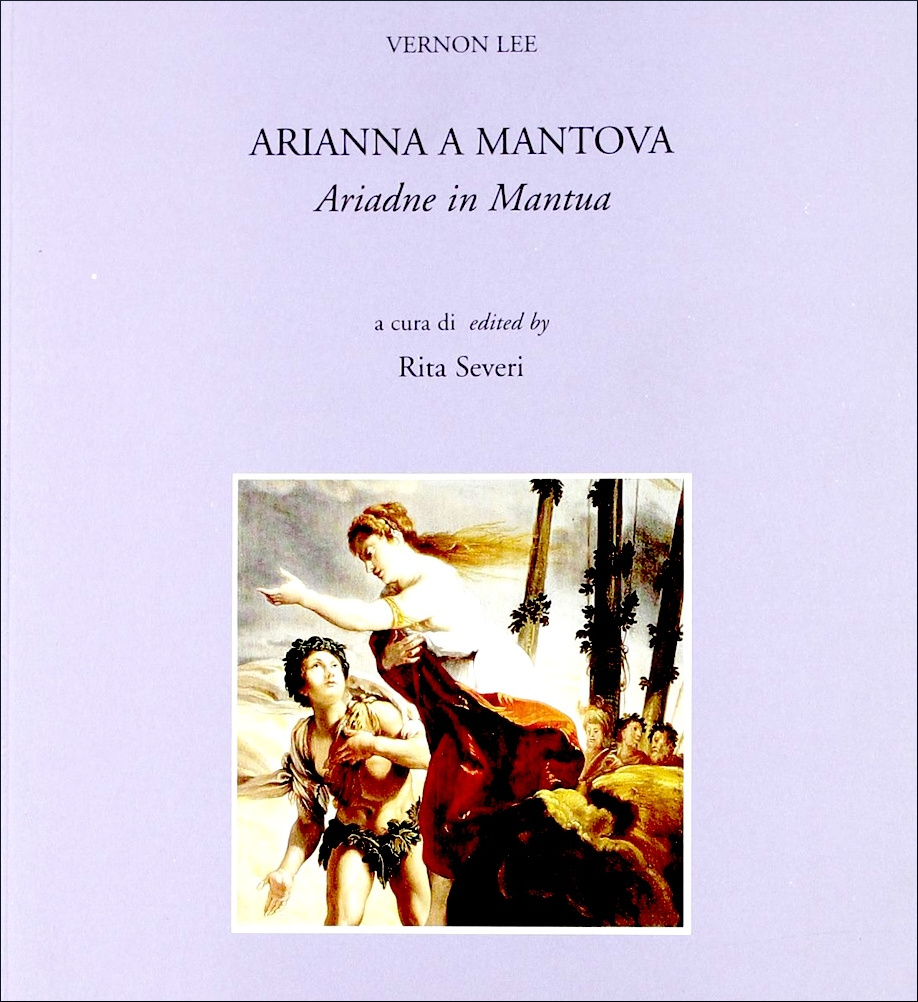
Lee, Vernon. Arianna A Mantova / Ariadne in Mantua, bilingual text, ed. with Introduction by Rita Severi, Fondazione Marcegaglia Edizioni Postumia – Gazoldo degli Ippoliti - Cierre Edizioni – Verona, 1996.
_____. Genius Loci: Notes on Places. London, Grant Richards, 1899.
_____. Hauntings: Fantastic Stories. London: W. Heinemann, 1892.
Created 7 June 2026