
Introduction
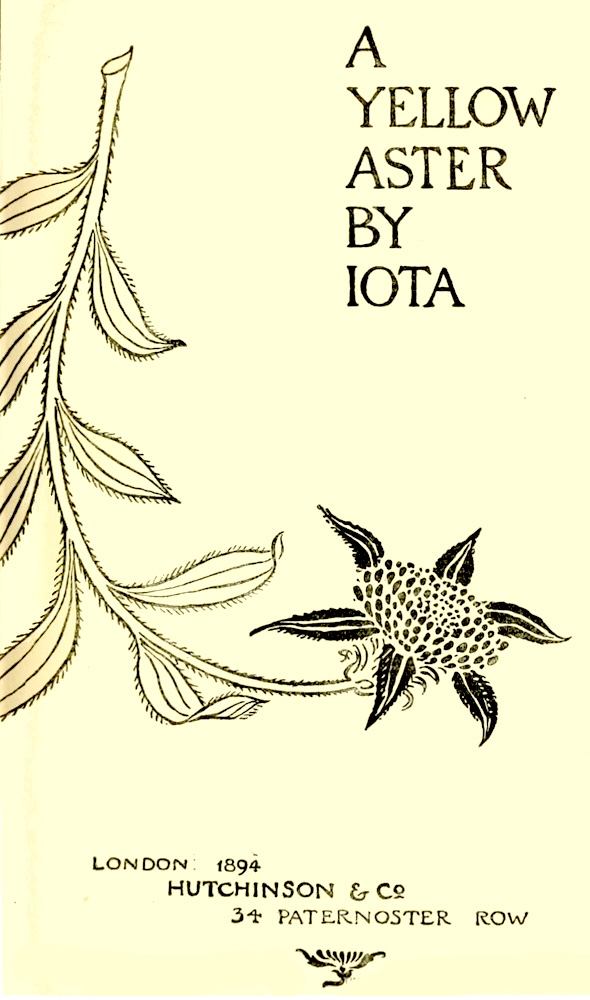
Cover of the 12th ed, "completing 15th thousand,"
from a copy on the HathiTrust website.
Kathleen Mannington Caffyn’s (Iota’s) first published novel, A Yellow Aster (1894), was an immediate and sensational success. It became a bestseller, selling four editions in a month and was widely reviewed as a “book of the day” (Solomon). Associated with the New Woman phenomenon, the novel contains a social commentary that delves into the issues of female identity, societal expectations, love, and the institution of marriage during the late nineteenth century. The novel’s title is a metaphor of an unnatural anomaly or a rare curiosity, represented by the protagonist, Gwen Waring. A yellow aster is a botanical impossibility (as they are naturally purple, blue, lavender, pink, and crisp white). Yellow asters can only be produced through scientific manipulation.
Caffyn's introductory epigraph serves as the foundation for the entire plot:
And if this fought–for climax is ever reached, and science, creeping along the path of experiment, so invades the realm of Nature that a blue chrysanthemum or a yellow aster can be produced at will, the question still remains, has Nature been made more beautiful thereby?
The author expresses her scepticism toward scientific progress when it comes at the expense of natural, emotional, or spiritual beauty. The epigraph serves as the central metaphor of the novel. By using the example of creating a “yellow aster” (a flower with yellow petals does not grow naturally), Iota questions some scientists’ obsession to alter the natural world through purposeless experimentation and modification. This passage foreshadows the main heroine’s background, showing how her cold, excessively intellectual parents raised her strictly on scientific principles while completely withholding love and maternal warmth. Iota criticises pure intellect and artificial perfection which offer flawless efficiency, but risk stripping away the messy, authentic imperfections that give humanity and the world their deeper meaning.
A plot outline
A married couple of amateur scientists and freethinkers, the Warings, are absorbed in their study of abstract mathematics to the extent that they view their two children (Gwen and Dacre) as a distraction. Grace Waring is more interested in geology than parenting, and her emotional negligence causes her daughter Gwen to grow up incapable of normal human emotions.
“Ah,” said his wife plaintively, “the feeding and physical care of children seems a terrible responsibility; it weighs upon my life. But the development of their intellectual powers! – I wish the time for it had kept off just a little longer, until we were farther on in our last, our best work.” [Vol. I, Chapter I]
As a result, their daughter, a pretty, and intelligent but precocious girl, is raised in an experimental manner to become a coldly rational and emotionless heroine. Gradually, Gwen realises her emotional void created by her parents.
Would anyone think it to look at me? I look so very sound and complete, and yet I am rotten at the core, a sort of Dead Sea apple. What a hackneyed order of fruit to belong to, I am not even original – ugh! I am inclined to think if I were a downright bad woman, who had sinned, sinned solidly, and all for love – I wish to Heaven I could get the feelings of one of them just for five minutes, to understand this temptation which to me is so utterly incomprehensible – Well, I really think that Humphrey would do better to marry a woman of this sort than me. It has come to a pretty pass when I – I, Gwen Waring, have taken to envying that sort of person!” [Vol. II, Chapter XXI]
Although devoid of feminine emotions due to her detached scientific upbringing, she finally decides to marry an aristocrat, Sir Humphrey Strange, a rich and handsome world traveller even though she does not love him. His relationship with Gwen in marriage reveals Gwen’s slow process of emotional awakening and self-discovery of love, motherhood and religion. Although Gwen initially finds her marriage empty and emotionless, she finally discovers her authentic womanhood through pregnancy and motherhood. Her complete transformation occurs after her baby survives a severe illness. Through motherhood she realises her true, fully rediscovered identity.
“I am,” she cried, with a happy laugh, “I am a giant refreshed with wine, a whole volume of new life has flowed into me, I could move the world at this moment, not to say carry this mite. I am a woman at last, a full, complete, proper woman, and it is magnificent. No other living woman can feel as I do; other women absorb these feelings as they do their daily bread and butter, and they have to them the same placid everyday taste, they slip into their womanhood; mine has rushed into me with a great torrent – I love my husband, I worship him, I adore him – do you hear, my dear?” [Vol. III, Chapter XLII]
Eventually, Gwen discovers her intense maternal feelings, and directly connects motherhood to the ultimate fulfilment of a woman’s life. The following passage illustrates the climax of Gwen’s emotional journey: her profound awakening and psychological rebirth; the transformation from a cold, emotionally detached individual into a passionately feeling human being:
“Then this haunting, sweet-bitter pain is motherhood,” she thought, the first day she was up, as she watched the sleeping child gobbling a red fist, “and it’s for this that one half the women in the world live and brood Madonna-like over their infants, with that awful peace in their eyes which takes the commonness from the most common of them! Goodness, what wouldn’t I give for just the merest knowledge of that motherhood that rests and broods and commands the world! That painted wretch downstairs is teeming with it, and – it’s bitter, it’s terrible, to want your mother as I want mine now, to teach me the meaning of motherhood!” [Vol. III, Chapter XL]
Having been raised by her cold, hyper-intellectual parents, Gwen has never experienced maternal love. This passage raises a central late-Victorian dilemma regarding the "New Woman." It questions whether a woman’s intellectualism and independence may destroy natural maternal instincts. Raised by parents who prioritised cold intellect over affection, Gwen entered marriage with Humphrey Strange as a purely intellectual and social arrangement, explicitly stating she could not feel love. However, Gwen’s motherhood is also a path to marital reconciliation. Before her emotional awakening due to motherhood, Gwen’s relationship with her husband was entirely barren on her side. She married him for companionship and freedom, explicitly telling him she was incapable of love. Humphrey, who deeply loved Gwen, lived in a state of constant rejection. Gwen finally confesses her love for her husband. The new-born child becomes the focal point that allows the couple to rebuild their broken relationship.
Metaphorical title
The “yellow aster” is a metaphor used to describe the protagonist of the novel, Gwen Waring, whose parents, a couple of science-obsessed amateur geologists, raise her focusing solely on her intellectual development, neglecting her feminine emotional and spiritual needs. The author uses the yellow aster image to emphasise her development as untypical and unique in the Victorian context. Yellow asters, as indicated above, are unnatural compared to the purple, white, blue and pink varieties. For Victorians yellow often did symbolise something unnatural or artificial, a stark contrast to its modern connotation of friendship, happiness and joy. Thus, Gwen as a “yellow aster” is a symbol for her unusual, emotionally detached character and upbringing.
The “New Woman” stereotype
The novel’s protagonist, Gwen Waring, is a “New Woman” character due to her unconventional views on marriage and her initial unemotional, unfeminine demeanour, which was often regarded as disagreeable by contemporary critics. While Gwen begins as a cold, independent rebel, the birth of her child triggers the awakening of her maternal and marital love. This laid the novel open to criticism as "part of the recent assault on decency in fiction" (Cunningham 58). However, critics often view Gwen as a less rebellious New Woman precisely because her eventual acceptance of traditional womanhood allows her to become a more “warm, big-hearted, divinely-natural” (Vol. III, Chapter XXXII) person, ultimately embracing love and maternity.
Conclusion
A Yellow Aster is part of a wide debate in the late Victorian era on gender roles, love, marriage, science, religion and female autonomy. The book is closely associated with the New Woman fiction, which explored the changing roles and increasing independence of women. Caffyn wrote the novel when she lived in Australia, but it has no local content. Rather, the novel was described by contemporary reviewers as “Zolaesque,” and also as showing the influence of Ibsen. Some reviewers condemned the novel’s frankness regarding marriage, love, motherhood and childbirth: Naomi Hetherington notes that it was "debated and derided" alongside other "New Woman" novels like Sarah Grand's Heavenly Twins and George Egerton's Keynotes, both published in the previous year (49); but most commended it: the twelfth edition is prefaced by the glowing praise of, amongst others, the Westminster Gazette:
A first impression is that A Yellow Aster is one of the very best novels we have read for many months; a second, that, in saying this, we do it rather less than justice. For it is a novel apart, with a strikingly original subject, which is worked out with a skill which is altogether unusual. This is a strong and excellent story, which, with all its pathos and tragedy, has the refreshment of a tonic.
In sum, the novel provides an insight into changes in domestic life and the social landscape of late nineteenth-century British society, showcasing the dilemmas faced by women during this period. Gwen’s unconventional upbringing is shown as a critique of Victorian social experiments. It takes time for a highly intelligent but completely detached heroine to experience and express love and maternity. At the same time, the novel's critical reception demonstrates the divided opinions of those who saw New Woman writing as an "articulation of the obsessional interiority and self-scrutiny of late nineteenth century woman in general, and of feminism in particular" (Pykett 41), and those who welcomed its eventual focus on more traditional womanly feeling. It is noteworthy that after the novel's success, Caffyn "publicly distanced herself from the political women's movement" (Hetherinton 49).
Bibliography
Cunningham, Gail. The New Woman and the Victorian Novel. London: Macmillan, 1978.
Hetherington, Naomi. “Feminism, Freethought, and the Sexual Subject in Colonial New Woman Fiction: Olive Schreiner and Kathleen Mannington Caffyn.” Victorian Review, Vol. 37, No. 2 (Fall 2011), pp. 47–59.
Iota [Kathleen Mannington Caffyn], A Yellow Aster, London: Hutchinson & Co, 1894; also available on Project Gutenberg, HathiTrust and the Internet Archive.
Pykett, Lyn. The "Improper" Feminine: The Women's Sensation Novel and the New Woman Writing. London: Routledge, 1992.
Solomon, Geulah. “Stephen Mannington Caffyn (1850–1896)”, Australian Dictionary of Biography, Vol. 3, 1851–1890, ed. by Douglas Pike. Melbourne: Melbourne University Press, 1978; https://adb.anu.edu.au/biography/caffyn-stephen-mannington-3137
Created 28 October 2025