
Caroline E. Giddis Macia is a a curatorial research associate at the High Museum of Art in Atlanta. The following essay won third prize in the John Pickard Essay Prize of 2025 for an essay on any individual related to the Pre-Raphaelite circle, and first appeared in the Pre-Raphaelite Society Review, Vol. XXXIII (Spring 2025), pp. 15-21. Reproduced here with the permission of the author and editor, it has been slightly adapted to suit our own format. Click on the images to see larger pictures. — JB

ary Seton Watts (1849–1938) first trained as a portraitist and sculptor, produced work in the liminal realm of mortuary design from 1894 on, after claiming the opportunity to design and build the Watts Cemetery Chapel in Compton, Surrey and its adjacent Compton Cemetery (see Rose 61-62). While this mortuary structure served as a site of universal and community-wide mourning, Seton Watts cultivated a practice of expertly designing grave ornaments, memorials, and headstones which were personal to the individual and their direct circle of bereavement. Those memorialized through her work include her father, Charles Edward Fraser-Tytler (1817–1881), her cousin Alice Margaret Hanson (1848–1901), her artist husband, George Frederic Watts (1817–1904), Julian Sturgis (1848–1904), her half-sister, Eleanor Kellie Maccallum Dalgleish (1853–1909), her brother, Edward-Grant Fraser-Tytler (1856–1918), her sister, Etheldred Fraser-Tytler (1844–1919), among many others. In addition to these securely attributed grave markers, there are several more spread throughout the isle which she likely designed as well: once her designs were made into molds, they could be reproduced by the Potters’ Arts Guild for grave markers in perpetuity (see Calvert and Boreham 167).
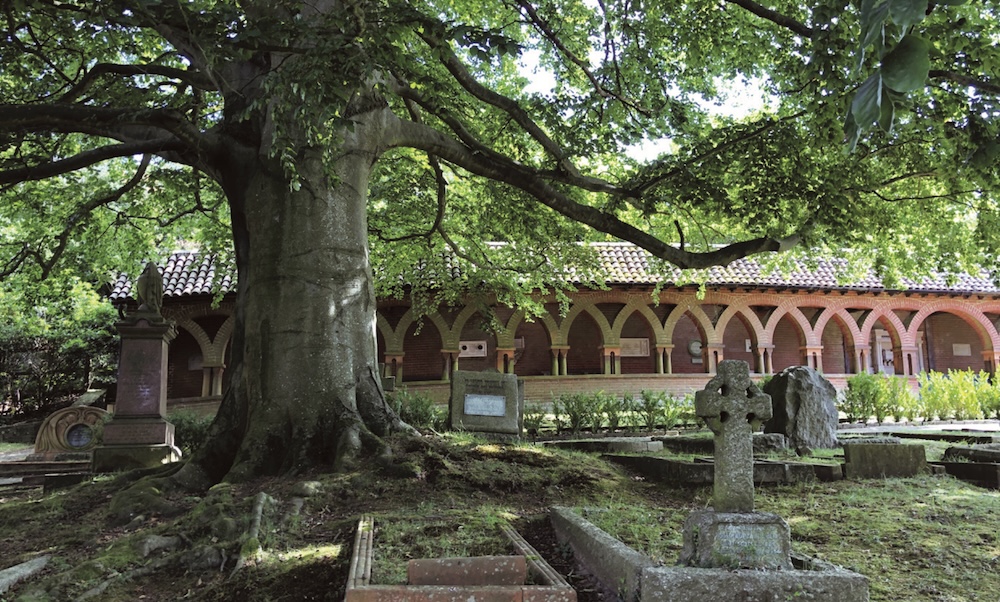
A view of Compton Cemetery and the cloister, 2019. Photograph by author.
Her gravestone production has been examined and cataloged within her larger artistic career but less so within the context of her personal relationships and losses, which were numerous and affected her deeply. Evidenced through daily diary entries and letters from 1887 to 1908, Seton Watts had an enviable capacity for great empathy. In August 1887, after troubled by some news she received the previous day, Seton Watts penned a conversation she had with G.F. Watts:
I was telling him how shaken I felt by the sorrows I had been hearing [...] He says he understands it well, often he has to reason himself out of a feeling that something dreadful is going to happen, “the black rays of a calamity seems round me I say to myself it is merely physical. There are sorrows where we can stir ourselves and help and there are sorrows where we can give nothing but sympathy, and if it vexes that we can do no more, we must remember that our daily work is required of us, and our minds must not be made unfit for that by vainly grieving where we can't help.” [Diary [1887], 107]
His advice to combat sorrows with action where possible seemed a boon to her compassionate artistic inclinations. Years of entries demonstrate her enjoyment from chronicling daily visitors to the studio—friends, callers, and colleagues alike. She documented the lives of others and the anecdotes they brought to her own experience. Her role as a social reformer — an educator with the Home Arts and Industries Association and later as the president of her local affiliate of the National Union of Women’s Suffrage Societies — demonstrate not only her empathy but her belief in action. It makes sense then that she would take up the mantle of mediating and assuaging grief through the installation of artful sites of memory. Some of her earliest documented interest in funerary artwork dates to the time she spent in Greece, Turkey, Italy, and Egypt on her honeymoon in 1887, when she became enthralled by the practices and artwork of the ancient world’s various cults of death, especially those of the ancient Egyptians (Diary [1887], 33-34). In conjunction with this fascination, Seton Watts’s passion for and prolific career in mortuary artmaking was grounded in her familiarity with grief but fueled by a noble desire to beautify remembrance with design embedded in nature.
Seton Watts’s career in mortuary design developed first out of the necessity of the loss of a friend. In 1891, G.F. Watts was commissioned to design Lady Louisa Beresford, Marchioness of Waterford’s gravestone, designing the angels of the headstone while Seton Watts designed the recumbent Celtic cross ornamented with a labyrinth shield and "as much beauty of symbol as is possible to put into it" (Diary [1891], 192). Shortly after this in 1893, she had an epiphanic moment upon visiting her aunt’s grave, a site she vehemently rejected due to its simplistic cross, a style increasingly popular in cemeteries, reiterating her preference for intricate design: "What an opportunity wasted. The idea passed through my mind, could I do anything? Artists [and] friends who would design, use terra cotta and brick […] Teach the people to make their own" (Diary [1887], 170). This has been previously identified by scholars as the moment in which Seton Watts decided to pursue mortuary artmaking. In September 1894, Seton Watts wrote, "My mind full of improving churchyards, memorials!" (qtd. in Gould 45). So strong was her enthusiasm, that when the Chapel project was proposed in 1894, she seized her opportunity to begin formal production of terracotta works with her students, which would turn into the Compton Pottery and the successful Potters’ Arts Guild in 1904.
Seton Watts’s exposure to death itself came early, losing her mother Etheldred St. Barbe in 1851 and her half-brother Charles-William to typhoid in 1877. After marrying G. F. (a near-septuagenarian) and into an older crowd, Seton Watts became familiar with loss again. After just a year into their marriage, G.F. fell ill. Riddled with the fear of impending loss, she penned the following entry:
I dozed and woke to know I had my darling still. I lay beside him the relaxing of the tension being too much for me. Yesterday, in an instant of time what awful things seemed close upon me, I remember chiefly a sense of everything being emptied – the skies, the sun, the pretty house, all I had cared so much for a few minutes before had suddenly become as void. I tasted death, but it has passed! [Diary [1887], 166]
The aging Pre-Raphaelite Brotherhood, many of whom were close friends of the Wattses, died while Seton Watts was between her thirties and forties, except for William Holman Hunt, who died in 1910. Within a short period, the Wattses mourned the deaths of Ford Madox Brown, William Morris, John Everett Millais, and their dearest friend Edward Burne Jones. Seton Watts, born the same year as the Brotherhood, saw it flicker and extinguish. On top of her familial deaths (she outlived all her six siblings), the loss of so many within her circle created a pattern of bereavement for her, that in turn informed her artmaking. In July 1904, Seton Watts unfortunately became more intimate with the whirlpool of grief, deepening her understanding when G. F. "Signor" died. A few days after, she bared her soul in a diary entry:
I have gone thro’ hells tortures all alone. I am a spirit as it were outcast from a high heaven. I feel as if never again would I atune [sic] my life to that sweet high pitch that for 18 years (so nearly) I have had daily in my ears, making such music in my heart. Oh Signor, Signor, help me still! [Diary [1904], 14]
Her pain turned ugly and sharp later that month, "Signor, you made me care to live, and now you make me want to die – here in this desolate house – I seem to wish you in every spot at every turn" (Diary [1904], 14). By December her grief had dulled to a chronic condition with occasional thorns in her side. A woman of action, her mourning became a motivator: "The last year – the last golden year for me dies. Now for me it must be all looking forward, forward to the day when deaths [sic] gate open to the beyond. If only I may meet Signor & say “I have followed, worked, loved as you did beloved.'"
Even before knowing the darkest depths of bereavement, Seton Watts demonstrated a keen awareness of the pangs of loss among her peers and simultaneously and empathetically recognized that gravesites provide a place to visit the remains of their loved one, tying their grief in a pilgrimage site, consoling them with the physicality of natural elements of stone, marble, or clay, made from thousand-year-old materials from the earth. Set in beauty, a grave marker can aid the grieving process. In 1898, after most of the chapel had been completed, she launched into terracotta grave marker design production with the students from her classes who had become full-fledged potters. Seton Watts had a broader vision for the industry of cemetery design, and she did her best to circulate that vision beyond what she could control within her village. Her designs, often rendered as recumbent or low-profile markers alive with her Celtic interlace or art nouveau angels and brought to life in terracotta, complemented the British landscape, pushing the experience of cemeteries closer to that of a lush private garden. In 1911, Seton Watts completed the cemetery cloister she designed to house G.F.’s memorial and plaques of the future deceased, giving an interview to the Surrey Times stating:
If people will put memorial tablets in the cloister instead of erecting tall upright stones above the graves, the cemetery will be more like a garden. Tall stones are very often beautiful in themselves, but one destroys the beauty of the other. Recumbent monuments in a cemetery are much more beautiful, and have a much more restful effect. [Calvert and Boreham 182]
Here, Seton Watts differentiated herself from cemetery architects and designers working in Europe at the time who were producing tall stones, mausoleums, and architectural monuments in marble (see Dixon and Muthesius 114-15). In almost complete contrast, her works were low-profile and made in terracotta, distinguishing her vision and artwork from her peers in mortuary artmaking. Demonstrating this Seton-Wattsian ideal is the grave ornament of her cousin, Alice Margaret Hanson, née Ogilvy (1848–1901):
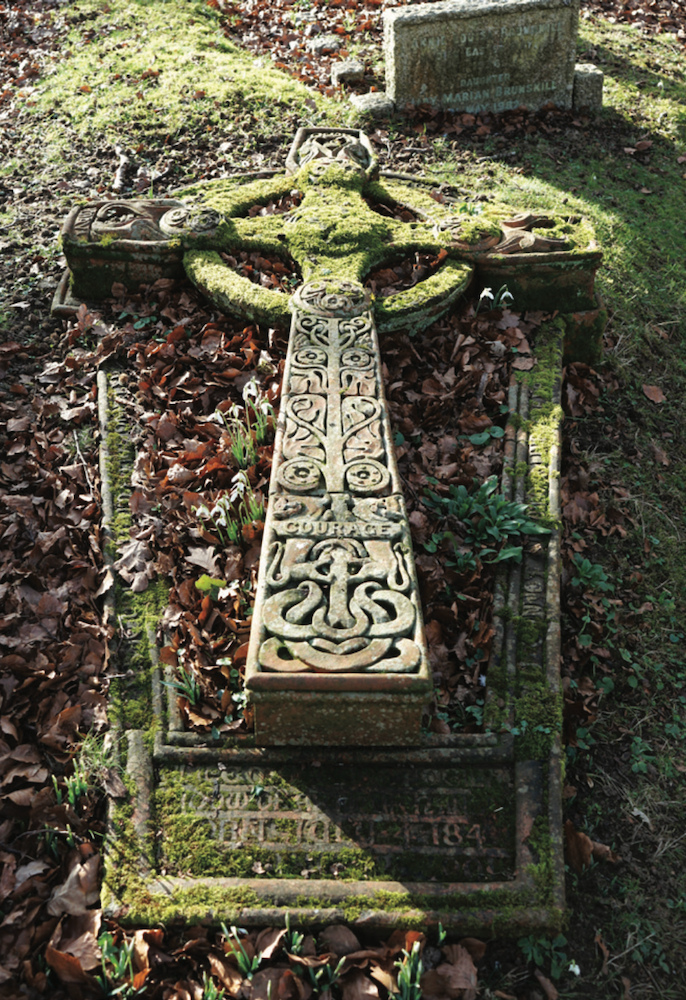
The grave of Alice Margaret Hanson, Compton Cemetery, 2024. Watts Gallery Trust.
Alice frequently visited the Wattses, staying with them for a period in 1896 while battling a chronic illness. Seton Watts’s entries mark the ebbs and flows of Alice’s condition and how they either worried or eased her. An October diary entry reads, "Darling Alice came – shocking to see her thin, thin face and the two big lamps of eyes, so dear to me" ([1896], 46). This was followed by two updates in early November: "In every direction her malady increased, enormously, and yet she says 'I was never afraid nor for an instant wavered in my belief that it will be overcome at last,'” and later, "Dear Alice so bright in the afternoon […] always bright and sympathetic – always beautiful in her large rich full heartedness, the spirit of her mother ripened in a southern sun" ([1896], 48, 49-50). Alice’s grave is a recumbent, outlining kerb of terracotta surrounding a Celtic cross, a composition which acts as an extension of the design embedded in the chapel exterior. The face of the cross’s panel bears a sprouting tree, closely resembling the chapel’s tree of life motif, which trails up the engaged columns of the exterior in a tangle of flora and fauna. In Seton Watts’s textual accompaniment to the chapel, The Word in the Pattern: A Key to the Symbols on the Walls of the Chapel at Compton, Surrey (1905), she wrote of the tree of life as, "a noble tree spreading its branches to the light of Heaven, yet fed and upheld by roots working in the darkness of the earth, converting all it meets with, even death and decay, into a rising stream of life" (6-7). For her, this symbol held much power, and was capable of acting as a conduit between life and death. The elaborate design and effort put into this site reflects the deep affection she held for her cousin. Seton Watts owed much of the emotional depth of her designs to their Celtic style, writing to James Morton in 1901:
There is no decoration so suited to telling its story. It is, I believe, like the Gaelic language, the most emotional of the styles of decoration. But had the dangers common to all highly emotional things & requires temperance & judgement in the soul of the designer, to prevent it from becoming meaningless. [qtd. in Gould 86]
The curvilinear lines meditatively weave, branching off only when necessary, lending a softness on the eye. Equally, the labyrinthine forms provide a distraction for a viewer experiencing mental or emotional numbness, a common expression of the grieving process, and allow the visitor to trace the many lines while, or instead of, confronting an onslaught of emotion.
Working in tandem, the unique details of each grave and architectural plan of a cemetery such as the one in Compton could facilitate a positive grieving process. Examining the aesthetics of grief in the nineteenth century, cultural psychologist Luca Tateo writes, “The cemetery became an organized space of atmosphere suggesting an affective experience, to mediate both the cultivation of memory and the elaboration of grief" (423-24). Seton Watts intuited that the cemetery could be a picturesque site of sentimentality which welcomed mourners and encouraged positive remembrance, shifting focus from the deceased to the griever.
An example of a mortuary work which facilitated all these experiences was that of Julian Sturgis (1848–1904), American-British novelist and poet, and close friends of the Wattses, who died a few months before G.F. in 1904. Sturgis was cremated and interred in Compton Cemetery not far from where his friend would be buried in July. While Sturgis was buried in April, Seton Watts did not complete his gravestone until months later, still working at it on New Year’s Eve in 1904, dedicating time and care to ensure its perfection (see Diary [1904], 43-44).
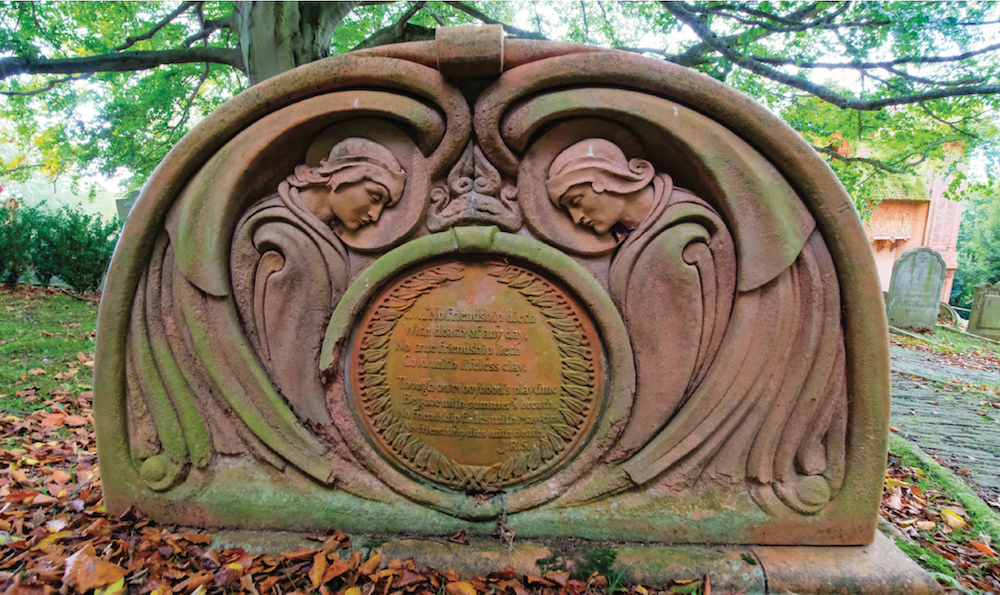
The reverse of the grave of Julian Sturgis. Watts Gallery Trust. Photo by Andy Newbold.
The marker, which broke her recumbent design rule, is shaped in the form of two angels bowed toward one another who resemble fleshed out cousins of the profiled angels present on the "Garment of Praise" friezes, which wrap the Watts Chapel exterior. The central medallion contains Sturgis’s name and life dates on the front while the reverse contains auspicious lyrics from Sturgis’s song Through the Ivory Gate (1895):
No friendship dieth
With death of any day,
No true friendship lieth
Cold with lifeless clay.
Though our boyhood's playtime,
Be gone with summer's breath,
No friendship fades with Maytime
No friendship dies with death.
That November, Sturgis’s family had visited her to view sketches of the marker, including his widow Mary and his brother Henry Sturgis, and they may have suggested using this passage or provided feedback on her design (see Seton Watts's Diary [1904], 19; Mary Maude de la Poer Beresford, wife of Julian Sturgis is a distant relative of Henry de la Poer Beresford, 3rd Marquess of Waterford, husband of Lady Louisa Beresford). Through their involvement, Seton Watts ensured that the many visiting mourners would experience the nearness of Sturgis through his words and the soft invitation of the angels and lush grounds.
Set within scenic hills and lush landscape, her ideal garden cemetery provided benefits to the mind and body, softening the blows of terrible loss within an environment that felt no less comfortable than visiting a loved one in their home garden. The hill of Compton Village Cemetery, nestled among old and new vegetation more or less maintains this effect to this day. According to social historians, the change in the physical landscape had a ripple effect on the way grief was treated in society, evolving from maintaining strict rites of mourning to an enlightened perception that loss created a prolonged psychological effect and should instead be continually "treated" (see Ariès 99-100; also Tateo 424).
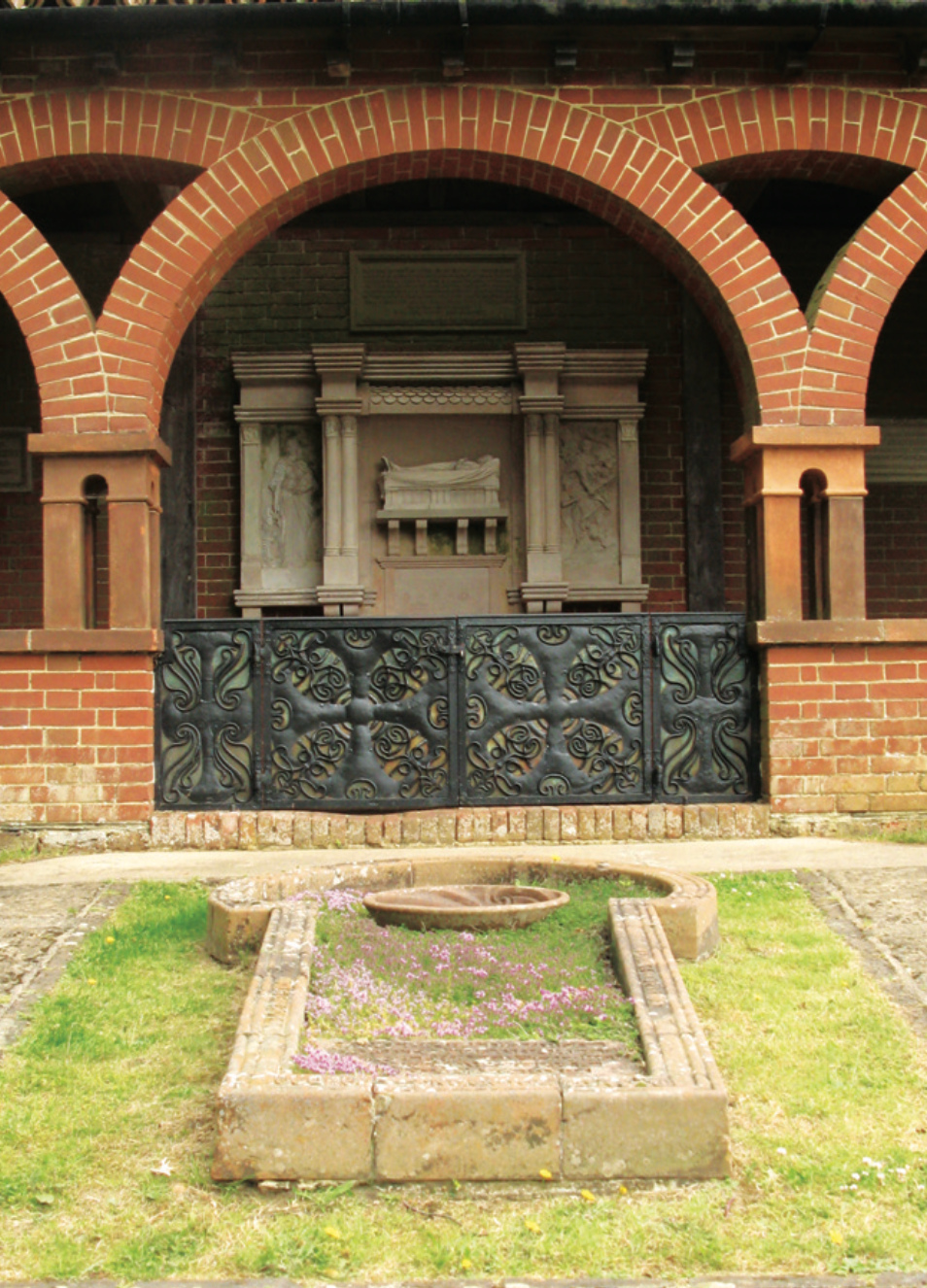
The graves of George Frederic and Mary Watts. Watts Gallery Trust.
Concentrating on the beauty of each grave, Seton Watts surpassed the mourner’s need to know where their loved one’s body lay, but to provide comfort, awe, inspiration — a cult of memory. Reflecting on G.F.’s funeral service years later, Seton Watts wrote, "mother earth took back my darling’s little dust into her safe keeping" (Diary [1906-08], 11). Thirty years later, her own cinerary casket would be interred with G.F.’s in the same grave. A simple outlining kerb design made from terracotta, the Watts's grave marker nearly fades into the grass, into the landscape, supporting every tenet of her ideal design concept.
Many of the grave ornaments surrounding them, pinpointing the resting places of friends and loved ones, were made with Seton Watts’s skilled hands and intellectual vision. Mortuary works designed by Seton Watts can be found across Britain embodying her ability to promote local and widespread change through design and action. A life nearly overflowing with terrible grief brought forth beauty from that experience, providing mourners a respite for centuries in terracotta. Seton Watts’s career was a beautiful symmetry of give and take; she removed clay from the humble earth to craft a higher design, while a loved one took its place, filling that gap in the ground. Dust became solid as solid turned to dust.
Related Material
- Tomb of G. F. Watts
- More views of the Art Nouveau tombstone for J. R. Sturgis
- An Art Nouveau tombstone for Margerie Gillett
- Ceramic well in Compton Cemetery
- Another view of the Memorial Cloisters
- Compton Cemetery Chapel
- British Funerary Sculpture
Bibliography
Ariès, Philippe.
Calvert, Hilary, and Louise Boreham, eds.>Mary Seton Watts and the Compton Pottery. London: Philip Wilson Publishers, 2019.
Dixon, Roger, and Stefan Muthesius. Victorian Architecture. Rpt. London: Thames and Hudson, 1988.
Gould, Veronica Franklin. Mary Seton Watts (1849–1938): Unsung Heroine of the Art Nouveau. Over Wallop, England: Watts Gallery, 1998).
Rose, Lucy Ella. “Subversive Representations of Women and Death in Victorian Visual Culture: The ‘M/Other’ in the Art and Craft of George Frederic Watts and Mary Seton Watts.” Culture in Britain 17, no.1 (2016): 61-62.
Tateo, Luca. “Cultural Mediation of Grief: The Role of Aesthetic Experience.” Culture & Psychology 29, no. 3 (2023): 423–24.
Watts, Mary Seton. The Diary of Mary Seton Watts. [1887 - 1904]. Transcribed by Desna Greenhow (unpublished archival material, Watts Gallery Trust).
_____. The Word in the Pattern: A Key to the Symbols on the Walls of the Chapel at Compton, Surrey. 2nd ed. London: The Astolat Press, 1905.
Created 26 February 2026