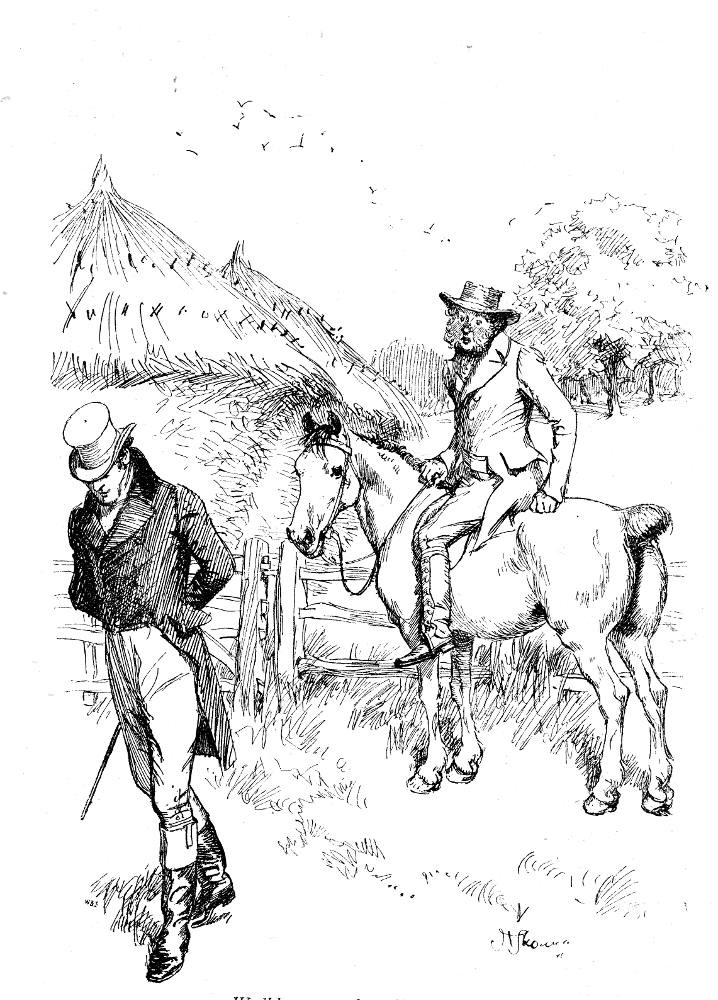
Walking away from William Larkins.
Hugh Thomson
1905
Photomechanical reproduction of a pen-and-ink drawing
12.2 by 8.4 cm (4 ¾ by 3 ½ inches), vignetted
Jane Austen, Emma, facing page 405.
Scanned image and text by Philip V. Allingham.


[Victorian Web Home —> Jane Austen —> Visual Arts —> Illustration —> Hugh Thomson —> Next]
Walking away from William Larkins.
Hugh Thomson
1905
Photomechanical reproduction of a pen-and-ink drawing
12.2 by 8.4 cm (4 ¾ by 3 ½ inches), vignetted
Jane Austen, Emma, facing page 405.
Scanned image and text by Philip V. Allingham.
[You may use this image without prior permission for any scholarly or educational purpose as long as you (1) credit the person who scanned the image, and (2) link your document to this URL in a web document or cite the Victorian Web in a print one.]
Of their all removing to Donwell, Emma had already had her own passing thoughts. Like him, she had tried the scheme and rejected it; but such an alternative as this had not occurred to her. She was sensible of all the affection it evinced. She felt that, in quitting Donwell, he must be sacrificing a great deal of independence of hours and habits; that in living constantly with her father, and in no house of his own, there would be much, very much, to be borne with. She promised to think of it, and advised him to think of it more; but he was fully convinced, that no reflection could alter his wishes or his opinion on the subject. He had given it, he could assure her, very long and calm consideration; he had been walking away from William Larkins the whole morning, to have his thoughts to himself.
“Ah! there is one difficulty unprovided for,” cried Emma. “I am sure William Larkins will not like it. You must get his consent before you ask mine.”
She promised, however, to think of it; and pretty nearly promised, moreover, to think of it, with the intention of finding it a very good scheme.
It is remarkable, that Emma, in the many, very many, points of view in which she was now beginning to consider Donwell Abbey, was never struck with any sense of injury to her nephew Henry, whose rights as heir-expectant had formerly been so tenaciously regarded. Think she must of the possible difference to the poor little boy; and yet she only gave herself a saucy conscious smile about it, and found amusement in detecting the real cause of that violent dislike of Mr. Knightley’s marrying Jane Fairfax, or any body else, which at the time she had wholly imputed to the amiable solicitude of the sister and the aunt.
This proposal of his, this plan of marrying and continuing at Hartfield — the more she contemplated it, the more pleasing it became. [Chapter LI, 403-405]
In Chapter LI, following the acceptance of his proposal, Emma quips that Knightley should seek the prior approval of the Donwell Abbey estate manner, William Larkins, before even contemplating the move to Hartfield. The long-serving steward will be constantly looking to Knightley for managerial advice on estate matters and tenants’ needs, but Knightley will be miles away. Typifying his role as supervisor of day-to-day operations on the agricultural estate, Larkins, in working garb, appears on horseback in a hayfield. But instead of dialoguing with Larkins, Knightley, mentally and emotionally wrapped up in his plans to marry Emma and live at Hartfield, walks away: Larkins seems puzzled and curious. The scene does not actually occur in the chapter; rather, Thomson seems to be personifying the fields in the person of the mounted estate agent, and “he had been walking away from William Larkins the whole morning to have his thoughts to himself” (403).
The reader, perusing the illustration in advance of encountering Emma’s quip, may well be shocked to discover that the illustration is not a realisation of an actual textual moment.
Austen, Jane. Emma. Ed. Austin Dobson. With forty pen-and-ink illustrations by Hugh Thomson. The Novels of Jane Austen. London: Macmillan, 1896, rpt. 1905.
Austen, Jane. Emma. Ed. R. Brimley Johnson. With coloured illustrations by C. E. Brock. The Novels and Letters of Jane Austen. 2 vols. New York & Philadelphia: Frank S. Holby, 1906.
Austen, Jane. Emma. Ed. George Justice. 4th edition. New York: W. W. Norton, 2011.
Austen, Jane. Emma: An Annotated Edition. Ed. Bharat Tandon. Cambridge, Mass., and London: Belknap Press of Harvard U. P., 2012.
Last modified 8 June 2026