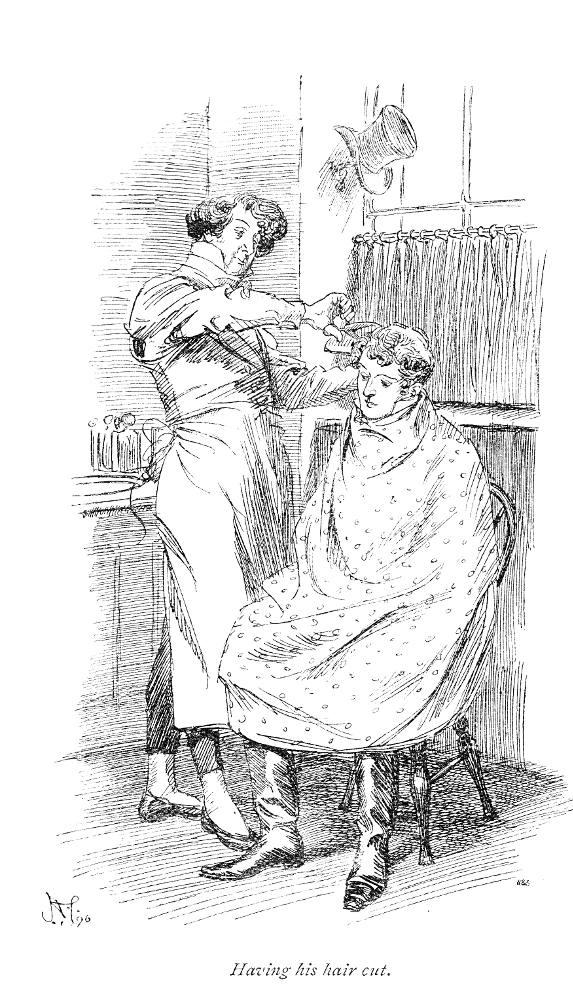
Having his hair cut
Hugh Thomson
1905
Photomechanical reproduction of a pen-and-ink drawing
11 by 6.8 cm (4 ⅜ by 2 ⅝ inches), vignetted
Jane Austen, Emma, facing page 183.
Scanned image and text by Philip V. Allingham.


[Victorian Web Home —> Jane Austen —> Visual Arts —> Illustration —> Hugh Thomson —> Next]
Having his hair cut
Hugh Thomson
1905
Photomechanical reproduction of a pen-and-ink drawing
11 by 6.8 cm (4 ⅜ by 2 ⅝ inches), vignetted
Jane Austen, Emma, facing page 183.
Scanned image and text by Philip V. Allingham.
[You may use this image without prior permission for any scholarly or educational purpose as long as you (1) credit the person who scanned the image, and (2) link your document to this URL in a web document or cite the Victorian Web in a print one.]
Emma’s very good opinion of Frank Churchill was a little shaken the following day, by hearing that he was gone off to London, merely to have his hair cut. A sudden freak seemed to have seized him at breakfast, and he had sent for a chaise and set off, intending to return to dinner, but with no more important view that appeared than having his hair cut. There was certainly no harm in his travelling sixteen miles twice over on such an errand; but there was an air of foppery and nonsense in it which she could not approve. It did not accord with the rationality of plan, the moderation in expense, or even the unselfish warmth of heart, which she had believed herself to discern in him yesterday. Vanity, extravagance, love of change, restlessness of temper, which must be doing something, good or bad; heedlessness as to the pleasure of his father and Mrs. Weston, indifferent as to how his conduct might appear in general; he became liable to all these charges. His father only called him a coxcomb, and thought it a very good story; but that Mrs. Weston did not like it, was clear enough, by her passing it over as quickly as possible, and making no other comment than that “all young people would have their little whims.” [Chapter XXV, 181]
As wigs fell out of fashion toward the end of the eighteenth century, it became consequently more important for men to keep their hair trimmed. Of course, it transpires that Frank is not "merely" in London "to have his hair cut," but also to order the musical instrument that will generate so much mystery and speculation later in the novel. [Tandon, 244]
The sixteen miles "twice over" trip London and back (a considerable one prior to the railway age) is not merely about the vanity of young, fashionable Frank, member of the generation that no longer wears a wig, and must therefore keep his hair fashionably styled. Rather, his trip to the metropolis and back involves his ordering a piano. This is a secret romantic gesture for Jane Fairfax, whom he had met some time before at Weymouth. Frank's gift allows Jane, a gifted musician, to play regularly, even as he keeps the true nature of their relationship secret from their society. He will thus have a pretext for regular visits to her. Going to London for a fashionable haircut gives Frank the opportunity to make delivery arrangements for the compact musical instrument (an early 19th c. pianoforté, far less expensive than a grand piano) in private.
Austen, Jane. Emma. Ed. Austin Dobson. With forty pen-and-ink illustrations by Hugh Thomson. The Novels of Jane Austen. London: Macmillan, 1896, rpt. 1905.
Austen, Jane. Emma. Ed. R. Brimley Johnson. With coloured illustrations by C. E. Brock. The Novels and Letters of Jane Austen. 2 vols. New York & Philadelphia: Frank S. Holby, 1906.
Austen, Jane. Emma. Ed. George Justice. 4th edition. New York: W. W. Norton, 2011.
Austen, Jane. Emma: An Annotated Edition. Ed. Bharat Tandon. Cambridge, Mass., and London: Belknap Press of Harvard U. P., 2012.
Last modified 2 May 2026