
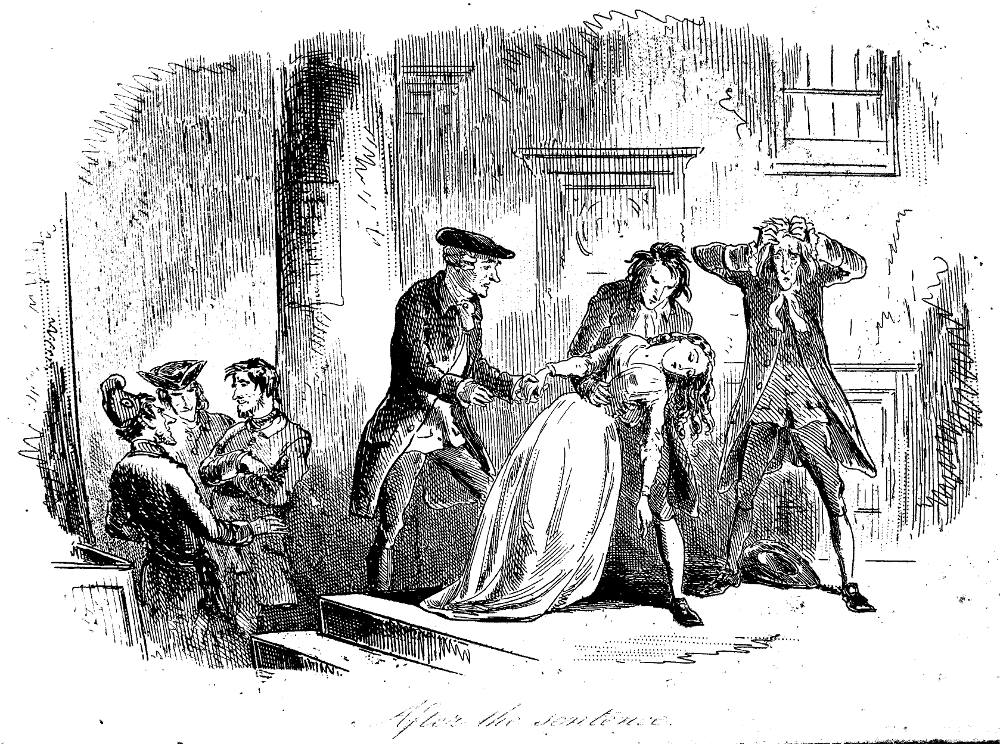
After the Sentence (facing p. 225) — Phiz's ultimate illustration for Charles Dickens's A Tale of Two Cities, December 1859. Steel engraving for Book III, Chapter XI, "Dusk" (originally in Part 7, December 1859). 10.5 cm high by 14.6 cm wide (4 ⅛ by 5 ¾ inches), vignetted. Instalment No. 28 in the All the Year Round weekly numbers on 5 November. For a discussion see Phiz's December 1859 Plates for Dickens's A Tale of Two Cities. [Click on the image to enlarge it.]
Passage Illustrated: Dr. Manette's Own Words Condemn His Son-in-Law
“My husband. No! A moment!” He was tearing himself apart from her. “We shall not be separated long. I feel that this will break my heart by-and-bye; but I will do my duty while I can, and when I leave her, God will raise up friends for her, as He did for me.”
Her father had followed her, and would have fallen on his knees to both of them, but that Darnay put out a hand and seized him, crying:
“No, no! What have you done, what have you done, that you should kneel to us! We know now, what a struggle you made of old. We know, now what you underwent when you suspected my descent, and when you knew it. We know now, the natural antipathy you strove against, and conquered, for her dear sake. We thank you with all our hearts, and all our love and duty. Heaven be with you!”
Her father’s only answer was to draw his hands through his white hair, and wring them with a shriek of anguish.
“It could not be otherwise,” said the prisoner. “All things have worked together as they have fallen out. It was the always-vain endeavour to discharge my poor mother’s trust that first brought my fatal presence near you. Good could never come of such evil, a happier end was not in nature to so unhappy a beginning. Be comforted, and forgive me. Heaven bless you!”
As he was drawn away, his wife released him, and stood looking after him with her hands touching one another in the attitude of prayer, and with a radiant look upon her face, in which there was even a comforting smile. As he went out at the prisoners’ door, she turned, laid her head lovingly on her father’s breast, tried to speak to him, and fell at his feet.
Then, issuing from the obscure corner from which he had never moved, Sydney Carton came and took her up. Only her father and Mr. Lorry were with her. His arm trembled as it raised her, and supported her head. Yet, there was an air about him that was not all of pity — that had a flush of pride in it. [Book the Third, “The Track of a Storm,” Chapter XI, “Dusk,” 225]
Related Materials
- A Tale of Two Cities (1859) — the last Dickens's novel "Phiz" Illustrated
- Costume Notes on A Tale of Two Cities
- List of Plates
- Compare to McLenan's illustrations
- 25 Illustrations for Dickens's A Tale of Two Cities by Fred Barnard (from the Household Edition, 1874)
- The Climactic Scene of Fox Cooper's The Tale of Two Cities (July 1860)
- A Tale of Two Cities (1859): A Model of the Integration of History and Literature
Scanned images and texts by Philip V. Allingham. [You may use this image without prior permission for any scholarly or educational purpose as long as you (1) credit the person who scanned the image and (2) link your document to this URL in a web document or cite the Victorian Web in a print one.]
Bibliography
Allingham, Philip V. “Charles Dickens's A Tale of Two Cities (1859) Illustrated: A Critical Reassessment of Hablot Knight Browne's Accompanying Plates.” Dickens Studies Annual. 33 (2003): 109-158.

Sanders, Andrew. "Introduction" to Charles Dickens's A Tale of Two Cities. Oxford: Oxford University Press, 1988.
Dickens, Charles. A Tale of Two Cities. Illustrated by Phiz (Hablot Knight Browne). London: Chapman and Hall, November 1859.
Woodcock, George. "Introduction" to Charles Dickens's A Tale of Two Cities. Harmondsworth: Penguin, 1970.
Created 29 July 2011 Last modified 3 November 2025