
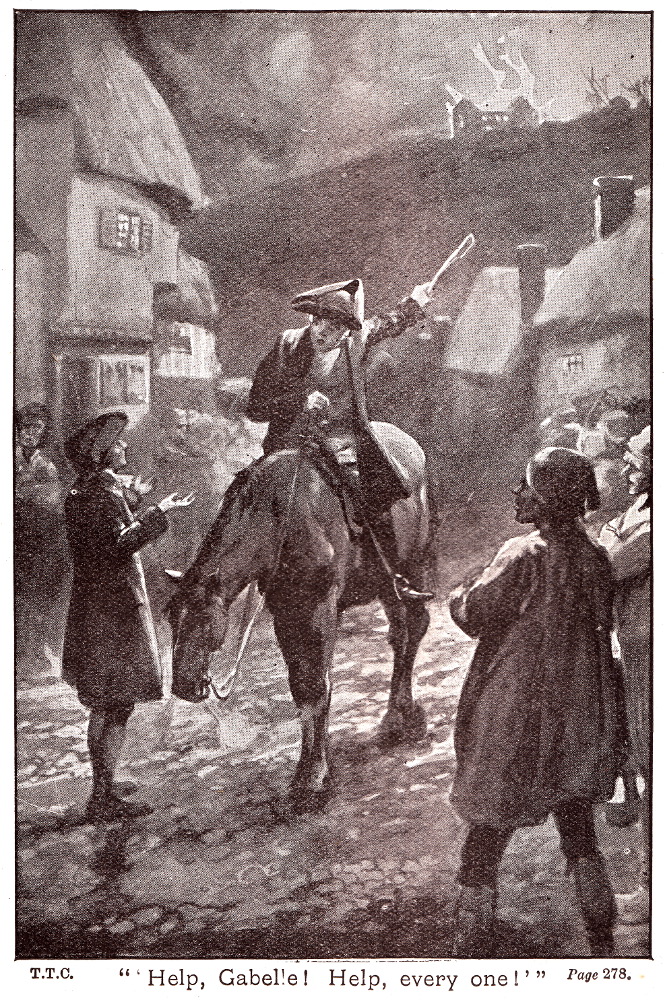
“Help, Gabelle! Help, every one.”
Arthur A. Dixon
1905
Watercolor as lithograpgh
4 ⅝ inches high by 3 ⅛ inches wide (11.8 cm by 8 cm)
Eighth illustration for Collins edition, p. 256.
Book II, “The Golden Thread,” Ch. 23, “Fire Rises,” p. 278. Oxford World's Classics edition p. 282. Gabelle is appealed to as the Evremonde chateau on the hillside burns.
Scanned image and text by Philip V. Allingham.
[You may use this image without prior permission for any scholarly or educational purpose as long as you (1) credit the person who scanned the image and (2) link your document to this URL in a web document or cite it in a print one.]

Passage Realised: The Destruction of the Chateau of the Marquis
A faint murmur arose about the house from the few people who were left there, and there was a saddling of a horse and riding away. There was spurring and splashing through the darkness, and bridle was drawn in the space by the village fountain, and the horse in a foam stood at Monsieur Gabelle’s door. “Help, Gabelle! Help, every one!” The tocsin rang impatiently, but other help (if that were any) there was none. The mender of roads, and two hundred and fifty particular friends, stood with folded arms at the fountain, looking at the pillar of fire in the sky. “It must be forty feet high,” said they, grimly; and never moved. [Book the Second, "The Golden Tread," Chapter XXIII, “Fire Rises,” p. 278]
Commentary: The Burning of the Chateau Portends the Fall of the Ancienne Regime
Dixon relegates the burning chateau to the background, choosing to focus instead on the reactions of the Evrémonde tenants. In Book II, Chapter 22, the St. Antoine mob seizes the royalist functionary, Foulon, and sweeps him away to decapitation (as depicted in Phiz's The Sea Rises (Part 19, the September 1859 instalment)). Meanwhile, throughout the the countryside the oppressed peasants are revolting. In Book II, “The Golden Thread,” Ch. 23, “Fire Rises,” we realise the foreshadowing implicit in the chapter title. The well-dressed rider, just descended from the burning building on the hill, cries out for Gabelle to organize a fire brigade, but Gabelle is not to be found. Nobody in the village attempts to intervene; in fact, the peasantry celebrate the destruction of the chateau, as if it foreshadows the eradication of the noble family who have resided there for centuries. The villagers ring the bell for joy, light celebratory candles in their windows, and pursue the local tax-collector, Gabelle, who cowers in his attic. The peasantry in their caps (right) merely stare in silence as the messenger exhorts them to come to the rescue of the chateau, symbol of the Ancienne Regime. What Dixon misses in his depiction of the scene is the sheer number of villagers who refuse to help: "The mender of roads, and two hunded and fifty particular friends, stood with folded arms at the fountain, looking at the pillar of fire in the sky" (278). Dixon shows neither the mob nor the sizeable "pillar."
Other Illustrated Editions (1859-1910)
- Hablot K. Brown or 'Phiz' (16 monthly steel-engravings)
- John McLenan (64 wood-engravings, 1859)
- Sol Eytinge, Junior (8 wood-engravings, 1867)
- Fred Barnard (25 wood-engravings, 1874)
- Harry Furniss (32 lithographs, 1910)
Related Material
- A Tale of Two Cities 1859 — the last Dickens's novel "Phiz" Illustrated
- How did Victorian critics define the historical novel?
- Images of the French Revolution
- A Tale of Two Cities (1859): A Model of the Integration of History and Literature
- Costume Notes on A Tale of Two Cities
Bibliography
Allingham, Philip V. "Charles Dickens's A Tale of Two Cities (1859) Illustrated: A Critical Reassessment of Hablot Knight Browne's Accompanying Plates." Dickens Studies. 33 (2003): 109-158.
Dickens, Charles. A Tale of Two Cities. Illustrated by John McLenan. Harper's Weekly: A Journal of Civilization, 7 May through 3 December 1859.
Dickens, Charles. A Tale of Two Cities. Ilustrated by Hablot Knight Browne. London: Chapman and Hall, 1859.
Dickens, Charles. A Tale of Two Cities and Great Expectations. Diamond Edition. Illustrated by Sol Eytinge, Junior. Boston: Ticknor and Fields, 1867.
Dickens, Charles. A Tale of Two Cities. Illustrated by Fred Barnard. The Household Edition, 22 vols. London: Chapman and Hall, 1874. Vol. VIII.
Dickens, Charles. A Tale of Two Cities. Illustrated by A. A. Dixon with an engraved title by Harry Furniss. London: Collins, 1905. (From the personal collection of George Gorniak, Editor of The Dickens Magazine.)
Dickens, Charles. A Tale of Two Cities, American Notes, and Pictures from Italy. Illustrated by Harry Furniss. Charles Dickens Library Edition. 18 vols. London: Educational Book Company, 1910. Vol. XIII.
Victorian
Web
Illus-
tration
A. A.
Dixon
A Tale of
Two Cities
Next
Created 2 November 2013
Last updated 31 August 2026