
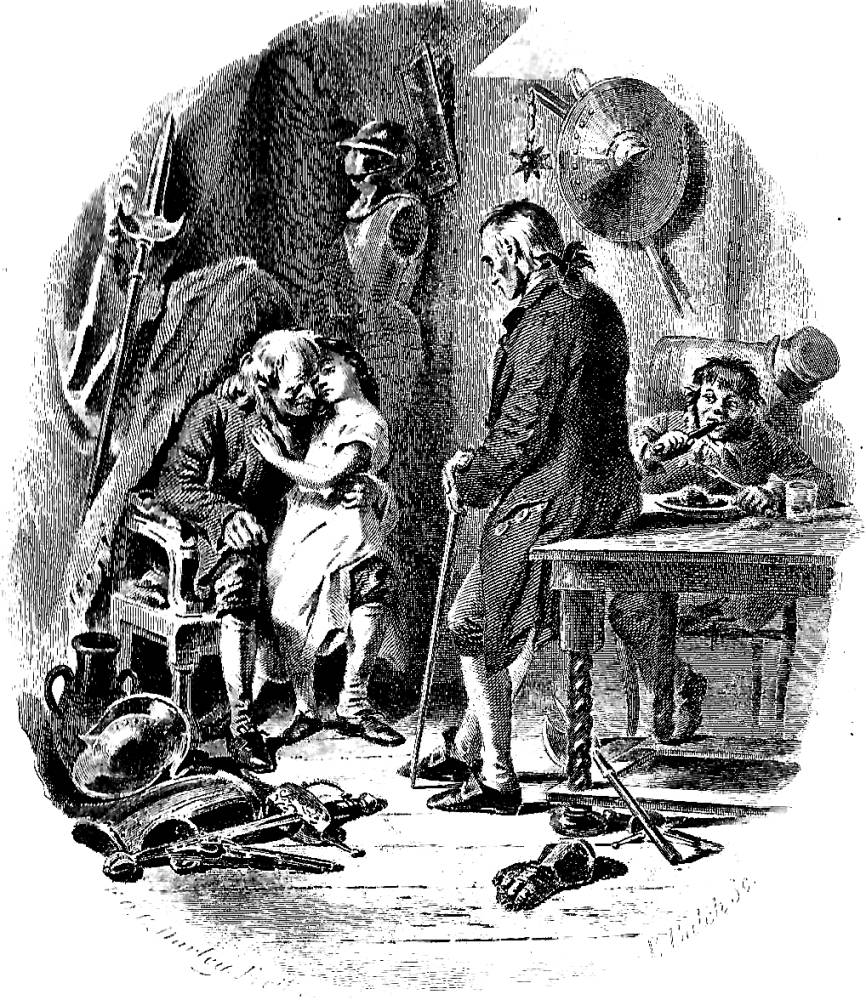
"Do I love thee, Nell," said he; "say do I love thee, Nell, or not?"
Felix O. C. Darley
1861
9.8 x 8.5 cm (3 ¾ by 3 ¼ inches) vignetted
Photogravure
Frontispiece to the first volume of Dickens's The Old Curiosity Shop in the Household Edition.
[Click on the illustration to enlarge it.]
Scanned image and text by Philip V. Allingham from his own collection.
Throughout Master Humphrey's Clock the focal characters of Little Nell and Grandfather Trent, as depicted by Dickens's team of illustrators — Hablot Knight Browne, George Cattermole, and Daniel Maclise — appear singly or together in twenty-three of the seventy-six illustrations, the most celebrated representation of Nell being Cattermole's beatific At Rest (Chapter 71, 30 January 1841).
Passage Illustrated
The old man had again relapsed into his former abstraction and took no notice of what passed, but I remarked that when her laugh was over, the child's bright eyes were dimmed with tears, called forth by the fullness of heart with which she welcomed her uncouth favourite after the little anxiety of the night. As for Kit himself (whose laugh had been all the time one of that sort which very little would change into a cry) he carried a large slice of bread and meat and a mug of beer into a corner, and applied himself to disposing of them with great voracity.
"Ah!" said the old man turning to me with a sigh, as if I had spoken to him but that moment, "you don't know what you say when you tell me that I don't consider her."
"You must not attach too great weight to a remark founded on first appearances, my friend," said I. "No," returned the old man thoughtfully, "no. Come hither, Nell."
The little girl hastened from her seat, and put her arm about his neck.
"Do I love thee, Nell?"said he. "Say — do I love thee, Nell, or no?"
The child only answered by her caresses, and laid her head upon his breast. — Vol. I, Chapter 1, p. 19.
Commentary
Just as the passage from the opening chapter of The Old Curiosity Shop, first published on 25 April 1840 as the first instalment in Dickens's own weekly journal Master Humphrey's Clock, so the Darley illustration demonstrates the deep sympathy of little Nell for her grandfather that becomes the basis for the story's role reversal in which the child becomes guardian and caregiver — and dies before before her grandparent. The Darley frontispiece is a realistic reworking on the first illustration in the novel, Cattermole's The door being opened, the child addressed the old man as her grandfather, and told him the little story of our companionship, which offers so much detail that the three human figures (Kit Nubbles is not in evidence) are lost in the stage properties, which include two suits of armour, copious furnishings, and almost nowhere for Grandfather Trent to sit. The addition of Kit Nubbles proved less of a problem for Darley than the issue of how much bric-a-brac to include as Phiz had already given him a useful image in Kit at Home in Chapter 10.
Although essentially passive figures whose presence across the narrative-pictorial program binds the various picaresque episodes together, the two are active insofar as they abandon London for the provinces in order to escape the odious Daniel Quilp. Darley himself would revisit the image of Nell and her grandfather as "wayfarers" established by Phiz in The Pilgrimage Begins (27 June 1840: Chapter 12). However, in his later study, Little Nell and Her Grandfather (1888), the pair are nearing the end of their earthly pilgrimage together, whereas here they are still living in the shop kept by Grandfather Trent, with the assistance of the shop-boy, Kit Nubbles, "a shock-headed shambling awkward lad with an uncommonly wide mouth" (page 18), depicted as consuming some bread, meat, and a glass of something (in the text, Dickens specifies "a mug of beer," p. 19). The fourth and dominant figure in the 1861 Darley illustration is the narrator, Master Humphrey himself. In the background are the mediaeval armour and weapons which are the specialty of the shop:
There were suits of mail, standing like ghosts in armor, here and there; fantastic carvings brought from monkish cloisters; rusty weapons of various kinds; distorted figures in china, and wood, and iron; and ivory; tapestry and strange furniture that might have been designed in dreams. [14]
At best, Darley merely suggests the diverse contents of the shop, so that the shield and morning-star above Kit and Master Humphrey, the plate armour and pike behind little Nell and her grandfather, the carved chair and table, and the crossbow and firelock pistol in the foreground are mere metonymies for the items in Dickens's catalogue. The novelty in Darley's frontispiece is the presence of "the single gentleman," Master Humphrey, editor and antiquary, who happens to be Grandfather Trent's brother (Davis, 185). Although usually thought of as "a misshapen, deformed old man," Master Humphrey in this composition, despite his cane and eighteenth-century mode of dress, seems more vigorous, the kind of man capable (like Charles Dickens himself) of walking miles at night. The scene near Covent Garden Market in which the narrator first encounters little Nell far from home, however, does not suggest any prior association, let alone that Master Humphrey is the child's great uncle. Certainly when he arrives at the shop, there is nothing in his exchange with Grandfather Trent to suggest that the two are brothers — clearly, assigning Master Humphrey this relationship to Grandfather Trent was an ill-conceived afterthought.
A Relevant Illustration from the 1840-41 Serial in "Master Humphrey's Clock"

Above: George Cattermole's 1840 wood-engraving of the opening scene in the Old Curiosity Shop, London, in The door being opened, the child addressed the old man as her grandfather, and told him the little story of our companionship [Click on the image to enlarge it.]
Bibliography
Bentley, Nicolas, Michael Slater, and Nina Burgis. The Dickens Index. New York and Oxford: Oxford U. P., 1990.
Darley, Felix Octavius Carr. Character Sketches from Dickens. Philadelphia: Porter and Coates, 1888.
Davis, Paul. Charles Dickens A to Z: The Essential Reference to His Life and Work. New York: Facts On File, 1998.
Dickens, Charles. The Old Curiosity Shop. Illustrated by F. O. C. Darley. The Works of Charles Dickens. The Household Edition. 55 vols. New York: James G. Gregory and W. A. Townsend, 1861. 3 vols.
Dickens, Charles. The Old Curiosity Shop. Illustrated by Charles Green. The Works of Charles Dickens. The Household Edition. London: Chapman and Hall, 1871.
Hammerton, J. A. "Chapter 13: The Old Curiosity Shop." The Dickens Picture-Book. The Charles Dickens Library Edition. 18 vols. London: Educational Book, 1910. Vol. XVII. Pp. 171-211.
"The Old Curiosity Shop — Thirty-nine Illustrations by Charles Green." Scenes and Characters from the Works of Charles Dickens, Being Eight Hundred and Sixty-six Drawings by Fred Barnard, Gordon Thomson, Hablot Knight Browne (Phiz), J. McL. Ralston, J. Mahoney, H. French, Charles Green,, E. G. Dalziel, A. B. Frost, F. A. Fraser, and Sir Luke Fildes. London: Chapman and Hall, 1907.
Vann, J. Don. "The Old Curiosity Shop." Victorian Novels in Serial. New York: Modern Language Association, 1985. Pp. 64-65.
Created 2 November 2015 Last updated 20 July 2026