

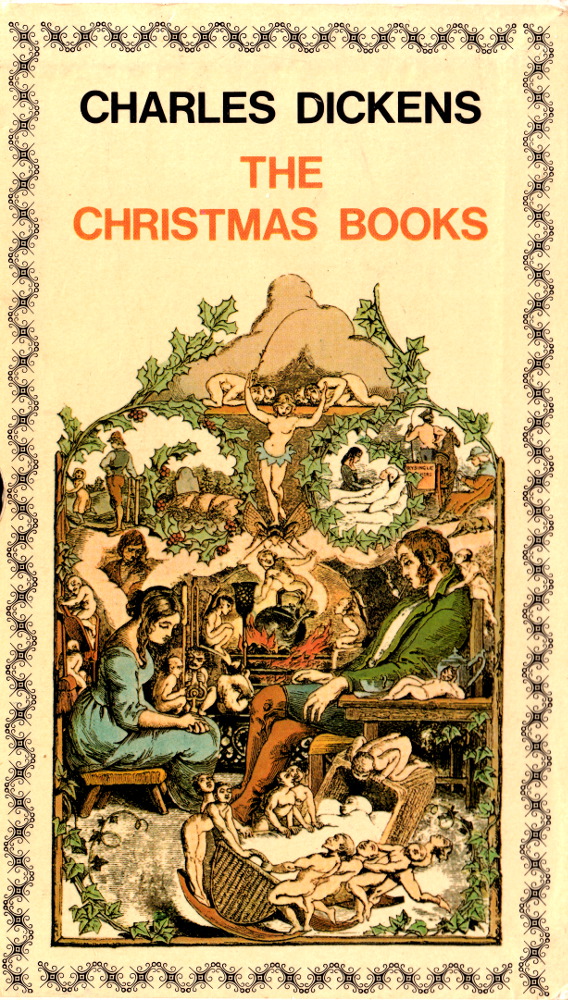
Frontispiece: John and Dot Peerybingle before the Fire (December 1845) by Daniel Maclise and J. Thompson (engraver) for Charles Dickens's second Christmas Book, The Cricket on the Hearth, 16.3 cm high by 9.7 cm wide (6 ½ by 3 ⅞ inches), framed: full-page illustration for Dickens's The Cricket on the Hearth: "Chirp the First," facing Maclise's engraved title showing the Moorish reaper on the Dutch clock. Daniel Maclise, a Royal Academician, possessed a style of illustration markedly different from that of the lead artist on the project, John Leech (essentially a caricaturist and cartoonist); however, by leaving publication so late in the autumn of 1845 Dickens could not rely on a single illustrator to meet his publication deadline. The colourised version on the right, for the second volume of The Christmas Books (Penguin, 1978), emphasizes the inset figures of the domestic spirits of hearth and home swirling around the Peerybingles in their parlour: 17.8 cm high by 10 cm wide (7 by 3 ⅞ inches), framed. [Click on the images to enlarge them.]
Passage Anticipated: The Old Carrier's Fairy-Guarded Fireside
The kettle began it! Don't tell me what Mrs. Peerybingle said. I know better. Mrs. Peerybingle may leave it on record to the end of time that she couldn't say which of them began it; but I say the kettle did. I ought to know, I hope? The kettle began it, full five minutes by the little waxy-faced Dutch clock in the corner, before the Cricket uttered a chirp.
As if the clock hadn't finished striking, and the convulsive little Hay-maker at the top of it, jerking away right and left with a scythe in front of a Moorish Palace, hadn't mowed down half an acre of imaginary grass before the Cricket joined in at all!
Why, I am not naturally positive. Every one knows that I wouldn't set my own opinion against the opinion of Mrs. Peerybingle, unless I were quite sure, on any account whatever. Nothing should induce me. But, this is a question of fact. And the fact is, that the kettle began it at least five minutes before the Cricket gave any sign of being in existence. Contradict me, and I'll say ten.
Let me narrate exactly how it happened. I should have proceeded to do so, in my very first word, but for this plain consideration — if I am to tell a story I must begin at the beginning; and how is it possible to begin at the beginning without beginning at the kettle?
It appeared as if there were a sort of match, or trial of skill, you must understand, between the kettle and the Cricket. And this is what led to it, and how it came about. ["Chirp the First," pp. 1-3]
Commentary: The Noble Couple Depicted in the Preraphaelite Frontispiece
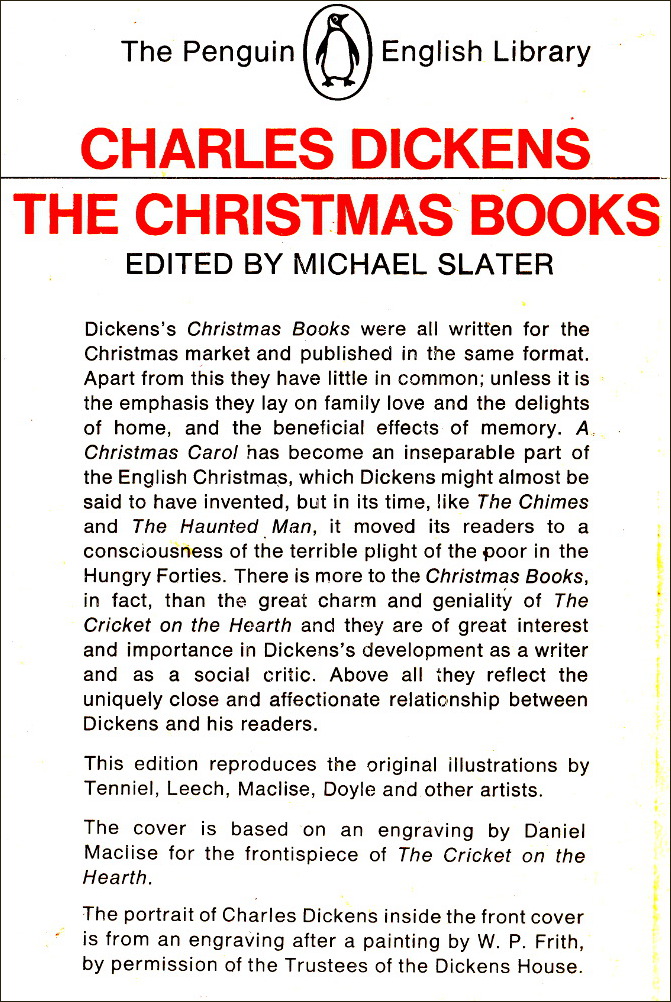
A Christmas Carol has become an inseparable part of the English Christmas, which Dickens might almost be said to have invented, but in its time, like The Chimes and The Haunted Man, it moved its readers to a consciousness of the terrible plight of the poor in the Hungry Forties. There is more to the The Christmas Books, in fact than the great charm and geniality of The Cricket on the Hearth and they are of great interest and importance in Dickens's development as a writer and as a social critic. [Penguin Ed. of The Christmas Books, edited by Michael Slater: volume 2, back cover]
Readers of the third Christmas Book (issued in December 1845) must have instantly noticed the disparity of styles between Daniel Maclise's elegant, almost Pre-Raphaelite frontispiece showing the fairies playing about the fireside and figures of the affluently attired middle-aged husband and fashionably coiffed young wife here, and a far more prosaic version of the same moment, Richard Doyle's Chirp the First on the opening page of the seasonal novella. In fact, each illustrator visualises the couple somewhat differently, creating dissonances in reader reception. Although the cricket and the kettle compete with one another in the opening scene to welcome the carrier home, the brief appearance of the fairies — "All night, the household Fairies had been busy with him" (128) — does not occur until "Chirp the Third."
Scanned images and text by Philip V. Allingham. [You may use the images without prior permission for any scholarly or educational purpose as long as you (1) credit the person who scanned them and (2) link your document to this URL in a web document or cite the Victorian Web in a print one.]
Bibliography
Cohen, Jane Rabb. "The Illustrators of the Christmas Books, John Leech." Charles Dickens and His Original Illustrators. Columbus: Ohio State University Press, 1980. Pp. 141-151.

Dickens, Charles. The Christmas Books. 2 vols. Illustrated by John Leech, Daniel Maclise, Richard Doyle, Clarkson Stanfield, and Edwin Landseer. Engraved by George Dalziel, Edward Dalziel, T. Williams, J. Thompson, R. Graves, and Joseph Swain. Ed. Michael Slater. Harmondsworth: Penguin, 1971, rpt. 1978. 2 vols.
Dickens, Charles. The Cricket on the Hearth. A Fairy Tale of Home. Illustrated by John Leech, Daniel Maclise, Richard Doyle, Clarkson Stanfield, and Edwin Landseer. Engraved by George Dalziel, Edward Dalziel, T. Williams, J. Thompson, R. Graves, and Joseph Swain. London: Bradbury and Evans, 1846 [December 1845].
Dickens, Charles. The Cricket on the Hearth. Christmas Books. Illustrated Fred Barnard. The Household Edition. 22 vols. London: Chapman and Hall, 1878. Vol. XVII. Pp. 77-117.
Dickens, Charles. Christmas Stories. Illustrated by E. A. Abbey. The Household Edition. 19 vols. New York: Harper and Bros., 1876. Vol. III.
Created 24 October 2023
Last modified 23 October 2026