

He . . . steadily looked at me
H. M. Brock
Photographic reproduction of pen and ink drawing
1903
13.8 cm high by 9 cm wide (5 and ⅜ by 3 ½ inches), framed, p. 234.
Seventh illustration for Dickens's Great Expectations, p. 234
Scanned image and text by Philip V. Allingham.

Passage Illustrated: Jaggers prepares to "put the case" regarding Estella's parentage
“So! You know the young lady’s father, Pip?” said Mr. Jaggers.
“Yes,” I replied, “and his name is Provis — from New South Wales.”
Even Mr. Jaggers started when I said those words. It was the slightest start that could escape a man, the most carefully repressed and the sooner checked, but he did start, though he made it a part of the action of taking out his pocket-handkerchief. How Wemmick received the announcement I am unable to say; for I was afraid to look at him just then, lest Mr. Jaggers’s sharpness should detect that there had been some communication unknown to him between us.
“And on what evidence, Pip,” asked Mr. Jaggers, very coolly, as he paused with his handkerchief half way to his nose, “does Provis make this claim?”
“He does not make it,” said I, “and has never made it, and has no knowledge or belief that his daughter is in existence.”
For once, the powerful pocket-handkerchief failed. My reply was so unexpected, that Mr. Jaggers put the handkerchief back into his pocket without completing the usual performance, folded his arms, and looked with stern attention at me, though with an immovable face. [Chapter LI, 301]
Commentary: The Enigmatic Attorney "Puts the Case"
Significantly to Pip even years after receiving the news of his "Great Expectations" from Jaggers at the Jolly Bargemen, Pip still thinks of his guardian as "Mr." Jaggers. Their relationship remains legally rather than personally defined, and Pip remains his ward and responsibility rather than his adopted son. And the inscrutable attorney, keeper of secrets, even now refuses a frank communication about Estella's origins; he merely "puts the case" in a series of hypotheticals about Miss Havisham, Molly and Abel Magwitch. He affirms nothing in this scene that is critical to the revelation of a major plot secret.
How, then, does H. M. Brock, late Victorian illustrator, present the attorney and his client, who has become an amateur detective in the Sensation mode, common in that species of popular novel (1860-1880)? In Jaggers's book-lined office, the criminal attorney almost scowls at Pip, who rises from his chair in alarm at what his guardian is confiding in him. The granite-faced lawyer has a certain rough-and-ready quality about his dress as he plants his foot on the fender, sending sparks flying. As he starts to make his suppository revelations, Jaggers stares intently at Pip, attempting to judge his ward's reactions to Estella's origins among the criminal classes of the metropolis.
Whereas John McLenan's Jaggers in the Harper's Weekly serial illustrations is tall, lighter-haired, and somewhat full in the face, Brock's here seems much more faithful to this description because the illustrator makes him seem "burly" and stolid, with deep-set eyes, extensive eyebrows, a mask-like visage, and a conspicuous watch-fob. More significantly, like Sol Eytinge, Jr., in his 1867 Diamond Edition portrait, Brock gives Jaggers a determined, interior gaze that betokens the enigmatic attorney's singular ability to shut out entirely whatever and whomever he does not wish to deal with. He has avoided this topic for years, but now he must confront it, but, of course, only hypothetically.
Parallel Illustrations for Mr. Jaggers from Other Editions (1861-85)
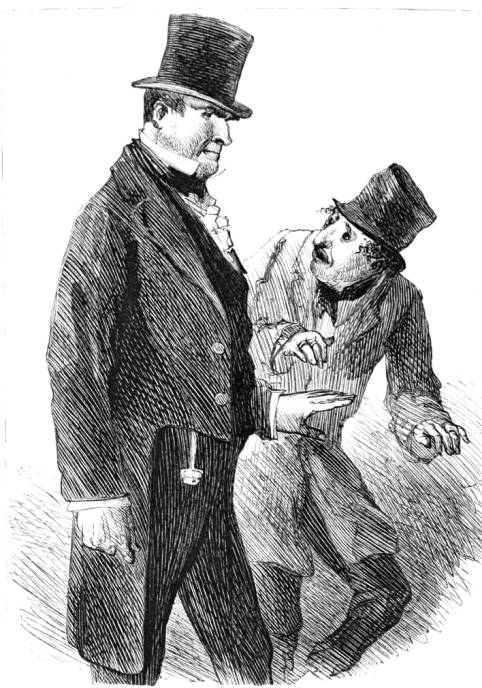

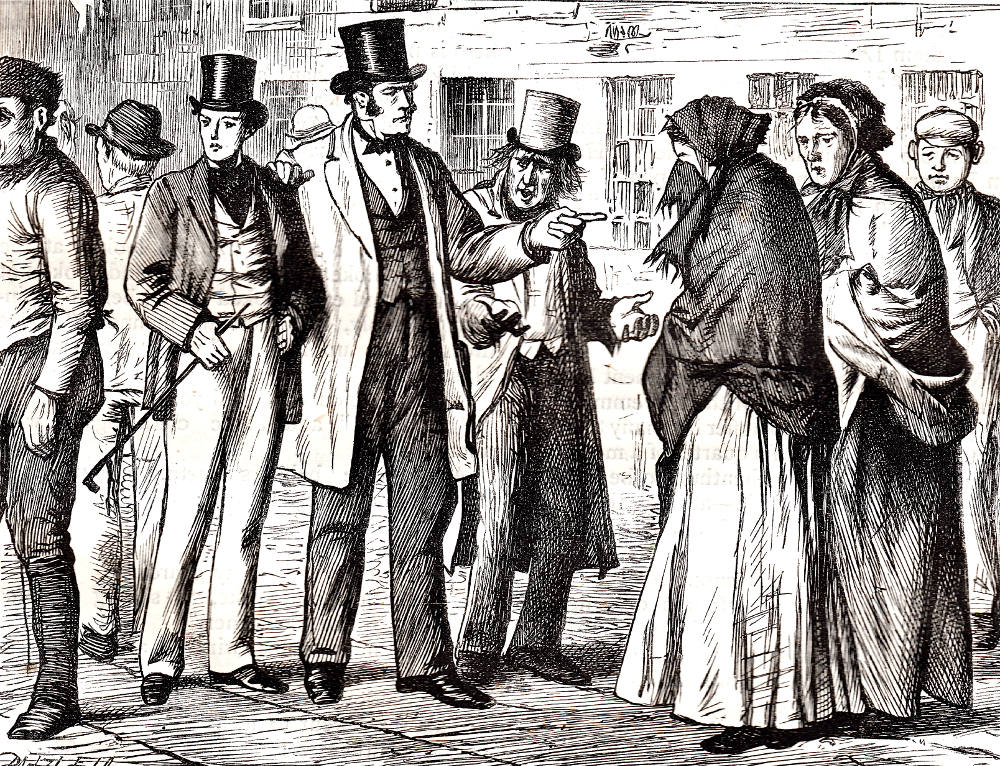
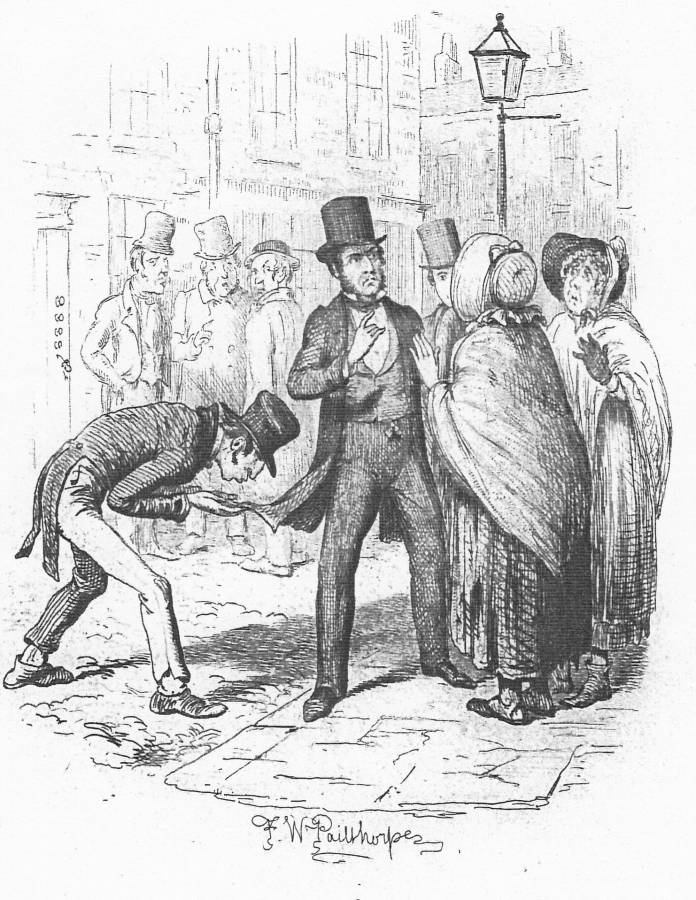
Left: Sol Eytinge, Jr.'s portrait with one of his dubious "clients" in the streets of Little Britain in the Diamond Edition: Jaggers (1867). John Mclenan's description of the circumstances of Jaggers' initial appearance in the narrative: Saturday night at the Three Jolly Bargemen (9 February 1861). Right of centre: F. A. Fraser's initial representation of Jaggers as an uncompromising realist and street-smart criminal attorney: "Say another word — one single word — and Wemmick shall give you your money back" (1876 in the Household Edition). Right: Frederic W. Pailthorpre's version of Jaggers in the street when Pip first comes up to London: Mr. Jaggers and His Clients (1885).
Other Artists’ Illustrations for Dickens's Great Expectations
- A Comparison of Fraser's Illustrations in the original 1870s Household Edition plates and those in the Collier New York edition of 1900
- J. Clayton Clarke or "Kyd"
(2 coloured lithographs) - Felix O. C. Darley (2 plates)
- A. A. Dixon (8 lithographs)
- Sol Eytinge, Jr. (8 wood-engravings)
- F. A. Fraser (30 wood-engravings)
- Harry Furniss (28 plates)
- Charles Green (10 lithographs)
- Frederic W. Pailthorpe (21 lithographs)
- John McLenan (40 plates)
- Marcus Stone (8 plates)
Bibliography
Dickens, Charles. Great Expectations. Imperial Edition. 16 vols. London: Gresham Publishing Company [34 Southampton Street, The Strand, London], 1901-3.
Created 19 January 2002 Last updated 30 April 2026