
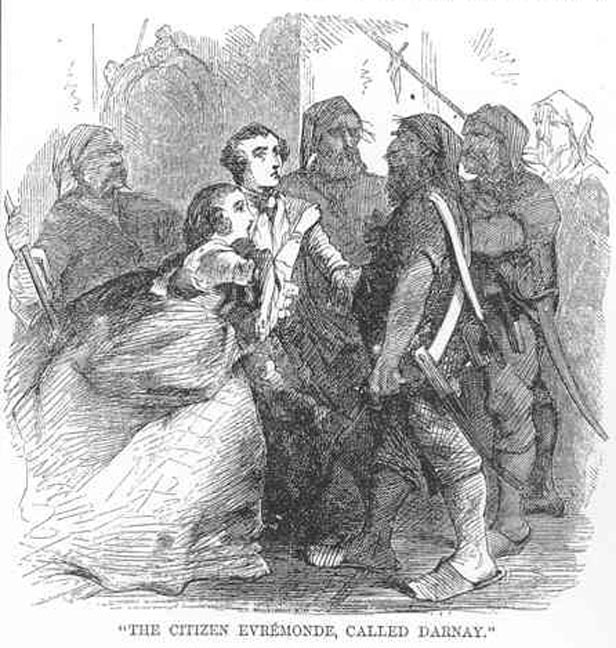
"The Citizen Evrémonde, called Darnay" by John McLenan, 8.8 cm high by 8.8 cm wide (3 ½ inches square). In the T. B. Peterson volume, it faces p. 168. This scene of Darnay's being re-arrested by burly Jacobins, which appears on the same page as the instalment's headnote vignette, depicts an event that occurs after the event realised in the headnote, when Dr. Manette is paraded through the streets after the trial at which he has vindicated his ' son-in-law, former aristocrat Charles Darnay. Compare this woodblock illustration to Phiz's steel-engraving The Knock at the Door (No. 2, November 1859). The twenty-fourth number of the novel appeared in Harper's Weekly on 15 October 1859 (p. 699); it had originally appeared without illustration in the UK on Saturday, 8 October, in All the Year Round. [Click on the illustrations to enlarge them.]
Passage Illustrated: Re-arrested after being Mysteriously Denounced Again
"My child," said the Doctor, rising, and laying his hand upon her shoulder, "I have saved him. What weakness is this, my dear! Let me go to the door."
He took the lamp in his hand, crossed the two intervening outer rooms, and opened it. A rude clattering of feet over the floor, and four rough men in red caps, armed with sabres and pistols, entered the room.
"The Citizen Evrémonde, called Darnay," said the first.
"Who seeks him?" answered Darnay.
"I seek him. We seek him. I know you, Evremonde; I saw you before the Tribunal to-day. You are again the prisoner of the Republic."
The four surrounded him, where he stood with his wife and child clinging to him.
"Tell me how and why am I again a prisoner?"
"It is enough that you return straight to the Conciergerie, and will know to-morrow. You are summoned for to-morrow." [Book the Third — "The Track of a Storm," Chapter VII, "A Knock at the Door," 699]
Related Material
- John McLenan's Thirty-One Headnote Vignettes for A Tale of Two Cities in Harper's Weekly (7 May — 3 December 1859)
- McLenan's and Phiz's Illustrations for
A Tale of Two Cities (1859): A Correspondence?
- Images of the French Revolution from Various Editions of A Tale of Two Cities (1859-1910)
- French Revolution
- Victorian Images of the French Revolution
- "A Tale of Two Cities (1859): A Model of the Integration of History and Literature"
Scanned image and text by Philip V. Allingham. [You may use this image without prior permission for any scholarly or educational purpose as long as you (1) credit the person who scanned the image and (2) link your document to this URL in a web document or cite the Victorian Web in a print one.]
Bibliography
Allingham, Philip V. "Charles Dickens's A Tale of Two Cities (1859) Illustrated: A Critical Reassessment of Hablot Knight Browne's Accompanying Plates." Dickens Studies. 33 (2003): 109-158.
Dickens, Charles. A Tale of Two Cities. Illustrated by John McLenan. Harper's Weekly: A Journal of Civilization, 7 May through 3 December 1859.
Dickens, Charles. A Tale of Two Cities. Illustrated by John McLenan (33 illustrations). Philadelphia: T. B. Peterson, 1859.
Dickens, Charles. A Tale of Two Cities: A story of the French Revolution. Project Gutenberg e-text by Judith Boss, Omaha, Nebraska. Release Date: September 25, 2004 [EBook #98].
Dickens, Charles. A Tale of Two Cities. With illustrations by John McLenan and Rowland Wheelwright. Orinda, Cal.: Sea Wolf Press, 2021.
Guiliano, Edward, and Philip Collins. The Annotated Dickens. 2 vols. New York: Clarkson N. Potter, 1986.
Vann, J. Don. "A Tale of Two Cities in All the Year Round, 30 April — 26 November 1859." Victorian Novels in Serial. New York: The Modern Language Association, 1985. Pp. 71-72.
Created 25 November 2007
Last modified 28 November 2025