
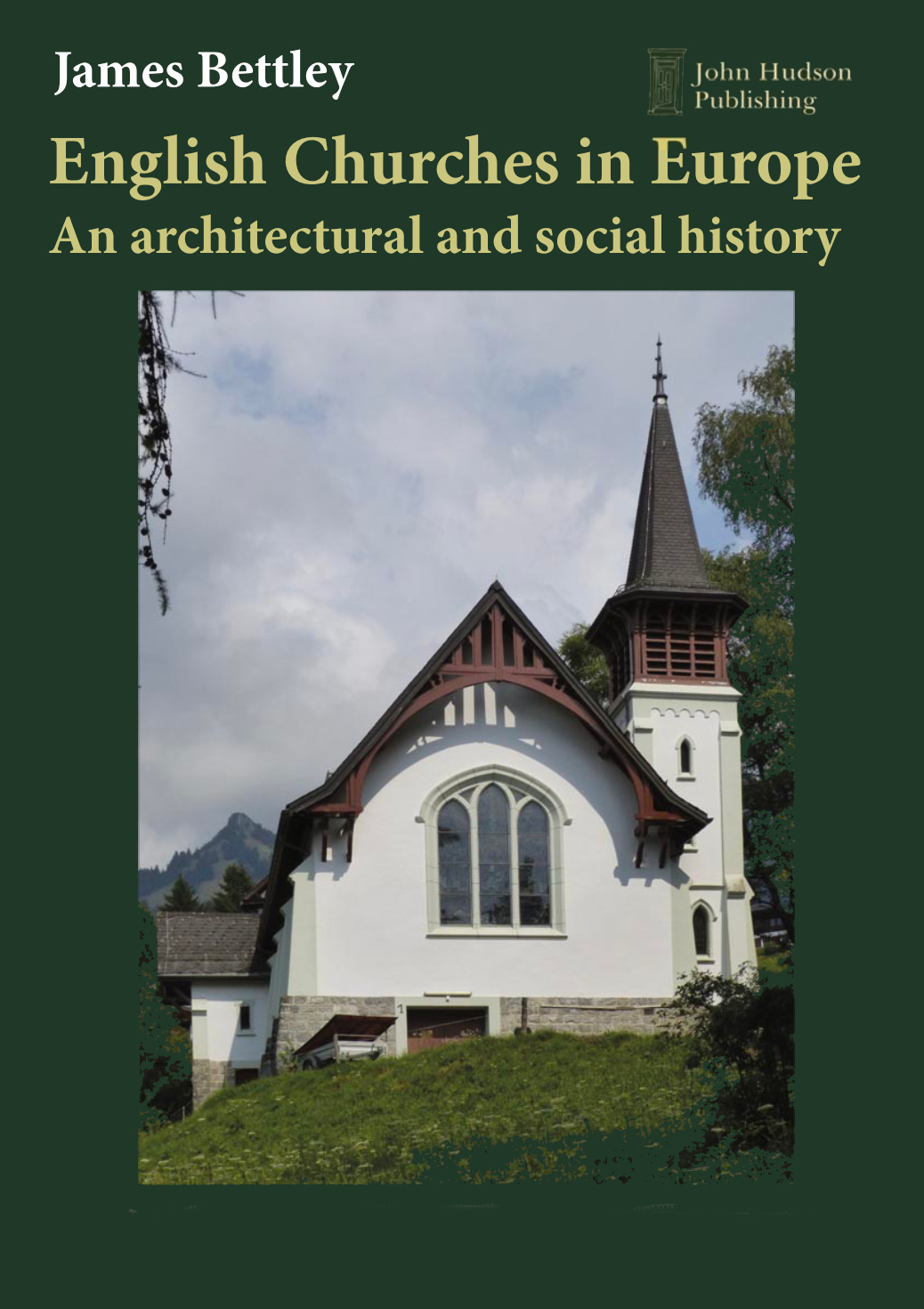
English Churches in Europe: An architectural and social history by James Bettley, tells the story of Anglican worship on the mainland of Europe, from the Reformation, when Calais was an English possession, until the twentieth Century. From 1815, with peace in Europe, followed by development of railways, the English began to travel widely, initially for purposes of health, which developed into other leisure and sporting activities, and in pursuit of trade. Where the English went, the Church of England went too, with congregations often meeting in communal or shared spaces, sometimes seasonally with summer chaplaincies in tourist areas. Increasingly, churches were built specifically for Anglican worship, to serve visitors and trading communities and also diverse expatriate groups including railway workers, governesses and even jockeys. Some were built by subscription, and others provided by hoteliers who needed to reassure English visitors they could worship in a familiar manner, or by such unlikely means as a fundraising fête at a Fisheries Exhibition in Berlin. The style of some reflected the vernacular of the host countries, while others were designed by British architects including such notable figures as G.E. Street and Arthur Blomfield. Some of the churches appear as if they could have been transplanted from an English suburb or village. The same controversies which raged in Victorian England over "high" and "low" liturgy and which building types were more "churchlike" were replicated in Europe, and in some larger centres, different churches and clergy reflected the various wings of Anglicanism. The bishops with oversight of these churches from afar had a much harder task of maintaining discipline than within England, and the story includes many "lively" characters who ploughed their own furrow and didn’t stick to the conventions of the Church of England. At the height, there were 300 Anglican churches in Europe, from Tangier in the south – well, almost Europe – to Archangel in the north, and a surprising number remain in use today, for worship by Anglicans or other denominations, or in other uses.
In this book James Bettley, author of the Pevsner Buildings of England volumes on Suffolk, Essex and Hertfordshire, presents his many years of research into this subject, in a hardback book of 500 pages and with an equal number of illustrations, both recent and historical, which combines scholarly coverage of the architecture and the social background with quirky stories of the tobogganing dean, and of the then-Archbishop of Canterbury and "Mr and Mrs Lewes" (novelist George Eliot and her partner, George Henry Lewes) staying at the same hotel in Murren, Switzerland.
The book when published in October 2026 will be available through all the usual channels via distributors Boydell & Brewer, in print and digital editions, and directly from them, but there is an apportunity to subscribe in advance, and to receive a copy signed by James Bettley, with your name included in the book as a subscriber, for a reduced price. To take advantage of this, please contact john@johnhudsonpublishing.com for more information. Note that the cover design may vary from the one shown here.
Bibliography
Bettley, James. English Churches in Europe: An architectural and social history. London: John Hudson Publishing (imprint of Boydell & Brewer), forthcoming, October 2026. Large format hardback. 500 pp. £90.00 (offer deadline 31 August 2026). ISBN: 978 1 7385400 3 7
Created 7 June 2026