

The following essay first appeared in Present State: The Newsletter of the Pugin Society No.17 (Spring 2020), edited by Judith Al-Seffar, pp. 12-13. We are grateful to be able to reproduce it here with the permission of the author, editor, and other committee members of the Pugin Society, as part of our shared aim to promote the wider appreciation of this inspirational architect . — JB
Where shall we find that widow's treasured mite,
Saved for the temple's service, heavenly wise?
Or where blest Mary’s costlier sacrifice?
As down Time’s stream we sail, first rise to sight,
The shrines of ancient faith; with ample might,
'Mid humbler homes of men, they pierce the skies.
Then thick the domes of human pride arise,
Rich-peopled hives, and numerous, large, and bright,
But few, and far between, decay’d and old,
While Avarice gathers up what Time impairs,
Or mark’d with tasteless art and thrifty cares,
Lest they o’er man’s possessions stretch too bold,
’Mid growing flocks, which seek another fold,
Stand houses of our God, while Mammon spares.
This sonnet, "The Ancient and Modern Town," was written by the Tractarian and devotional poet Isaac Williams (1802-1865), who was closely involved at the outset with the Oxford Movement. Those espousing the Oxford Movement, such as John Keble, Edward Bouverie Pusey, John Henry Newman (in his pre-Catholic phase) and Williams, stressed, whilst remaining within the Church of England, its pre-Reformation Catholic origins. They expounded their theology by publishing a series of tracts, known as the "Tracts for the Times." Isaac Williams was celebrated, in particular, for writing the controversial Tract 80, "On Reserve in Communicating Religious Knowledge."
In 1838 Williams, as poet, wrote "The Cathedral" and "Thoughts in Past Years." This last title consisted of six separate parts, one of which was "The Country Pastor," in which "The Ancient and Modern Town" is included as no. XXXII (p. 100). This sonnet’s particular interest to us, as first pointed out by the literary scholar G.B. Tennyson, is that it describes in words an approach very similar to that adopted by A.W.N. Pugin in his famous etching, contrasting a Catholic town of 1440 with the same town in 1840, in the revised edition of Contrasts of 1841 (Plate 26). Tennyson assumes that this plate was published before Williams’ sonnet, i.e. in the first edition of Contrasts, of 1836, suggesting that Williams could have been influenced by it. If anything, though, the influence is the other way round, since Pugin only added this particular plate in the second edition, of 1841. Isaac Williams' poetic voice was inseparable from his theological viewpoint. As Pugin used art to convey his message, so Williams used poetry. Both Pugin and Williams wanted to illustrate and contrast, in their different ways, the loss of the spiritually and architecturally elevated communities of the middle ages and their sorry replacement by those of the nineteenth century, governed only by commercial greed and a harsh social system. It is possible that Pugin may have come across this sonnet; it appears that he had read some of Williams’ work (see Belcher I: 340) and obviously applauded and sympathised with the leaders of the Oxford Movement, since their interpretation of what Anglicanism meant, or should be, was related to his hopes, as a Catholic, to evangelise England. He hoped for much from "The Oxford Men," as he called them, and had various friends amongst them.
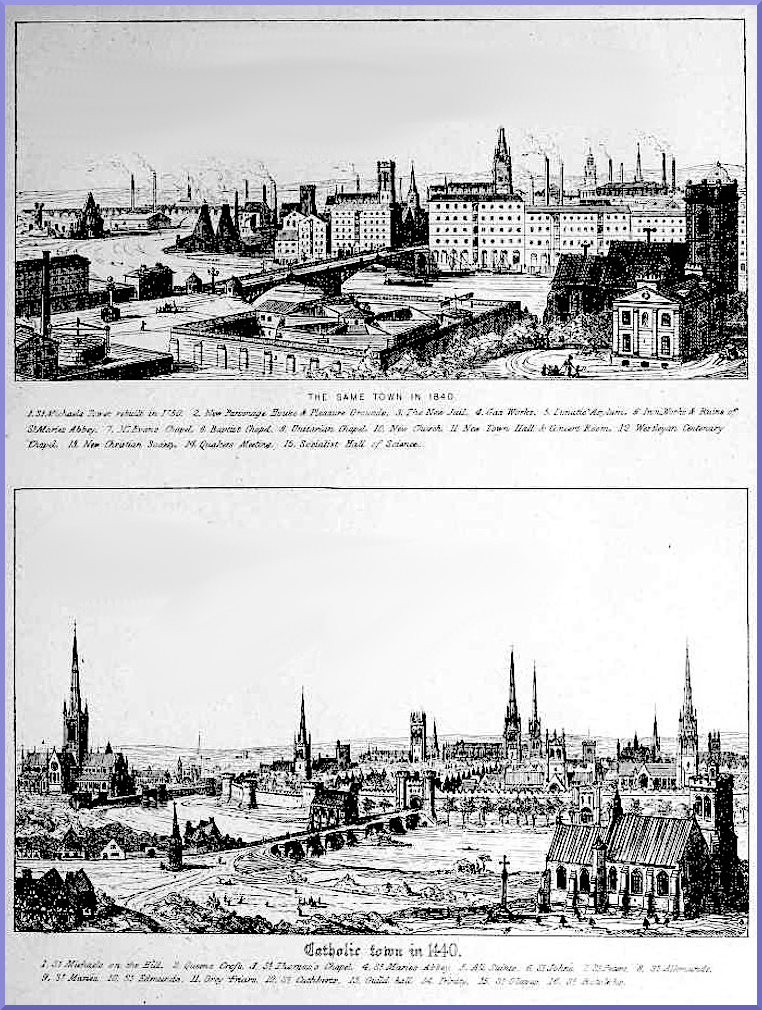
The plate from A.W.N. Pugin's Contrasts of 1841, comparing a Catholic town of 1440 with the same one in 1840. [Click on the image to see larger pictures.]
Pugin was certainly aware of Isaac Williams, and had other indirect links with him. In 1844 he (Pugin) was approached by Henry Champernowne of Dartington Hall in Devon, with in the a view to restoring and adding to the property. It is possible that this proposal came about through Williams, who had married Champernowne’s sister, Caroline, in 1842, a marriage about which Pugin wrote, rather unsympathetically but characteristically, "I am quite distressed at Williams’ Marrying [Pugin's use of a capital letter here], it is too bad. I thought he had the real ecclesiastical spirit” (Collected Letters I: 351). In the event, probably owing to the considerable expense of Pugin’s proposals for Dartington, very little of the work there was ever carried out.
Pugin might also have approved of "The Cathedral" - a unique work, which certainly entitles Williams to be thought of as the poet of the Gothic Revival. In "The Cathedral" he writes poems for all sections of a Gothic cathedral, with a keyed floor plan of the building included for the reader. In this volume, and in the two which followed, "The Baptistery" and "The Altar," he includes copious engravings, from other sources, both contemporary and earlier, and prose as well as poetry. His love and sympathy for the Christian symbolism of Gothic architecture, in particular for the rood screen, show how, like Pugin, and with the same commitment and earnestness, he sought to relate (with undertones somewhat of the seventeenth century poet and priest George Herbert) the tangible with the intangible.
Ultimately, however, whether or not Pugin was consciously influenced by Williams, aspects of their work, taken together, represent perhaps just one small window into an intense early Victorian world, where questions of faith, and the form it should take, were paramount, where they debated and written about, and where so many idealists and visionaries were simultaneously grappling with these immensely problematic issues.
Related Material
- The Tractarian Cathedral
- Isaac Williams' "On Reserve in Communicating Religious Knowledge — Tracts for the Times 80"
- Victorian Devotional Poetry: The Tractarian Mode by G. B. Tennyson
- Isaac Williams as a hymn-writer
Bibliography
Belcher, Margaret, ed. The Collected Letters of A.W.N. Pugin. Vol. I. Oxford: Oxford University Press, 2001.
Jones, O.W. Isaac Williams and His Circle. London: S.P.C.K., 1971.
Pugin, A.W.N. The Collected Letters of A.W.N. Pugin. Edited by Margaret Belcher. Vol. I. Oxford: Oxford University Press, 2001.
Tennyson, G.B. Victorian Devotional Poetry: The Tractarian Mode. Cambridge, Mass.: Harvard University Press, 1981.
Williams, Isaac. Thoughts in Past Years. Oxford: John Henry Parker, 1838. [Available on the Internet Archive, from a copy in Princeton Theological Seminary Library.]
Created 27 April 2026