

St Luke's Chapel, Fulham Road, by Edward Buckton Lamb (1805 or 1806-1869) is a Grade II* listed building, built from 1849-50 for the use of patients at The Hospital for Consumption and Diseases of the Chest at Brompton, the first hospital in London to admit consumptives. Much thought was expended on its convenience for them. For example, as the account in the Builder explains, certain seats were designed specifically "for patients in a very weak condition, and requiring the greatest degree of ease; these sittings are therefore separated by arms; the seats are wide, and in other respects large. The next sittings are still wide, and the backs far apart, but without arms; the last seats, up to the west wall, are of the ordinary dimensions of the open seats in churches for those patients who may be recovering, and who may shortly leave the institution" (377). As for the floor, the area "under the seats is boarded and made level with the gangways, in order that there shall be no difficulty in reaching the seats by the weak patients" (377).
Another consideration was to honour the church's founder, with the heraldic devices of the Rev. Sir Henry Foulis, Bart. liberally sprinkled on the corbels in the lobby, the hammerbeams of the chancel roof, the fittings, the tiles between the pulpit and lectern, and the stained glass. According to the listing text, the corbels in the entrance lobby bear monograms not only of Foulis, but also of Lamb, Foulis's sister, and Rose, Hon Sec to hospital." This might seem a bit ostentatious, but anyway the Builder's verdict was favourable, summed up at the end of its account: "This building was erected from the designs of Mr. E. B. Lamb, architect, and is quite worthy of his established reputation" (379).
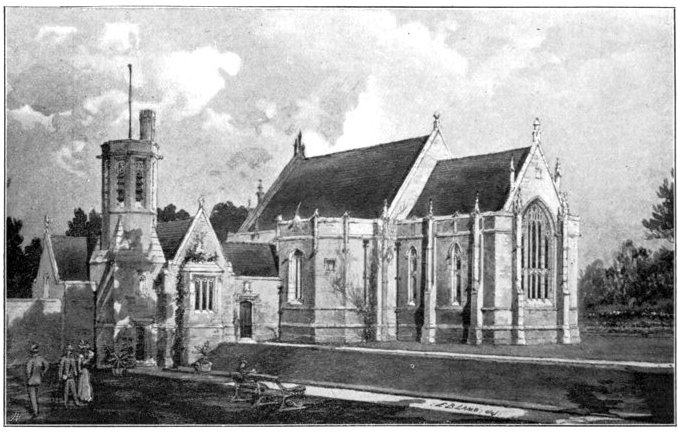
An engraving of a later date (1901) in Academy Architecture (though captioned, "The original form of the Chapel of the Brompton Consumption Hospital. Edward B. Lamb M.S.A.").
Further work was carried out in 1891-92 by another established architect, William White; but in extending the chancel White seems to have honoured the original design: the listing text assumes that White reset the heraldic work on the hammerbeams, and notes that he kept Lamb's sedilia and fittings.
However, the chapel, like the main hospital building, is no longer in use for its original purpose; Country Life reported in 2019 that it was up for sale, with a view to its conversion into a luxury private home.
Related Material
First image scan and text by Jacqueline Banerjee; second image scan by George P. Landow [You may use either of these images without prior permission for any scholarly or educational purpose as long as you (1) credit the person who scanned it and (2) link your document to this URL or mention the Victorian Web in your print document.]
Bibliography
Academy Architecture and Architectural Review. Ed. Alexander Koch. London: Academy Architecture, 1901. No. 1579 (p. 1). Wikimedia Commons, from the J. Paul Getty Center Library. Web. 24 May 2026.
"Chapel for the Consumption Hospital, Brompton." " The Builder VIII (10 August 1850): 377-79. Internet Archive. Web. 22 May 2026.
Chapel of St Luke, Brompton Hospital." Historic England. Web. 22 May 2026.
Elwes, Annunciata. "A magnificent chapel in Chelsea ripe for conversion into a superb top-end home." 1 November 2019. Country Life. Web. 22 May 2026. https://www.countrylife.co.uk/property/magnificent-chapel-chelsea-ripe-conversion-superb-top-end-home-206759
Created 16 May 2013
Last modified 24 May 2026