
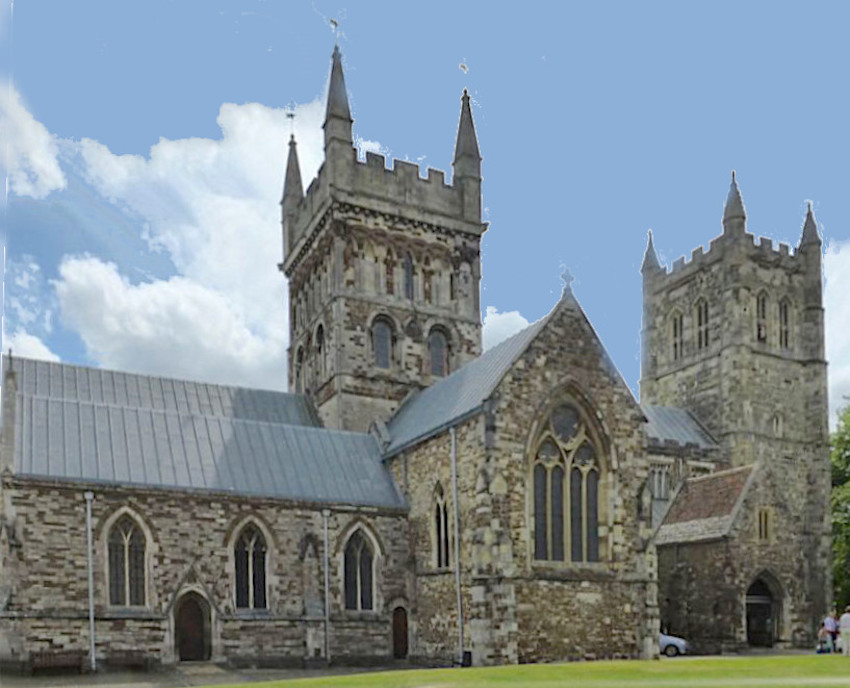
The ancient Minster Church in Wimborne, Dorset, on the west side of the High Street, is an impressive two-towered house of worship with a history going back to Saxon times. Indeed, the Saxon King Ethelred, brother of Alfred, was buried here. It is Grade I listed, and, like most cathedrals and other large churches, is the work of many hands over many centuries.


Left to right: (a) Approaching the Minster. (b) The Jack-o'-clock on the north wall of the western tower (photograph © Michael Day). (c) Looking up into the central tower.
According to the listing text, "the main fabric" dates to the twelfth century and later medieval times. For example, of the two towers, the one at the crossing dates from the twelfth century, while the one at the west end dates from around the mid-fifteenth century. The Minster was, however, much restored in the nineteenth century: early in the century the little figure of the Jack-o'-clock on the north side of the western tower was painted up as a grenadier, and the whole of the upper clerestory was rebuilt then, but using the old masonry (see Inventory). This would have been the ideal place for a trainee architect like the young Thomas Hardy to become acquainted with a range of architectural features from different periods, and to practice his draughtsmanship.
Hardy remembered his experiences at the Minster in his poem, "Copying Architecture in an Old Minster" (see Thomas Hardy's Other Career, as an Architect). Among several noteworthy features, the Minster's clock made a particular impression on him:
How smartly the quarters of the hour march by
That the jack-o'-clock never forgets;
Ding-dong; and before I have traced a cusp's eye,
Or got the true twist of the ogee over,
A double ding-dong ricochetts.
Just so did he clang here before I came,
And so will he clang when I'm gone
Through the Minster's cavernous hollows — the same
Tale of hours never more to be will he deliver
To the speechless midnight and dawn!
I grow to conceive it a call to ghosts,
Whose mould lies below and around....
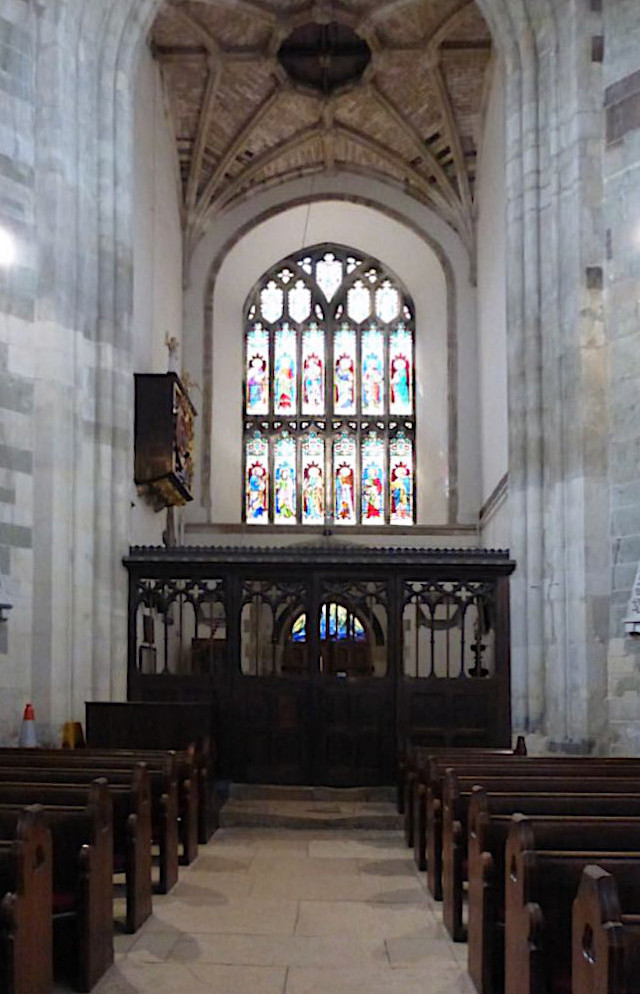

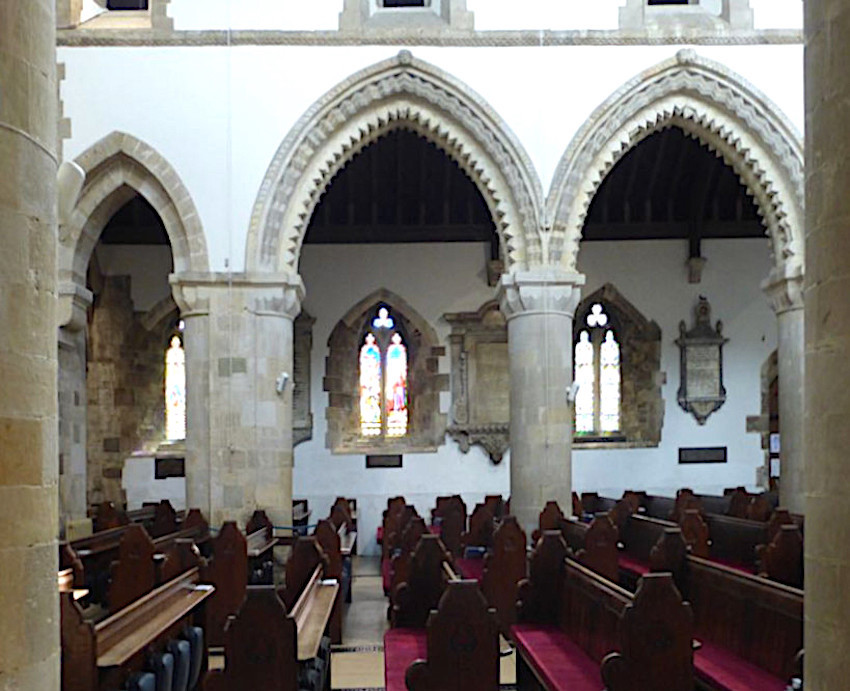
Left to right: (a) Looking west inside the Minster. (b) The astronomical clock in the baptistery (photograph © Lex McKee). (c) Looking across into an aisle.
The Jack-o'-clock on the exterior strikes the bells every quarter of an hour, while the astronomical clock on the wall within can be seen on the left above, in the view looking west, between the screen and the west window.
Of the monuments noted by Hardy "below and around" the clock, the most curious is the tomb shown below right, with its noticeably corrected age of death. God or Fate allowed its occupier, the well-born and eccentric Anthony Etricke, one-time Recorder of Poole, more years than he expected, and the discrepancy is still plain for all to see.

Anthony Etricke's tomb. Source: Harper, facing p.270.
To Hardy, as to present-day visitors, the ghosts of the Minster may warn of the perennial challenges of a "trouble-torn" world, in which generations pass to inevitable "mould"; but we might dispute his pessimistic view in the penultimate stanza, that our intentions are thus "foiled," and that "lovingkindness" is "vain" in such circumstances.
Related Material
- The Great West Window (by Heaton & Co.)
- Thomas Hardy's Other Career (as architect: includes the text, and an analysis, of the whole poem)
Photographs and image scan by the author, except for the photographs by Michael Day and Lex Mckee, both originally posted on Flickr, and kindly made available on the Attribution 2.0 Generic (CC BY 2.0) Licence. They have been slightly modified here for size and perspective. You may use these images without prior permission for any scholarly or educational purpose as long as you (1) credit the photographer and (2) link your document to this URL in a web project (or to Flickr as appropriate), or cite it in a print one. [Click on all the images to enlarge them.]
Bibliography
An Inventory of the Historical Monuments in Dorset. Vol. 5, East. London: Her Majesty's Stationery Office 1975. British History Online. Web. 16 December 2020.
The Minster Church of St Cuthberga. Historic England. Web. 16 December 2020.
Created 16 December 2020
Last modified 13 October 2026